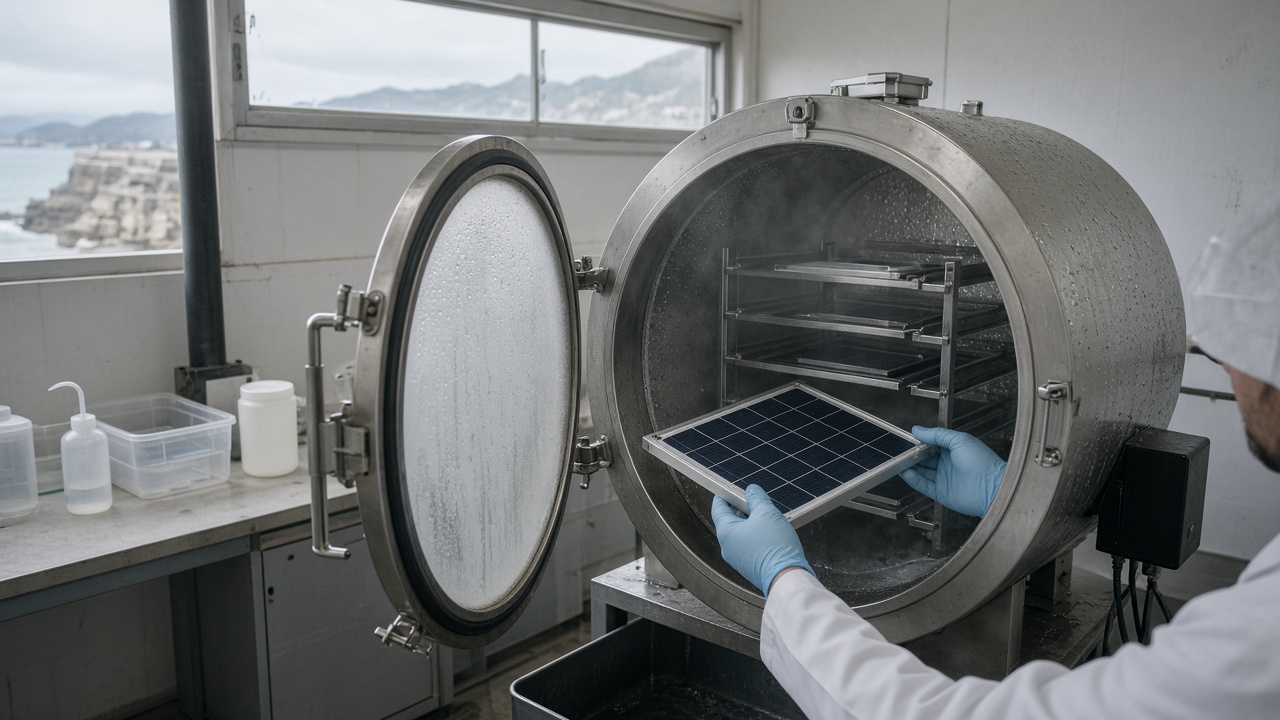
A KAIST team published salt-spray durability results Friday from Jeju coastal test chambers, reporting that encapsulated perovskite mini-modules retained 91 percent of initial efficiency after 1,000 hours of IEC 60068-2-52 cycling—data island utilities requested before mounting pilots on seaside bus shelters and school roofs.
Methods and limits
Researchers led by Professor Jung-Yong Lee shipped unencapsulated cells that survived 85°C/85% humidity in prior Nature Energy work, then applied a thin marine-grade edge seal developed with a Jeju materials startup. Chambers at the Korea Institute of Energy Research’s Jeju annex sprayed neutral salt fog at 35°C, interrupting weekly for UV soak to mimic typhoon-season cycles. Sample size was small—24 mini-modules, eight failures traced to seal pinholes—not a field deployment.
KAIST cautioned that open-air Jeju installations face wind-blown sand absent in the chamber. Replication will require at least one monsoon season on an outdoor rack adjacent to the lab; that track starts in October.
Why Jeju salt matters
Island grids push distributed solar on limited land; coastal corrosion destroyed early thin-film demos a decade ago. Provincial energy planners asked whether high-efficiency perovskite could beat silicon area constraints on narrow school rooftops if seals survive brine. The 91 percent retention figure is short of silicon baselines but close enough to justify a 200-kilowatt pilot pending fire-safety sign-off.
Comparison to prior KAIST work
Last year’s unencapsulated cells projected four-year room-temperature stability in humidity chambers but did not test chloride attack. The Jeju study adds the missing coastal variable without claiming commercial readiness. Certified efficiency on the mini-modules remained in the mid-22 percent range after salt exposure, down from mid-26 percent pre-test.
What happens next
NRF funded the chamber time under a regional energy resilience grant. Jeju Electric Power Corp. will host outdoor racks if October typhoon forecasts stay mild. Competitors at UNIST and POSTECH asked for seal recipes; KAIST will share edge geometries in the supplemental paper but not vendor slurry formulas until patents file.
What would replicate in Seoul labs
IBS and Seoul National University groups said they can reproduce fog cycling but lack Jeju’s humidity swing; they will import salt solutions and compare against standard 85/85 ovens. Success means independent labs hit within five points of retention on the same seal—a bar regulators could use before certifying coastal BIPV.
For now, the story is narrow: perovskite survived a Jeju salt bath longer than skeptics expected, but not long enough to skip outdoor proof. Island planners wanted numbers before bolting panels to bus stops; they finally have a chloride datapoint, not yet a warranty. Fire marshals still want smoke-toxicity tests on the edge seal before classrooms host arrays—a reminder that efficiency charts never close a permitting file alone.
Funding and disclosure
The Jeju startup co-developing the marine seal is unlisted; KAIST disclosed a sponsored research agreement but not equity ties. Journalists should treat the 91 percent figure as a chamber result until outdoor racks report quarterly, the same caution Lee’s team applied to earlier humidity claims.