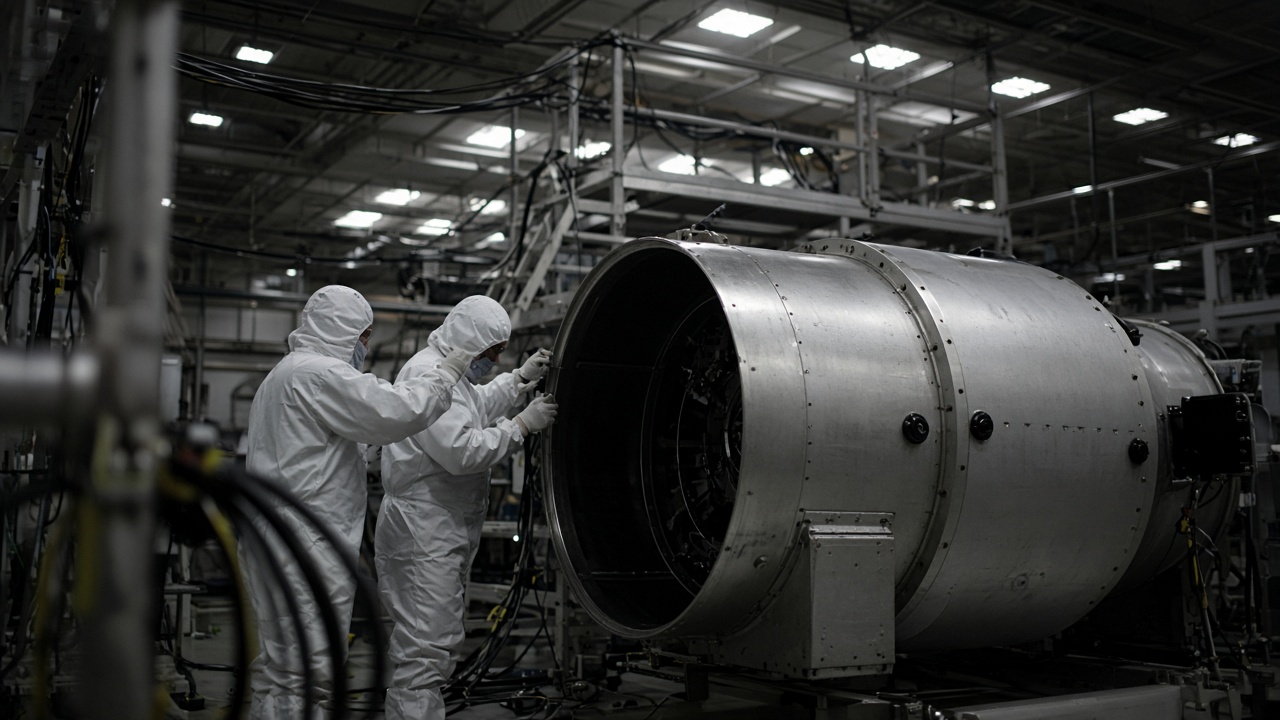
NASA has activated the Nancy Grace Roman Space Telescope’s primary Wide Field Instrument while the observatory is still weeks from its final orbit, a commissioning milestone the agency said confirms the 300-megapixel infrared camera survived launch and is responding to ground commands on the three-month trip to Sun-Earth L2.
What the team turned on
Mission managers at Goddard Space Flight Center reported on September 15 that engineers had completed the first power-on sequence for Roman’s Wide Field Instrument, a survey camera designed to map huge swaths of sky far faster than the Hubble Space Telescope while matching its depth on individual objects. The instrument carries 18 infrared detectors with a combined sensing area roughly the size of a laptop screen; together they will hunt for clues about dark energy, dark matter, and exoplanet populations.
Before activation, controllers kept the camera warm enough to dry out and decontaminate for 10 days, then cooled it to about minus 143 degrees Celsius. On September 11 they shut off the instrument heater; by the morning of September 12 they had switched on all 18 detectors. Over the following days the team exercised Roman’s calibration system, sent test frames through the pipeline to Earth, and for the first time in space rotated the element wheel that holds filters and dispersing optics.
Where Roman is headed
Roman lifted off from Kennedy Space Center on August 30 at 7:26 a.m. Eastern aboard a SpaceX Falcon Heavy, eight months ahead of an earlier public target date NASA had cited when the spacecraft finished integration early. The observatory is riding a million-mile transfer toward L2, a gravitationally stable point where it can keep the Sun at its back and limit stray light on the detectors.
Space.com reported September 16 that Roman still had about 12 weeks of travel remaining and that early telemetry showed nominal readings as commissioning continued. NASA also checked out the separate Coronagraph Instrument, which will block starlight to image planets around other stars; decontamination on that channel is expected to run about 30 days.
What scientists expect next
Project scientist Josh Schlieder said in a NASA statement that activating the Wide Field Instrument was a major step for the Goddard team and industry partners at BAE Systems and Teledyne. The mission plan calls for months of additional calibration before Roman opens its wide-field survey program.
NASA’s Roman blog said the observatory remains on schedule to release first science images in early 2027. Engineers also noted that precise Falcon Heavy insertion and conservative use of onboard fuel during early trajectory corrections could extend Roman’s operational life to roughly 22 years, well beyond the minimum design lifetime.
Why it matters on a crowded launch calendar
Roman is NASA’s next flagship astrophysics observatory after the James Webb Space Telescope, but its science model is different: repeated panoramic infrared maps rather than pointed deep fields. If commissioning continues without surprises, Roman will soon join Webb at L2 as a complementary wide-angle partner, giving researchers two infrared platforms tuned for different questions about how the universe expands and how common Earth-like worlds might be.
Until Roman settles at L2 and finishes its calibration queue, the operative facts are the successful Wide Field Instrument activation, the ongoing coronagraph checkout, and the early-2027 target for public science images — a long cruise that has already produced its first engineering proof that the camera works in the vacuum of deep space.