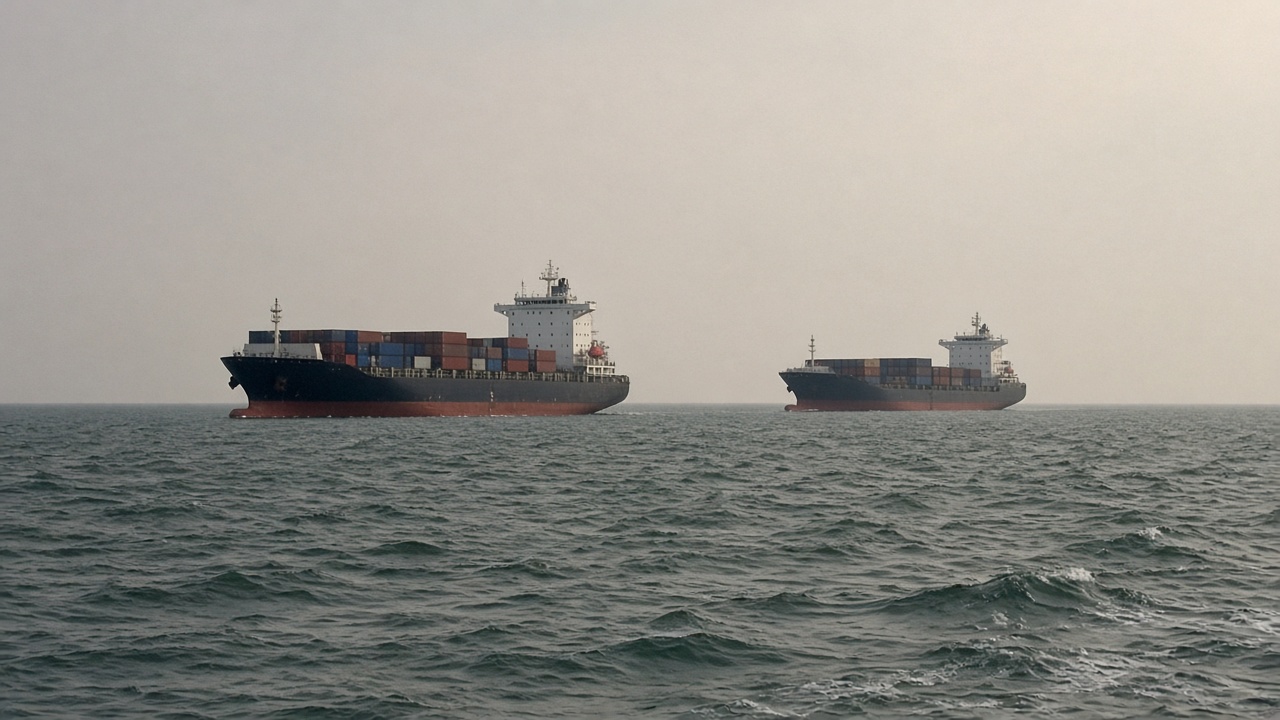
Footage showing a 229-meter bulk carrier plowing into a smaller Chinese fishing vessel in the Singapore Strait circulated widely on Monday, reviving scrutiny of traffic separation schemes in one of the world’s most congested maritime corridors. The Panama-flagged First Margaux struck the 49-meter Luqing Yuanyu 108 late last Thursday afternoon, according to ship-tracking data cited by The Maritime Executive and regional outlets, sending seawater across the trawler’s deck as crew members clung to rails.
Both vessels had departed anchorage near Singapore earlier that morning and entered the same westbound lane under the strait’s separation scheme, which routes supertankers and bulkers away from fishing traffic but cannot eliminate close-quarters encounters when multiple ships accelerate out of port at once. Video filmed from aboard the fishing boat shows the bulker bearing down from behind before impact; Al Jazeera and AsiaOne republished clips that had already drawn millions of views on Chinese social platforms over the weekend.
What trackers show
The Maritime Executive reported that First Margaux was leaving a busy anchorage on Singapore’s eastern side headed toward the Strait of Malacca when Luqing Yuanyu 108, which had left near Sentosa around the same time, was entering the lane. The collision occurred near 5 p.m. local time as both vessels converged, briefly pinning the trawler between the bulker and another merchant ship. South China Morning Post identified the vessels and dimensions, noting the dramatic surge of water across the smaller deck.
AsiaOne said it contacted the Maritime and Port Authority of Singapore for comment; by Monday afternoon the authority had not publicly detailed injuries or pollution reports. Industry databases list First Margaux as a bulk carrier carrying dry cargo; the fishing vessel is registered in China’s coastal fleet, which regularly transits the strait en route to squid and tuna grounds in the Java Sea.
Insurance and routing questions
Collisions in the Singapore Strait trigger immediate war-risk and hull insurer notifications because even minor hull breaches can close lanes used by a significant share of global container and energy trade. P&I clubs will examine whether watch officers on the bulker maintained proper lookout and whether the fishing vessel complied with crossing rules; both sides typically share liability when traffic separation lanes merge near port exits.
Pilots and harbor masters across Southeast Asia have warned for years that simultaneous departures from Singapore’s eastern anchorage create “pincer” patterns when smaller craft angle south while bulkers head west. Monday’s viral video gives those warnings a human face, even though the underlying geometry is routine on paper charts.
Local impact
For Singapore, the episode is less about immediate supply disruption—traffic continued through adjacent lanes—than about reputational risk for a hub that markets itself as a precision maritime controller. Shipping agents said no widespread delays were reported over the weekend, but charterers asked for updated risk assessments for vessels sailing within two hours of peak departure windows.
Investigators from flag states and possibly the MPA will pull voyage data recorder tracks and radio logs if a formal inquiry opens. Until then, the clip of a trawler crew scrambling as a bulker’s bow looms will serve as this week’s reminder that the strait’s separation lines are only as safe as the minutes when dozens of captains interpret them at once.