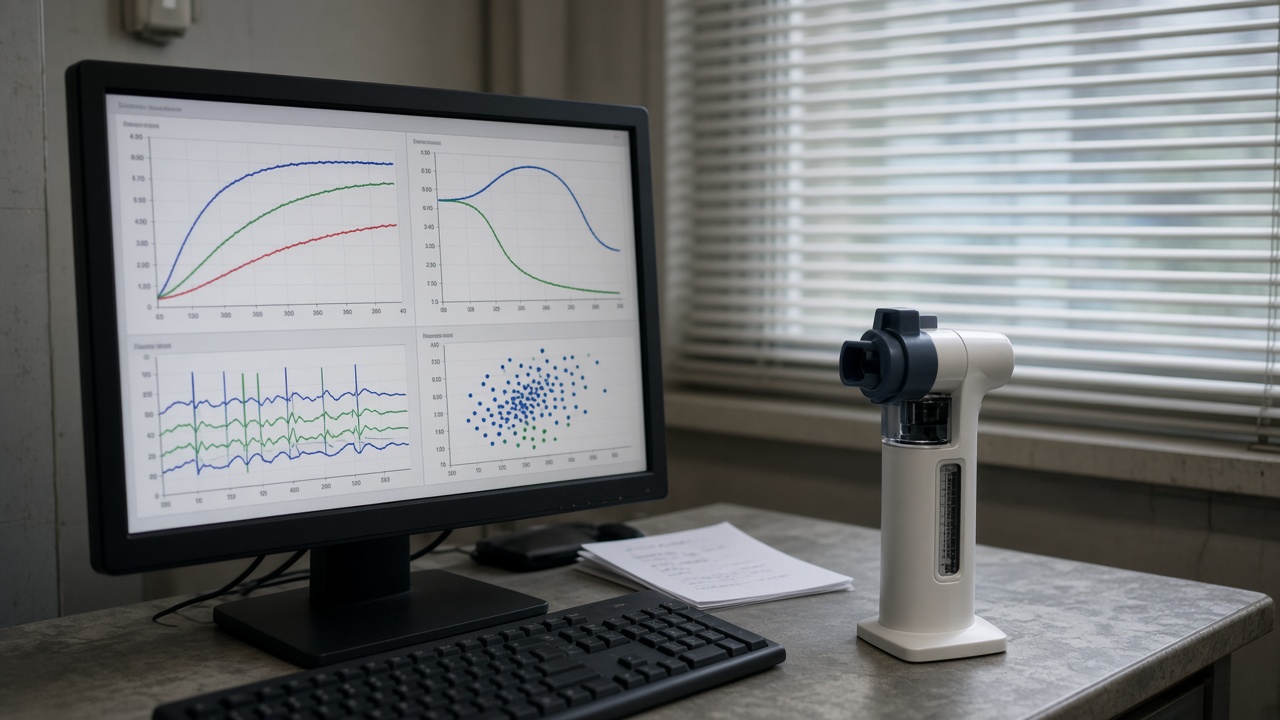
Huma Therapeutics has rolled remote asthma spirometry dashboards from its White City development floor into NHS integrated care board pilots, pairing home peak-flow and spirometry uploads with clinician triage views built for MHRA software-as-a-medical-device scrutiny. Three ICBs in north-west London, West Yorkshire, and the Black Country signed memoranda last month; dashboards went live for invited cohorts this week with read-only GP access and explicit patient consent flows.
\nWhat the dashboard shows clinicians
\nPatients use Huma’s existing modular app to capture forced expiratory volume readings from Bluetooth spirometers and manual peak-flow logs. The new dashboard aggregates trends, flags zone breaches aligned with NICE asthma guidance, and surfaces inhaler adherence gaps pulled from connected pMDI sensors where patients opt in. Clinicians see caseload tiles sorted by deterioration risk rather than chronological feeds—designed for respiratory nurses covering multiple PCNs.
\nHuma’s Queen Mary University of London partnership already explores AI coaching layers; the ICB pilots keep decision support rule-based to simplify regulatory classification. Product lead notes emphasise audit trails: every threshold alert links to the raw trace and device calibration stamp.
\nWhite City delivery hub
\nEngineering and clinical safety officers sit in Imperial WestTech Campus adjacent to White City Place, not Huma’s Millbank headquarters—proximity to NHS trust innovation teams was cited in board papers. Pilots ingest data into UK-hosted environments with NHS DARS-aligned encryption; no US-region replication for these cohorts, addressing ICO concerns raised in earlier remote monitoring tenders.
\nMHRA registration workstreams treat the dashboard as SaMD class IIa adjacent; Huma filed change notifications before ICB go-live, pausing features that might cross into autonomous dosing recommendations.
\nICB selection and equity
\nNorth-west London ICB targets high-deprivation wards with historically low asthma review attendance; West Yorkshire focuses on paediatric step-down after winter surge; the Black Country links community pharmacists to the same tiles GPs see. Each board set inclusion criteria—severe asthma or two unplanned care episodes in twelve months—avoiding blanket rollout that would drown nurses in noise.
\nPatient groups asked about digital exclusion; Huma supplies loan devices and SMS fallback for non-smartphone households in two pilot PCNs. ICB digital inclusion budgets cover connectivity stipends where home broadband fails quality bars for video follow-ups tied to dashboard alerts.
\nEvaluation metrics
\nPrimary outcomes at twelve weeks: unplanned A&E attendances versus matched controls, time-to-clinician review after a red-zone reading, and patient-reported quality of life scores. Secondary metrics track nurse minutes saved on phone chasing peak-flow diaries—an operational KPI ICB finance teams watch as tightly as clinical endpoints.
\nIndependent evaluators from NIHR-affiliated units will publish interim readouts in January; until then dashboards remain invitation-only with capped enrolment to prevent capacity shocks in thin respiratory teams.
\nCompetitive landscape
\nAptar and other respiratory platforms already run hospital-centred trials; Huma pitches modular integration with existing hospital-at-home stacks it operates for other conditions. NHS England’s national commercial team listed remote spirometry in primary care innovation menus earlier this year; Huma’s ICB deals are local procurements, not a national framework award—important for rivals bidding neighbouring boards.
\nData portability clauses let patients export traces if they leave the pilot—a response to GP concerns about vendor lock-in when annual contracts renew.
\nRisks and mitigations
\nFalse positives from poor spirometry technique could spike nurse workload; Huma embedded coaching videos and quality scores that suppress alerts until patients produce three acceptable blows. Clinicians retain override to snooze monitoring during acute intercurrent illness documented in the record.
\nRegulatory shifts under the UK’s AI regulatory white paper may tighten transparency on rule-based alerts too; Huma’s clinical safety officer said documentation already maps each alert to published NICE thresholds for inspector review.
\nWhat patients notice
\nEnrollees get a clearer feedback loop than paper diaries—graphs on phone, nurse callbacks within SLA windows when red zones hit. GPs see fewer “lost to follow-up” tags on QOF asthma registers if pilots hit adherence targets. Pharmacy teams on the Black Country pilot receive read-only tiles when rescue inhaler use spikes, closing a loop community pharmacists asked for after last winter’s steroid shortages.
For Huma, White City is the staging ground proving dashboards can scale across ICBs without becoming another siloed app—provided September’s early alerts translate into fewer winter admissions, not just prettier charts.