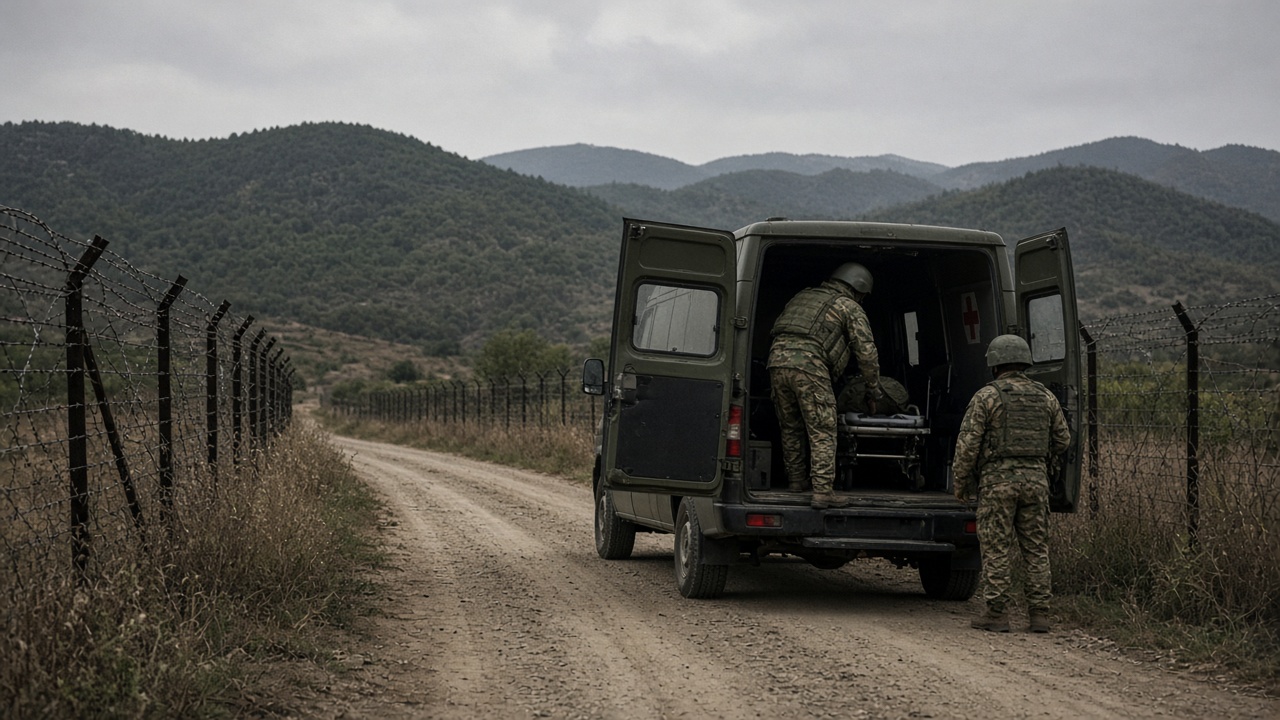
Three South Korean military officers were injured Monday by an explosion while conducting a search operation south of the Military Demarcation Line in the western sector of the demilitarized zone, the Joint Chiefs of Staff said in an urgent text message to reporters.
What the JCS confirmed
The blast struck a front-line unit under the Army’s 25th Infantry Division, which covers the western DMZ corridor near Paju and Yeoncheon. Two officers were flown out by emergency helicopter; the third was to be moved by road before air evacuation, the JCS said, without identifying ranks or naming the exact coordinate grid.
Reuters quoted the statement as saying the officers were hurt during an operation south of the MDL — language Seoul uses to stress the incident occurred inside territory the South controls, not on the northern side of the border fence. Yonhap News Agency flagged the alert as breaking news shortly after 1330 Korea Standard Time.
What investigators suspect
South Korean media, citing defense officials who were not authorized to speak publicly, said a landmine explosion is the leading theory. It remains unclear whether the device was laid by North Korean troops, part of a South Korean defensive field, or displaced by heavy rains that have altered terrain along some DMZ slopes this month.
The Joint Chiefs had warned earlier in September that satellite imagery showed ground movement in limited sections south of the MDL and that officials were consulting the United Nations Command about the possibility that North Korean sappers had planted mines during recent incursions. Monday’s incident will intensify those reviews even if the final forensic report takes days.
North Korean silence
Pyongyang’s state media had not commented on the blast by Monday afternoon. The Korean People’s Army usually ignores single-incident casualties unless it can frame them as provocations by Seoul or Washington. The UN Command, which oversees the armistice, said it was aware of reports and coordinating with the JCS but released no additional details.
What it means for the border
Search operations inside the DMZ buffer are routine after floods expose old ordnance or when sensors detect tunneling noise, but casualties from explosions are rare enough to rattle markets already watching U.S.-North Korea diplomacy stall. Defense Minister nominees in the National Assembly will likely demand a timeline for clearing suspected minefields and upgrading medevac routes along the western corridor.
Until the 25th Division and the UN Command publish findings, the confirmed facts are three injured officers, two serious helicopter evacuations, and an unexplained detonation on a division patch that sits fewer than 50 kilometers from central Seoul — a reminder that the Korean War armistice still exacts a physical toll even when the front page is dominated by trade summits elsewhere in the world.