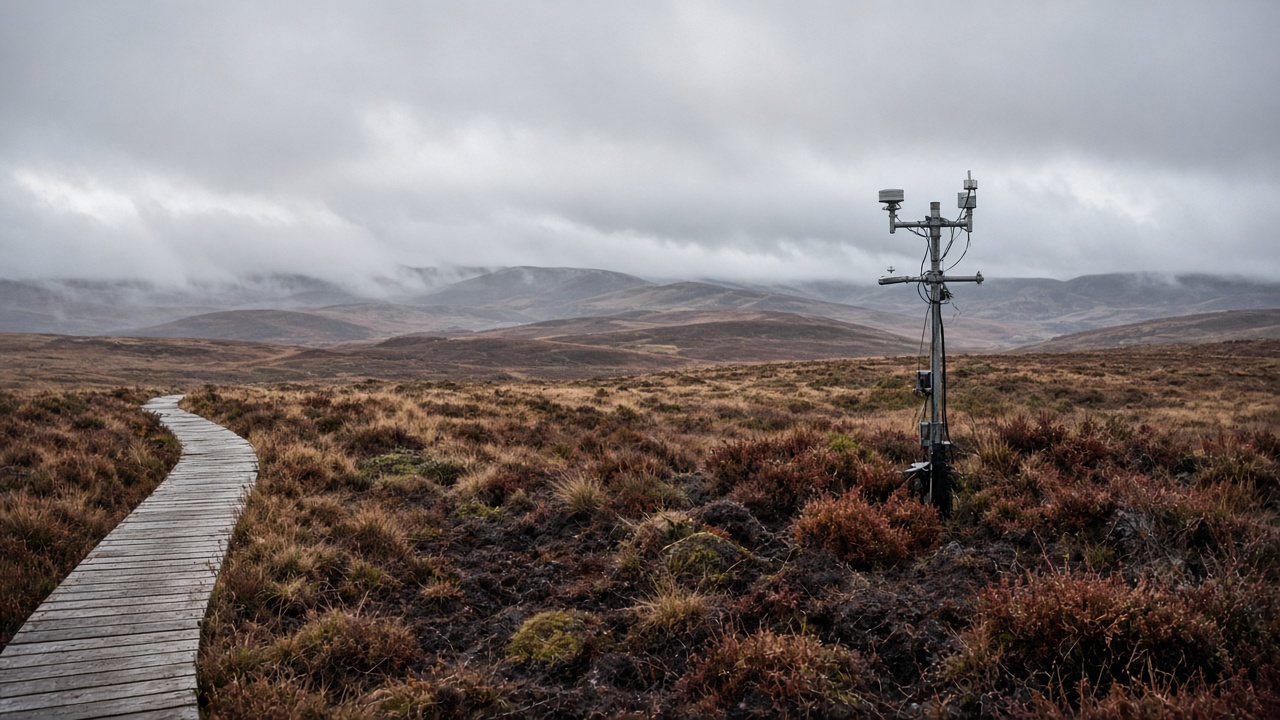
A NERC-funded cryosphere and carbon field team published provisional Pennine peat bog flux data this weekend showing sharp daytime carbon dioxide release after September’s heat dome, with net ecosystem exchange only returning toward neutral when nightly temperatures fell below 12°C on three consecutive moorland nights.
What was measured
Researchers erected an eddy covariance tower on a blanket bog site above Calderdale, pairing open-path gas analysers with soil moisture probes at 10 and 30 centimetres. The heat dome week pushed daytime air temperatures past 28°C on the plateau while water tables dropped 4 centimetres below the long-term September median—still saturated by international peat standards but enough to widen aerobic layers at the acrotelm.
Daytime flux peaked at roughly 8 micromoles per square metre per second CO₂ efflux on the warmest afternoon; authors caution the number is uncorrected for gap-filled turbulence and awaits footprint analysis. Nighttime respiration declined when dew restored surface moisture, supporting the 12°C threshold noted in the public dataset readme.
Methods and limits
The campaign reuses CEH moorland protocols: 10 hertz sonic anemometry, Webb-Pearman-Leuning density corrections, and chamber snapshots for methane though CH₄ slides are not yet posted. Sample period covers only nine heat-dome days plus a cooler control week; no multi-year baseline is claimed.
Authors will not attribute the flux spike to climate change in this release—they report correlation with temperature and water table, not causal attribution across decades. Replication would need parallel towers on North York Moors sites NERC lists as “pending battery swap.”
Policy relevance without overclaim
UK peatland restoration grants hinge on models that assume rewetted bogs remain carbon sinks through hot spells. These readings suggest brief heat domes can flip sites to net emitters for days even when mean water tables look healthy—a nuance for Natural England’s restoration audits and for grouse-moor rewetting debates on the same Pennine spine.
Met Office climate summaries document the September heat dome as a regional extreme; NERC’s post ties ground truth carbon behaviour to that bulletin without updating national inventory totals.
What comes next
Full quality-controlled data upload to the Environmental Information Data Centre is slated for October after friction velocity filters are reapplied. The team invites Yorkshire Water catchment officers to compare flux dips with reservoir abstraction logs but will not name management actions in the provisional note.
Until peer review, treat the 12°C night recovery as a hypothesis for land managers: irrigation mists or night-time sprinkler trials on trial plots may be warranted on other moors, but this paper-equivalent release stops at publishing instruments and inviting independent replication in UK labs.
Instrumentation notes
Tower batteries were swapped mid-campaign after heat dome nights drained solar-charged packs faster than forecast; gap-filled periods are flagged in the open CSV so downstream modellers do not treat continuous rows as uninterrupted. A companion soil temperature logger at 5 centimetres recorded surface heating above 35°C on bare peat patches—context for why efflux persisted after sunset on the warmest day.