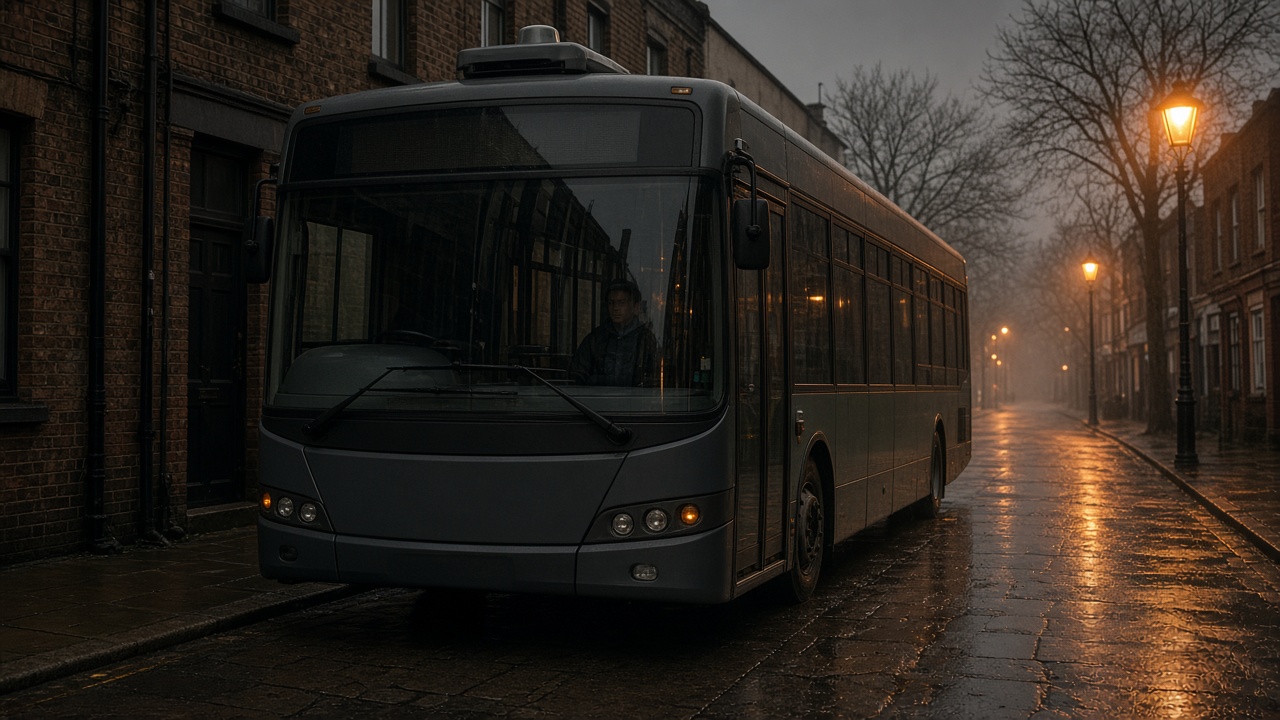
Wayve’s Camden autonomous bus pilots have started publishing fall fog interruption thresholds to Transport for London, documenting when embodied-AI perception hands control back to safety drivers as moisture, glare, and shortened sightlines breach confidence bands on north London test loops. The logs—shared under the UK’s automated passenger services pilot—are among the first operator-specific datasets tying weather opacity to minimum-risk manoeuvre rules for full-size buses, not just robotaxi saloons.
Why buses in Camden
TfL included Camden in the borough set where multi-passenger self-driving trials may run before public booking opens later in 2026. Wayve’s end-to-end model, trained without HD maps, faces narrow Victorian streets, school-run cyclists, and autumn fog rolling off Regent’s Canal—conditions robotaxi trials in sunnier US cities rarely stress together. Bus form factor adds mirror blind spots and stop kneeling mechanics the model must respect when visibility drops.
Wayve and Uber already test saloon cars nearby; the bus work uses a separate safety case filed with the Centre for Connected and Autonomous Vehicles. Camden councillors received a redacted threshold table showing fog density bands where supervised service pauses versus continues at reduced speed.
What the thresholds capture
Engineers instrumented lidar, camera, and radar fusion outputs against MET Office visibility readings at Kentish Town monitoring sites. When optical confidence scores fall below calibrated percentiles for three consecutive seconds, the bus initiates a minimum-risk stop and alerts the safety driver—who remains legally responsible under the Automated Vehicles Act transition regime. Logs record whether the model or the human completed the stop, feeding insurer reviews.
Fog is not a single switch: moderate mist may allow 20mph creep with heightened following distance, while dense fog triggers hard handback. Wayve’s Monday note to TfL lists separate curves for dawn glare plus particulates—common on Parkway commutes when low sun hits wet tarmac.
Policy and passenger messaging
UK regulators want transparent operator rules before fare-paying passengers board. Publishing interruption thresholds lets TfL compare Wayve against other pilot entrants without exposing model weights. Passenger-facing apps will eventually show “weather hold” banners; until then trials run with invited staff only, avoiding GDPR-heavy crowd scenes.
The Automated Vehicles Act’s authorised self-driving entity framework still assigns oversight to Wayve’s corporate safety board; Camden’s transport committee asked whether borough environmental sensors could feed live fog data—Wayve said integration is on the roadmap but not live for September runs.
Comparison with robotaxi trials
Waymo’s map-heavy London plans emphasise pre-scanned geometry; Wayve argues fog favours generalisable models that do not assume last week’s lane paint. Critics note both approaches fail if sensors are occluded—threshold logging is how Wayve proves it stops rather than hallucinating lanes. Uber’s partnership focuses on cars first; bus logs may inform shared safety driver training across vehicle types.
Insurance underwriters at Lloyd’s syndicates reviewing pilot bonds said bus interruption data is the gating item for passenger liability quotes—cars carried lower occupancy risk; a missed fog handback on a double-decker scales differently even on a single-deck test rig.
Operational schedule
September trials run pre-dawn and evening slots when fog historically peaks on TfL open-data charts. Wayve rotates two buses between Chalk Farm and Gospel Oak loops, avoiding school peak until thresholds stabilise. Each session uploads anonymised perception histograms to a DfT repository within 24 hours—a pilot transparency rule other operators must mirror.
Safety drivers report average two handbacks per foggy morning shift in week one, mostly at canal bridges where microclimates dip visibility faster than MET grid cells predict. Wayve is tuning sensor heating and wiper sync to reduce nuisance stops without delaying necessary ones.
What success looks like before fares
TfL will not open public booking until interruption rates align with human-driven bus delay statistics on the same loops in comparable weather. Wayve targets Q1 2027 for unsupervised segments on clear days only; fog may remain supervised indefinitely—a realistic expectation Camden residents said they prefer over silent automation.
For London’s autumn, the story is not headline autonomy but disciplined logging: when the model admits it cannot see, and how quickly humans recover the route. Wayve’s Camden bus pilots turn fog from a marketing footnote into measured engineering—a prerequisite if self-driving buses ever join the night bus map.