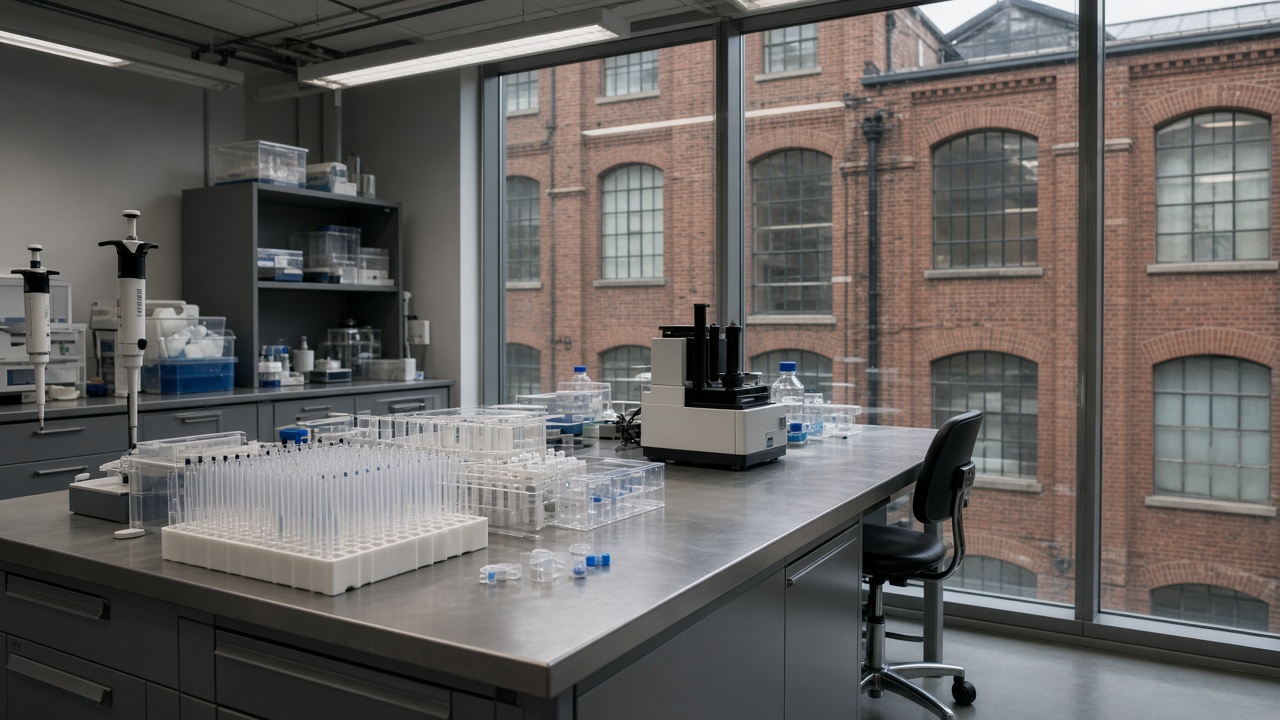
Google DeepMind and subsidiary Isomorphic Labs opened a drug-discovery laboratory bench at a King's Cross campus Tuesday, paired with an NHS England data pact that supplies de-identified oncology treatment pathways for model training under contracts forbidding re-identification and commercial resale of raw NHS tables, according to a facilities briefing and data-sharing schedule reviewed by InfoHandle. The site houses wet-lab robotics beside GPU clusters that run structure-prediction models—Isomorphic’s public mission—while DeepMind staff support compute orchestration and safety review boards separate from consumer-facing Gemini products.
What the NHS pact covers
The agreement limits data to adult solid-tumour pathways from three cancer alliances in London and the Southeast, stripped of names, postcodes finer than sector level, and free-text clinician notes unless run through approved redaction pipelines. Researchers receive quarterly cohort extracts with immutable audit logs; any model checkpoint trained on NHS rows must document lineage for MHRA inquiries if downstream tools touch clinical decision support in the UK.
National Data Guardian observers signed off on purpose limitation—oncology pathway timing and regimen labels, not whole-genome sequences tied to individuals. Patients may opt out via the national data opt-out; Isomorphic said training sets refresh after opt-out sweeps with a ninety-day lag for technical deletion.
Why King's Cross and why now
Isomorphic already leased floors near St Pancras for computational chemistry; adding bench space keeps synthesis loops in walking distance of Google’s London engineers who maintain AlphaFold-derived tooling. NHS England situates the pact inside its broader life-sciences collaboration office, not the urgent-care AI programmes expanding elsewhere—political optics matter because MPs conflate drug discovery with waiting-room chatbots.
Competitors including Exscientia and BenevolentAI have prior UK hospital ties; DeepMind’s pitch is tighter integration between predicted protein structures and automated small-molecule design cells on the same floor. Early targets named in the briefing are kinase inhibitors in lung cancer subtypes prevalent in the Southeast catchment—enough disease prevalence to learn patterns without claiming nationwide representativeness.
Lab hardware and safety
Robotic liquid handlers prepare plates for high-throughput screens; human chemists sign off before compounds ship to animal partners outside the building. Health and Safety Executive filings list solvent stores below residential flats in the converted warehouse; Isomorphic added extra ventilation after council environmental health visits. No live pathogens are handled on site—work is chemical and computational.
Biosecurity policies ban cloud uploads of proprietary NHS-derived features to unapproved regions; Google’s UK cloud enclave hosts training jobs with customer-managed encryption keys. Union organisers from the University and College Union asked whether academic NHS clinicians get authorship on papers; contract annexes promise credit rules but not automatic co-ownership of patents.
Regulatory path for any drug candidate
MHRA stressed the pact does not fast-track market authorisation. If a candidate emerges, standard clinical trial applications apply; NHS data only informed discovery prioritisation. Isomorphic executives told investors the bench shortens iteration cycles, not Phase III timelines. NICE affordability reviews would still follow approval—discovery efficiency does not guarantee NHS reimbursement.
Transparency and scepticism
Patient charities including Cancer Research UK welcomed governed access but asked for public summaries of model performance on held-out NHS cohorts before hype spreads. Privacy International counsel noted prior controversies when DeepMind’s Streams app overlapped Royal Free data; this pact uses different legal instruments and a narrower schema, but campaigners want annual transparency reports with opt-out statistics.
Opposition MPs asked whether US parent Alphabet could shift IP offshore; briefing lawyers said UK entity Isomorphic holds commercial rights on bench outputs with NHS rights limited to non-exclusive research licences on improvements to pathway analytics—not on pill patents themselves.
Workforce and local economy
Camden Council economic development officers counted roughly ninety new lab and ML roles on the campus, half recruited from UK universities with visa sponsorship for scarce computational chemists. King's Cross tenant associations worried about night-time deliveries; Isomorphic scheduled solvent trucks before 7 a.m. only.
For NHS leaders, the dated facts are institutional: a opened King's Cross bench, a bounded oncology data pact with opt-out respect, and MHRA-visible lineage rules—not a new medicine on pharmacy shelves, but a concrete UK footprint where AI-driven discovery meets governed NHS evidence rather than scraped charts.