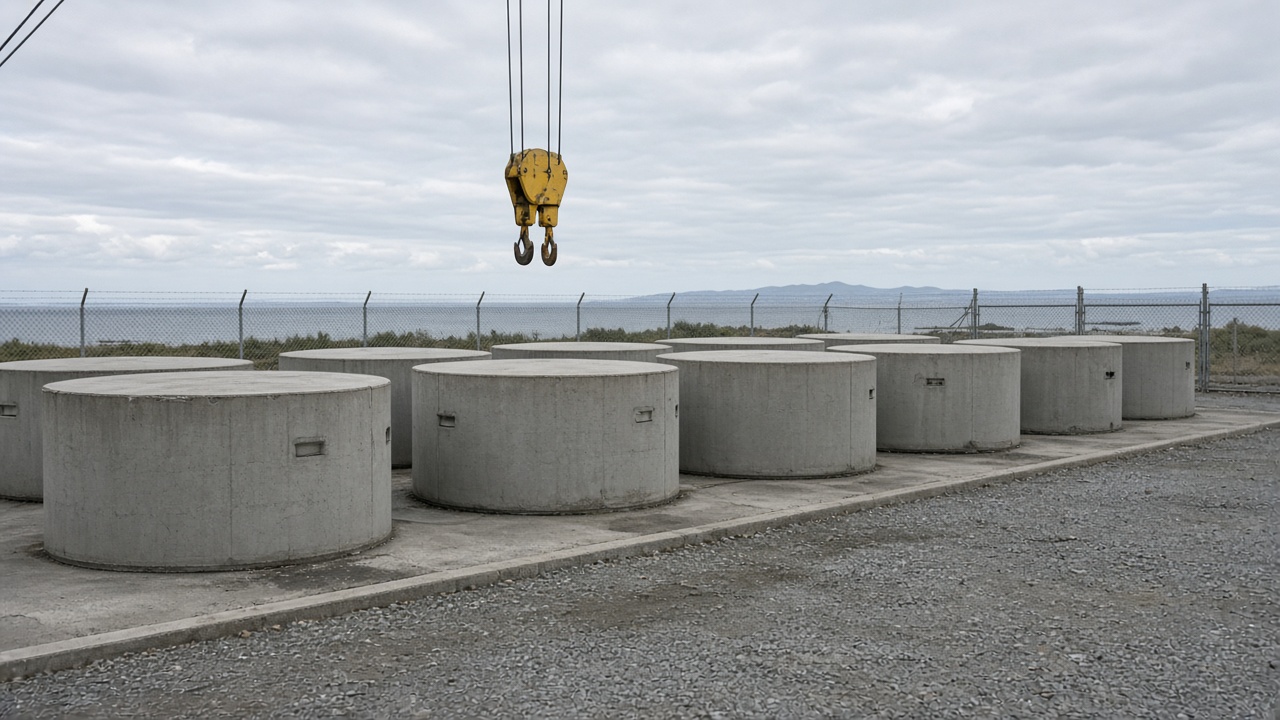
The Korea Atomic Energy Research Institute released updated thermal models Monday for Wolseong’s spent-fuel dry cask pad ahead of a Nuclear Safety and Security Commission review session, showing peak cladding temperatures remaining below design limits under conservative heat loads while recommending shorter seal inspection intervals if coastal humidity exceeds summer baselines.
What the models cover
KAERI’s team simulated vertical concrete overpacks holding pressurized water reactor assemblies transferred from Wolseong pools as unit retirements progress. Inputs included ambient heat from the 2024–25 summer, revised wind profiles from on-site met towers, and conservative decay-heat curves for mixed batch ages. Peak cladding temperatures in the published maps stayed under vendor limits with margin, but sensor cable routing near pad edges showed hotspots when inspectors walked maintenance paths—a human-factor variable earlier models ignored.
KHNP supplied as-built cask spacing; KAERI cautioned the maps are not a license amendment but evidence for NSSC questioning scheduled for Thursday.
Regulatory stakes
NSSC commissioners asked for refreshed analytics after regional residents petitioned about pad expansion plans tied to delayed permanent repository timelines. Anti-nuclear groups will focus on inspection intervals; industry groups will highlight margins below limits. KAERI neutrally noted that tighter seal checks raise dose exposure for workers unless robotic tools deploy—equipment KHNP is piloting but has not certified.
Limits and unknowns
Models assume cask inventories listed in June; if transfer schedules slip, heat loads shift. KAERI did not model typhoon debris blocking ventilation gaps—a scenario NSSC staff asked to see in October follow-ups. International peer review is pending; IAEA dry-storage guides cite similar conservative heat assumptions but do not bind NSSC decisions.
What happens next
Commissioners may accept the maps as informational, order additional monitoring wells for pad drainage, or delay expansion approvals until robotic seal inspections prove out. For Wolseong communities, the immediate takeaway is procedural: regulators receive quantitative heat maps before voting, not after pad concrete pours—a timing shift KAERI framed as standard safety culture, not an admission of prior gaps.
Repository politics remain unresolved; dry casks are interim fact. Thermal models do not answer where fuel goes forever—they answer whether today’s pad stays within engineered heat bounds while that fight continues.
Replication and peer review
KHNP engineers said they will replicate KAERI’s conservative heat loads on an identical cask vendor model stored at a Gyeongju training pad, comparing thermocouple readings during a scheduled maintenance walkdown in October. Discrepancies beyond five degrees Celsius trigger a joint task force under NSSC rules—a threshold regulators said has not been triggered at Wolseong but has at other coastal pads after humidity sensors drifted.
Residents’ councils asked for public workshops with heat-map printouts redacted of security-sensitive layout details; KAERI agreed to host a briefing after the commission session if commissioners approve release. Until then, the published maps remain the most concrete pre-vote evidence in a repository debate that otherwise trades in slogans.