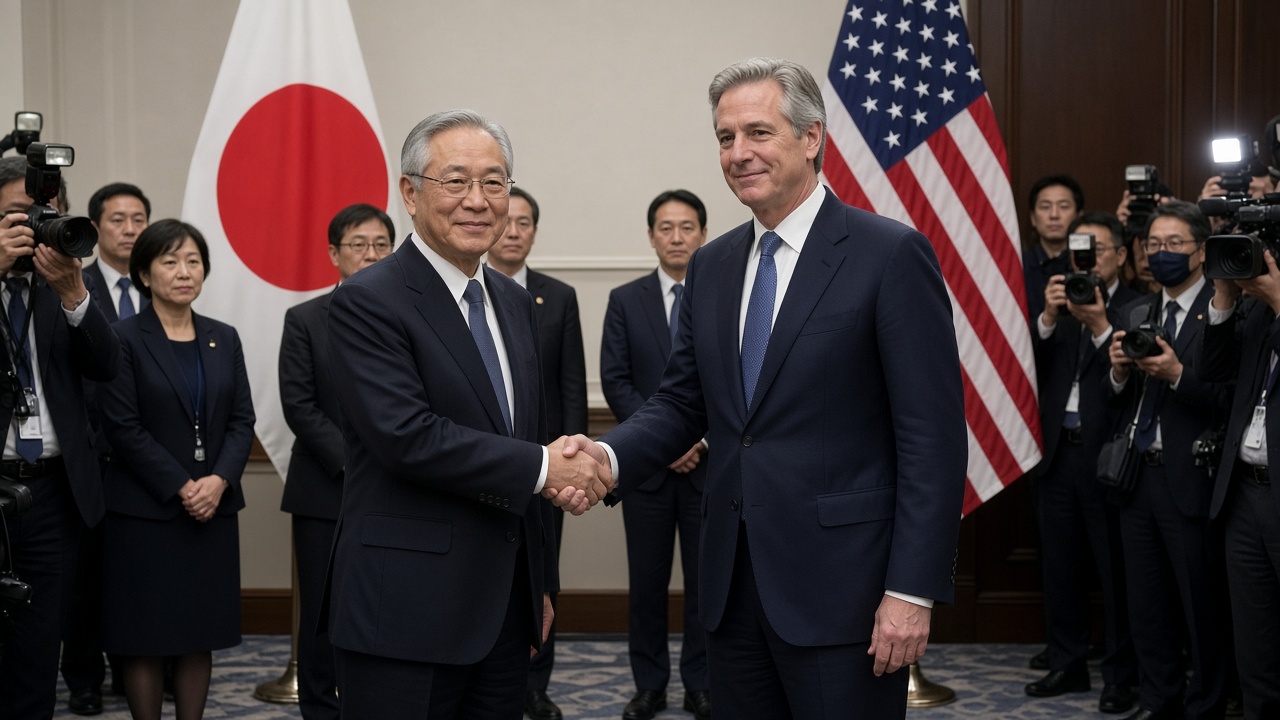
Prime Minister Sanae Takaichi and U.S. President Donald Trump agreed Tuesday to further strengthen the bilateral alliance, Japan’s government said, capping a New York meeting held as both leaders attended the United Nations General Assembly and weeks before a planned Trump summit with Chinese President Xi Jinping in Washington.
What Tokyo announced
Kyodo News carried a breaking alert shortly after 5 a.m. Tokyo time quoting Chief Cabinet Secretary Yoshimasa Hayashi, who said Takaichi and Trump shared assessments on regional security and economic cooperation. Hayashi did not release a full communique, but officials told Japanese reporters the talks covered extended deterrence, defence-industry collaboration and keeping semiconductor supply chains resilient.
The meeting followed a trilateral foreign-ministers session on Monday among the United States, Japan and South Korea, where the three governments emphasized peace in the Taiwan Strait and opposition to unilateral changes in the status quo. Tokyo has treated that language as a coordinated signal ahead of the U.S.-China leaders’ talks.
Alliance priorities cited by Takaichi
Takaichi’s office said she reiterated Japan’s plan to raise defence spending and streamline base-hosting procedures for U.S. forces, while seeking assurances that Washington will consult Tokyo on tariff and technology measures affecting Japanese exporters. With the yen still sensitive to U.S. rate expectations, finance officials joined part of the conversation by video, according to a senior Japanese official who briefed reporters on condition of anonymity.
Trump, in brief remarks to cameras before the sit-down, called Japan “a cornerstone partner” and referenced joint ship-repair projects in Yokosuka and Sasebo. He did not detail new basing announcements, but U.S. officials said follow-on staff talks would cover munitions co-production.
Regional context for Japanese readers
For domestic audiences, the summit’s timing matters: North Korea has resumed missile tests this month, and Chinese state media warned Washington not to cross Beijing’s “red lines” on Taiwan ahead of the Xi visit. Takaichi told reporters afterward that any U.S.-China bargain must not come at the expense of Japan’s security interests or the stability of sea lanes through the East China Sea.
Opposition lawmakers in Tokyo demanded a Diet briefing on what concessions, if any, Japan offered on agricultural market access—a recurring friction point in trade talks. Hayashi said details would be shared with parliamentary committees once ministries finalize notes.
Next steps
Japanese and U.S. defence officials plan a working-level session in October on counter-drone systems and space-domain awareness, according to the defence ministry. Takaichi is scheduled to address business leaders in Manhattan on Wednesday before returning to Tokyo, where she faces a special parliamentary session on the supplementary budget.
Tuesday’s handshake does not replace formal treaty commitments, but it sets a public marker that Takaichi intends to keep the alliance visible while Washington pivots between Middle East diplomacy and great-power competition with Beijing.