Europe’s newest vegetation scout and its Copernicus ocean sentinel are now flying as a paired mission after a dual launch from Kourou, giving UK scientists a fresh stream of fluorescence and sea-surface data built in large part on British assembly lines. FLEX and Sentinel-3C rode Vega-C flight VV30 on 15 September 2026, lifting at 02:21 UK time from the European Spaceport in French Guiana.
What each spacecraft measures
FLEX, the Fluorescence Explorer, is ESA’s eighth Earth Explorer. Its FLORIS instrument looks for the faint red glow plants emit during photosynthesis—a signal usually drowned out by reflected sunlight. Sentinel-3C extends the Copernicus Sentinel-3 series that tracks sea colour, land temperature, and ice margins. ESA plans orbital choreography so FLEX initially flies in tandem with Sentinel-3A before Sentinel-3C replaces 3A in the formation, letting researchers pair direct photosynthesis readings with atmospheric and thermal context.
Avio, which operates Vega-C, said the stack used a Vespa adapter: Sentinel-3C separated first, FLEX about an hour later into a sun-synchronous orbit near 810 km. Controllers at ESOC in Germany confirmed first signals from both spacecraft the same morning.
UK industrial roles
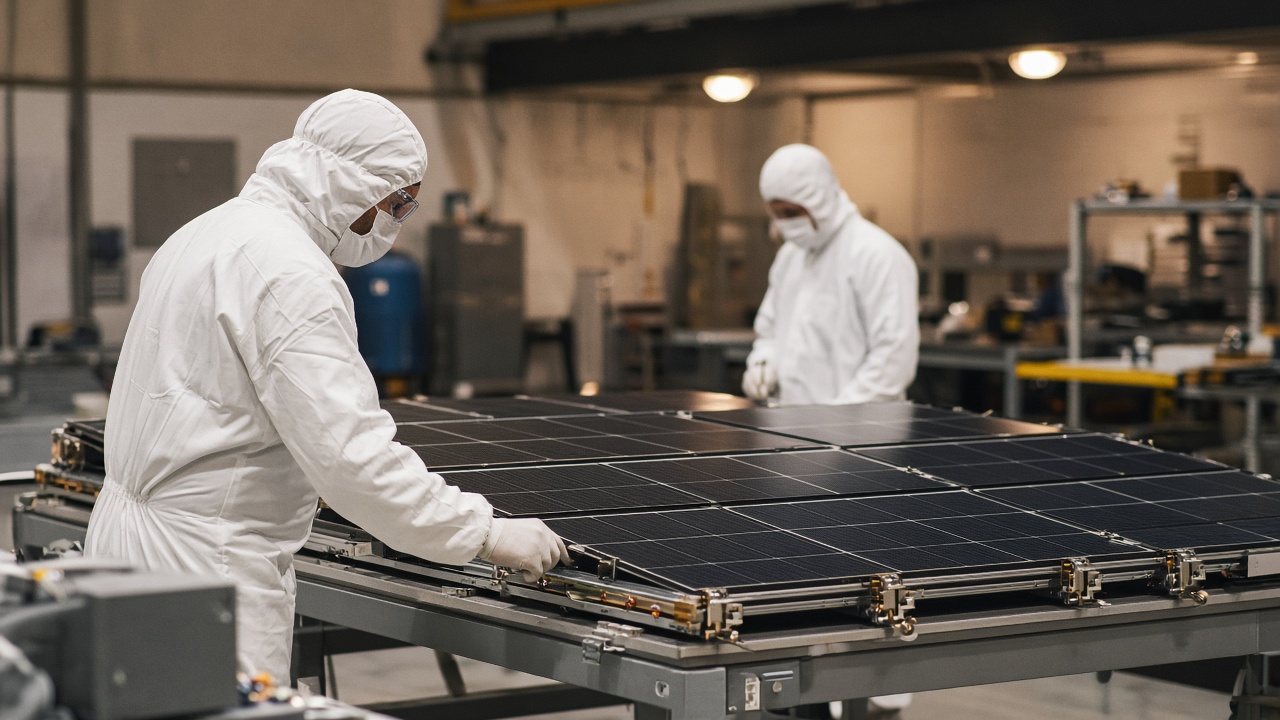
The UK Space Agency noted that Thales Alenia Space UK completed assembly, integration, and testing of the FLEX platform in Belfast, with Teledyne e2v supplying detector hardware, ABSL providing batteries, and Nammo Westcott contributing propulsion kit. At Harwell in Oxfordshire, the National Satellite Test Facility at STFC RAL Space ran large-scale environmental tests that simulated launch vibration and vacuum. Sentinel-3C carries a Sea and Land Surface Temperature Radiometer with UK involvement from RAL Space and Airbus Defence and Space, alongside additional Teledyne and ABSL components.
What scientists can—and cannot—claim yet
Commissioning will take months. FLEX teams must calibrate fluorescence retrievals against ground towers and aircraft campaigns before claiming crop-stress trends; Sentinel-3C must hand operational ocean products to Eumetsat. The tandem design improves interpretation—drought stress should not be read from fluorescence alone without atmospheric correction—but it does not remove cloud gaps or the limits of 300-metre-scale sampling.
Operations on the ground
ESA said FLEX will initially tandem with Sentinel-3A while engineers raise Sentinel-3C’s instruments, then manoeuvre 3C into the formation that replaces the ageing 3A spacecraft. Eumetsat will operate Sentinel-3C for ocean and weather services; FLEX stays under ESA science control. That split mirrors Copernicus practice: operational agencies run repeat measurements, while Earth Explorers test techniques that may graduate into permanent programmes.
Why the pairing matters for UK policy
Ministers have tied Copernicus participation to domestic climate and food-security planning. A successful tandem run gives Defra and the Met Office a European benchmark for vegetation health that does not depend on US or Chinese platforms alone. For Belfast and Harwell contractors, it is also proof that post-Brexit Britain can still anchor high-value space manufacturing inside EU-led missions—whether or not membership politics move on Blair’s timetable.