Hamas said on Thursday it is ready to move into the next phase of the US-brokered Gaza agreement, a day after President Donald Trump's Board of Peace put a six-month, $2.45 billion reconstruction package on the table. Spokesman Hazem Qassem said the group had "full readiness to implement the Board of Peace's roadmap" and had taken the steps required to do so. His statement did not mention disarmament. Israel has said reconstruction will not begin until Hamas gives up its weapons.
What exists as of Friday is a plan with a price tag and a statement of readiness, not a signed sequence. Neither document settles who moves first.
What the board put on the table
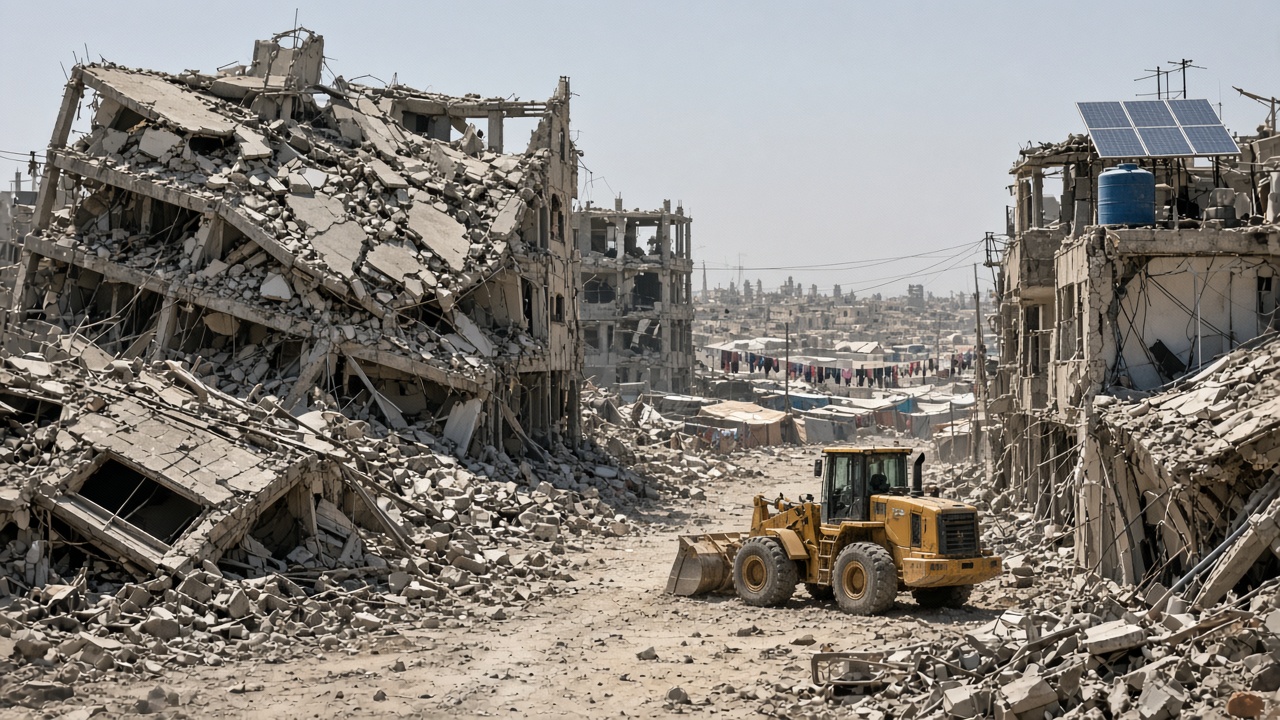
The plan, presented at an event on the sidelines of the UN General Assembly in New York on Wednesday, covers 66 programs to rebuild Gaza's infrastructure and economy. The board puts physical damage at $35.2 billion and full recovery at about $71.4 billion over the next decade, according to Reuters. The near-term package covers repairing border crossings, restoring electricity and water infrastructure, deploying 25,000 portable solar power kits and permanently filling tunnels beneath sites needed for priority reconstruction work.
Nickolay Mladenov, the board's lead Gaza envoy, said officials do not want Gaza to go back to the way it was before the war.
The sequencing problem
The 15-point roadmap the board published on July 30 is explicit about order. Hamas and the other factions hand civilian governance and security functions to the National Committee for the Administration of Gaza; heavy weapons, depots, production facilities and tunnels are decommissioned; an International Verification Committee certifies that both sides have met their commitments before the next phase begins; Israeli forces withdraw on an agreed timetable. The board's own summary of the arrangement is "One Authority, One Weapon, One Law."
That is where the two sides read the same document differently. Israel's stated condition is complete disarmament before any withdrawal or reconstruction. Hamas has tied progress on weapons to an end to the war, an Israeli pullout and the future administration of the Strip. Qassem kept that link intact, and instead asked Washington and the board to facilitate the entry of the technocratic committee so it can take up its duties and international forces can begin deploying.
"The complete obstruction of the ceasefire agreement and its related roadmap is due to the Israeli government's refusal to abide by the agreement," Qassem said in the statement carried by Xinhua and the Associated Press.
Israel has not accepted the roadmap on those terms. Prime Minister Benjamin Netanyahu used his own UN address on Thursday to defend Israel's strike on Iran; scores of delegates walked out. He announced no change of position on Gaza.
The money is the other bottleneck
A senior European Union official said only about 1 billion euros, or roughly $1.1 billion, of the 71 billion euros ($80.8 billion) the UN, the World Bank and the EU estimate the rebuild needs has been raised. Pledges and transfers are different numbers, and the six-month plan is funded far below the ten-year estimate attached to the same territory.
The board's own interim report to the Security Council described the same dependency: reconstruction only in areas where disarmament has been verified. Until that verification happens, the committee meant to run Gaza cannot take over areas Hamas still controls, and the stabilization force meant to hold the ground stays short of deployment.
What is knowable now
The roadmap allows a 14-day window, after all parties approve it, for the phase-two timetable and mechanisms to be prepared, extendable by the verification committee. No party has said it approved. Qassem's statement is a statement of readiness, not an acceptance of the disarmament language in the document he is asking to implement.
Watch three things: whether the technocratic committee is granted entry, whether pledged money is transferred rather than restated, and whether the verification committee is convened. Until one of those moves, both sides are describing a framework they do not agree on.