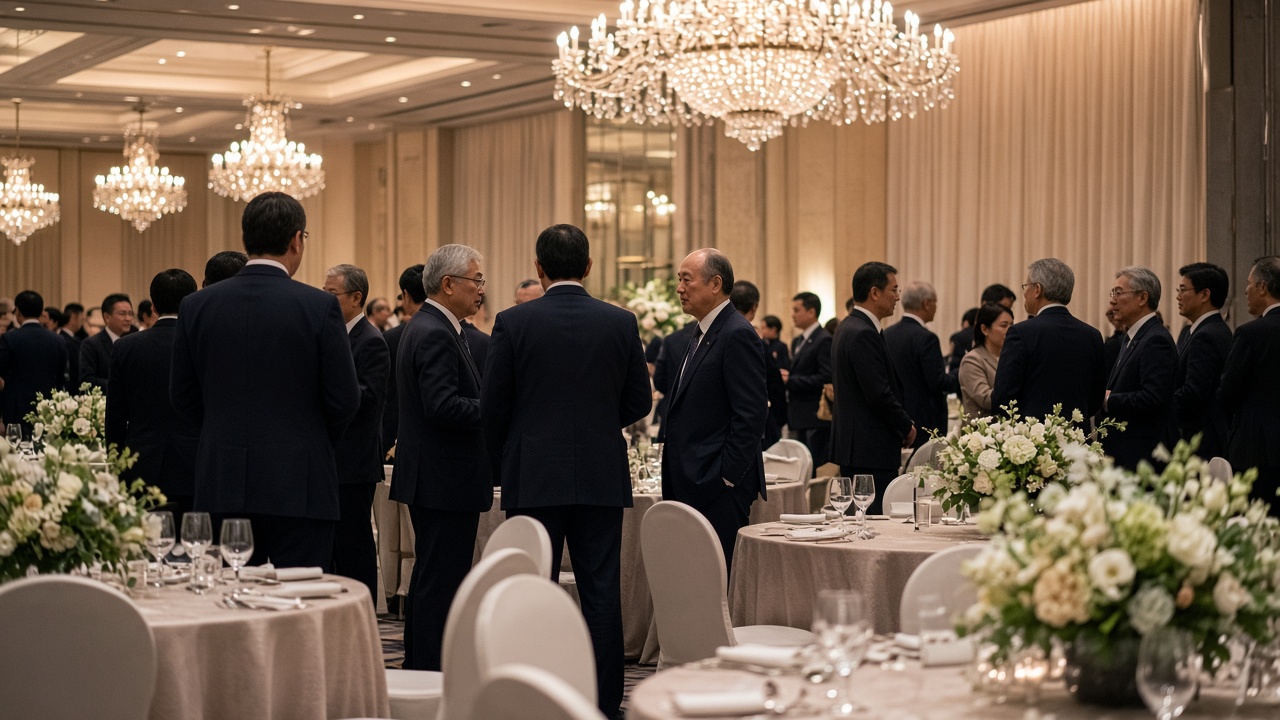
China's ambassador to Japan used a reception in central Tokyo to say the two countries face a “grave situation,” because the political foundation of the relationship has been “seriously damaged,” and to restate that Taiwan is the “core of China's core interests” — the same day Xi Jinping pressed the same question with President Donald Trump in Washington.
Wu Jianghao delivered the remarks on Thursday at the Hotel New Otani, at an event marking the 77th anniversary of the founding of the People's Republic. The Chinese Embassy in Japan posted the full text of his speech that night, at 10:51 p.m. Tokyo time.
The guest list reported by the Seoul Economic Daily ran to about 1,600 people, among them former prime minister Yukio Hatoyama, long viewed in Tokyo as friendly toward Beijing, Liberal Democratic Party Secretary-General Hiroshi Moriyama, and diplomats from a range of missions. Serving Japanese politicians in the room is the detail that gives the speech its weight: this was not a closed-door démarche but a public event with the governing party seated in it.
The two sentences that carry the demand
Read in full, Wu's speech makes two moves. First it fixes the yardstick — the four political documents between China and Japan: the Joint Statement of 1972, the Treaty of Peace and Friendship of 1978, the Joint Declaration of 1998 and the 2008 joint statement on advancing relations. In his text they are the “starting point of original intent” that both sides should uphold, and the “fundamental guarantee” for relations that hold steady over the long run.
“The Taiwan issue is the core of China's core interests, and no external interference can be tolerated,” Wu said, according to the embassy text.
Second, he put the disputed item in the conditional: “words and actions that run counter to them betray the basic good faith between nations and do not serve the fundamental interests of the peoples of both countries.” That is the part aimed at Tokyo rather than at Washington — an invitation to identify which of its own statements now falls on the wrong side of the four documents.
What Tokyo has not done
The unresolved item is a sentence. Relations cooled sharply after Prime Minister Sanae Takaichi suggested in November that Japan could intervene in a “Taiwan contingency.” Beijing said at the time that the remarks undermined the one-China principle and the political documents, and Wu has repeated the demand for a retraction at intervals since. At a February reception in Tokyo he said ties had “fallen into the most severe and difficult situation since the normalization of diplomatic ties, and the responsibility lies entirely with Japan.” No retraction has come.
The pattern repeats each time: Beijing names the four documents, identifies the offending remark, and asks Tokyo to remove it. Tokyo's answer has been a change of category rather than of text. According to CGTN's review of Japan's latest diplomatic blue book, the government downgraded ties with China from “one of the most important bilateral relations” to “an important neighbor.”
The Washington room, same day
Xi's message to Trump was the same message in another register: China wants the United States to “adhere to the correct position of opposing Taiwan independence,” wording that goes beyond Washington's stated position of not supporting independence. Trump said the two countries had “common interests” that had “even made us allies in World War II,” a line that will land awkwardly in Tokyo, which is a US treaty ally and the government Beijing is pressing hardest on the same question.
For Japan's desk at the foreign ministry, the practical questions are narrow. Whether the ministry answers the reception speech, and in what register. Whether the four-document language is repeated in the next bilateral contact between officials. And whether the seating at the next reception in this series still includes senior figures from the governing party — because the guest list is the part of this that Tokyo controls.