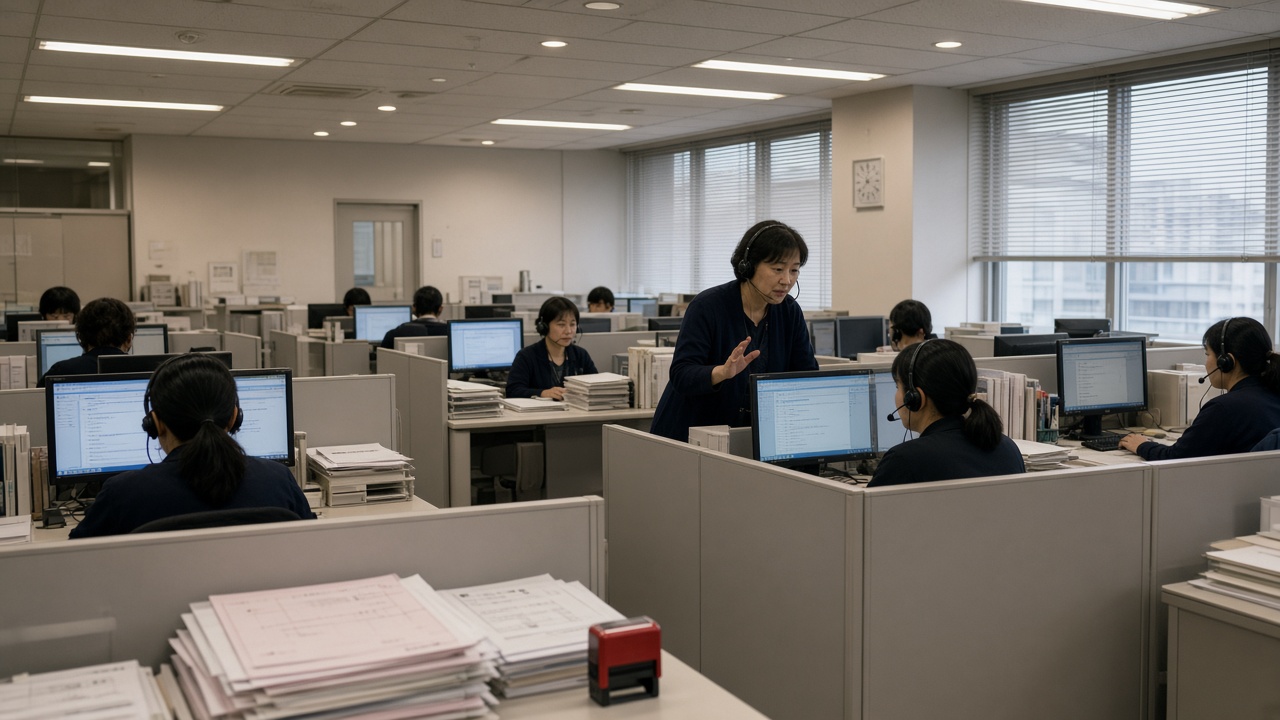
Fujitsu is offering local governments a summarization tool built on a large language model that stays inside the municipality's own network, with an audit log attached to every request. The target is the municipal help desk — the phone-and-counter operation where residents ask about residency certificates, tax payment slips, garbage collection calendars and childcare applications, and where a single call can pull in three different departments.
The framing is straightforward: the model drafts a summary of the call and a candidate answer, staff review it, and the log records what went in, what came out, and which employee accepted it. That last part is the difference between a demo and something a procurement officer can sign.
Why local government is the hard customer
Municipal help desks handle personal data by default. A caller's address, household composition, income bracket and benefit status can all surface in one conversation, which is why cloud-only inference has been a slow sell inside Japanese city halls. On-premise deployment removes one category of objection — data leaving the building — and moves the problem to operations instead. Someone has to patch the model, someone has to keep the server alive, and in a town with one IT staffer, "someone" is a real constraint.
The answer to that is packaging: hardware, model and logging as one unit, supported by the vendor rather than assembled by the customer. Whether the packaging holds up at small-municipality scale — the towns where the staffing problem is worst — is not something anyone has published numbers on. Nor does the offering, as described, settle which model sits underneath, a question a city's information policy officer will eventually ask and a vendor will eventually have to answer in writing.
The policy layer is a template, not a rule
The Ministry of Internal Affairs and Communications has put out a logging template for generative AI in municipal chatbots, now at version 1.3, as reported by Jiji. The document matters less for what it mandates — very little, at this stage — than for what it signals: the government expects logs to exist, and expects them to be readable by someone other than the vendor.
Read the template next to the product and the gap becomes visible. A template describes fields. It does not set retention periods. It does not say who inside a city hall may read the logs. It does not define what accuracy a summarization tool needs before it can sit in a resident-facing workflow. Those decisions are being made municipality by municipality, contract by contract, which is how most Japanese local IT policy actually gets written.
What the log does not capture
A per-request log records the input, the output and the operator. It does not record the draft the staff member deleted, the three minutes spent checking a form number against a PDF, or whether anyone read the summary before pasting it into the case file. Those are the places where errors survive.
That gap is not unique to Fujitsu; it is structural to how summarization gets deployed. The audit trail documents that a model was used. It does not document that a person disagreed with it.
What nobody can verify yet
Three things are missing from the public record. First, an evaluation: no accuracy figures for the kind of input a help desk actually receives — dialect, half-sentences, an elderly caller spelling a name twice, a form number read out loud over background noise. Second, an independent test: nothing here has been run through a third-party benchmark, which is normal at this stage and still worth saying out loud. Third, procurement evidence: no published list of municipalities that have bought or piloted the system.
Vendor-run trials are not useless. They are also not the same thing as an evaluation, and the difference is the entire question.
Not the SoftBank pilot
SoftBank's on-device assistant work, filed here earlier this week, keeps inference on the handset and treats the phone as the boundary. Fujitsu puts the boundary at the municipal network and treats the log as the control. The two address different problems: one is about consumer privacy, the other about institutional accountability. They get discussed as a single trend and they are not one.
NEC and other integrators occupy adjacent ground, which shapes how this gets bought. Japanese local government procurement rarely rewards the best model. It rewards the vendor that already runs the help desk's phone system, holds the maintenance contract, and can be held to a service level when something breaks at 4pm on a Friday.
What to watch
Two signals will settle the open questions faster than any product page. First, whether a named municipality publishes its own evaluation — even a small one — with error rates, sample size and a description of how staff corrected the model. Second, whether the MIC template moves from guidance to something with teeth, such as retention minimums or a requirement that logs be auditable by an outside body.
Until then, the accurate description of this product is an audit trail with a summarizer attached, sold to buyers who mostly want the audit trail. That is not a criticism. In municipal government, the paper trail is often the point.