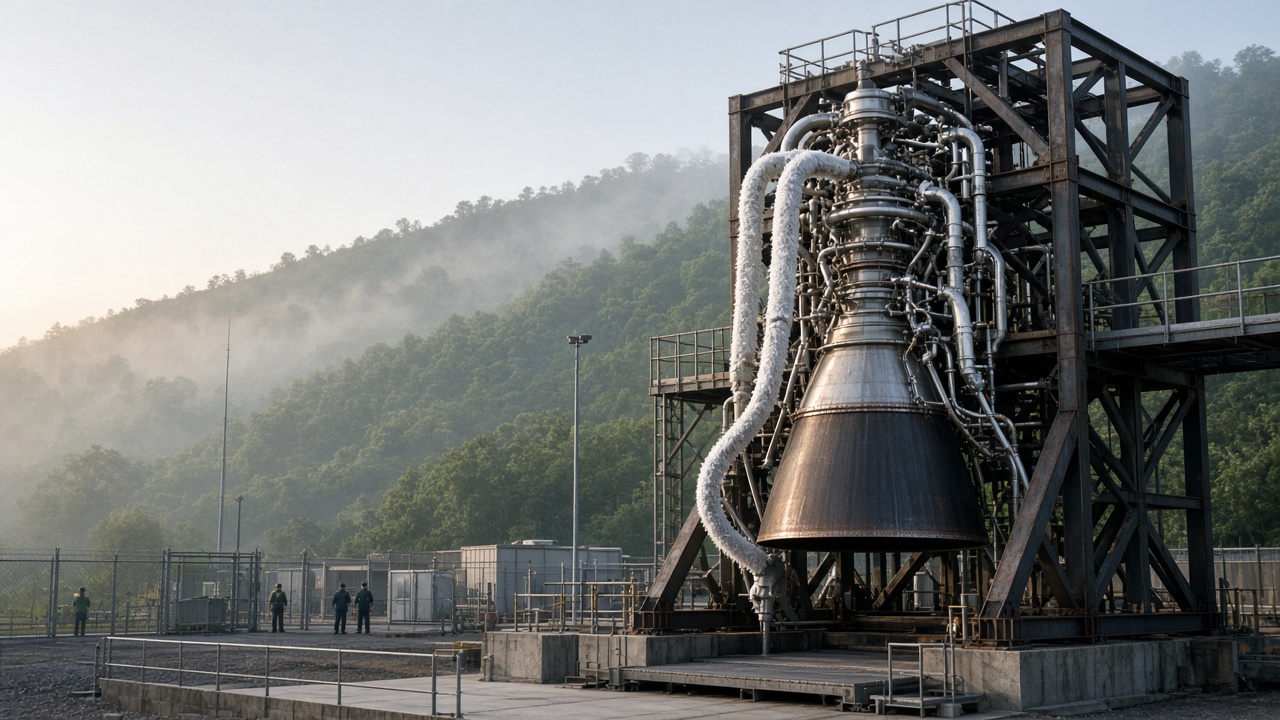
ISRO is working toward a mid-October launch window for NVS-03, the next satellite in the second-generation NavIC navigation series, after the September 9 acceptance hot test of its CE20 cryogenic engine cleared the propulsion path for the LVM3 vehicle assigned to the mission.
The order of events is the story. On an LVM3, the cryogenic upper stage is the last major element to be signed off before the vehicle is stacked, and the September 9 firing at the ISRO Propulsion Complex was an acceptance test rather than a development run. The difference is the one engineers care about: a development test asks whether the design works; an acceptance test asks whether this particular engine, built on this particular line, is cleared to fly.
Where the engine sits in the vehicle
LVM3 flies with two S200 solid strap-on boosters, an L110 liquid core stage and a C25 cryogenic upper stage powered by a single CE20 engine. The upper stage does the final work of placing a satellite into its transfer orbit, which is why its engine has to be qualified long before the launch campaign reaches the vehicle assembly building at Sriharikota.
An acceptance firing is the checkpoint between those two points. Once the engine is cleared, the C25 stage can be integrated, and only then does the vehicle move into the stacked configuration that the launch campaign schedules around.
What the test does not establish
The limits of an engine acceptance test are worth stating plainly, because they are the part of the cycle that gets read past. A hot test gives you data on one engine, on one test stand, over one burn profile. It does not tell you how the stage behaves when coupled to the L110 core under flight vibrations, how the vehicle performs through maximum dynamic pressure, or whether the satellite reaches its intended orbit.
Those questions are answered only in flight, and the September 9 release does not carry them. It confirms that the engine cleared its acceptance criteria. It is not a vehicle-level qualification and it is not a launch date. That gap — between a component that has passed its test and a mission that has passed its launch — is where most schedule slippage lives.
NVS-03 and the NavIC build-out
NavIC, India's regional navigation system, is being rebuilt in a second generation. The NVS satellites are meant to extend and modernise the constellation, adding signal structures that civilian receivers on the L1 band can use, alongside the older bands that most consumer chipsets never picked up. The spacecraft sit in the two-tonne class, well inside LVM3's roughly four-tonne capability to geosynchronous transfer orbit, which leaves margin for orbit-raising.
The series has been paced by hardware rather than demand. Each satellite carries an indigenous atomic clock, and the behaviour of those clocks in orbit is the variable the constellation's accuracy budget rests on. For a navigation satellite the payload is the clock: everything else — the orbit, the antenna, the power budget — exists to keep time and broadcast it.
Not an EOS-05 refile
It is worth keeping this apart from ISRO's September 4 earth-imaging launch of EOS-05, which served a different pipeline and a different vehicle configuration. The two are sometimes collapsed in launch-tracker coverage because they appeared within days of each other, but the CE20 test belongs to the navigation campaign. A hot test of a cryogenic upper stage engine is not evidence about an imaging mission, and treating them as one story obscures how the fourth-quarter pipeline is actually sequenced.
What an Indian lab could replicate
The engine test data itself is out of reach for a university group. The signal does not have to be. NavIC's L1 and L5 broadcasts are open, and the measurements a lab can make from a rooftop antenna — pseudorange, carrier-to-noise ratio, ionospheric delay over a fixed baseline — are the same quantities that determine whether the constellation's stated accuracy holds up on the ground.
That is the experiment worth running: a multi-week dataset from a known location, compared against the broadcast ephemeris, with the clock and ionosphere error terms separated out. It would not tell anyone what happened on the test stand at Mahendragiri on September 9. It would tell them whether the spacecraft already in orbit are delivering the accuracy the system promises — which is the question the next satellite is being launched to answer.
The October window remains a window, not a date. ISRO has not issued a formal launch date, and range scheduling, weather over Sriharikota in the retreating monsoon and residual integration work will decide the final slot. Until then, the September 9 acceptance run is the most recent hard data point in the chain.