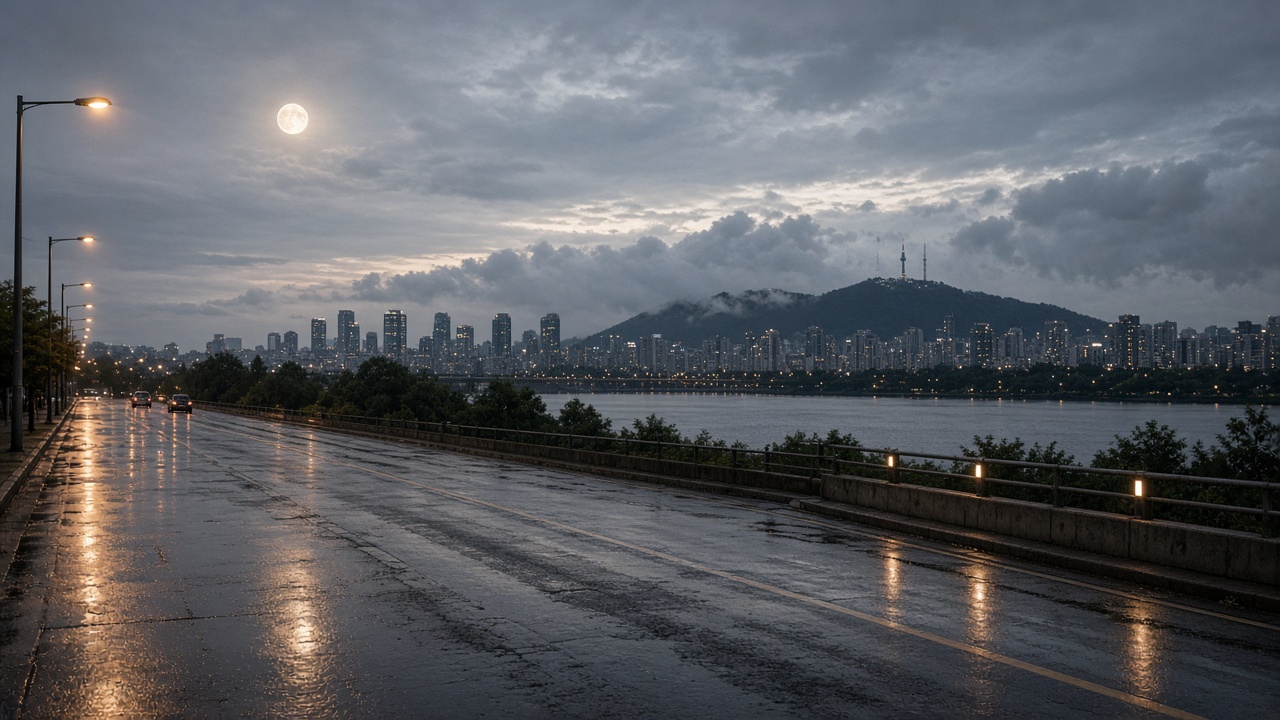
SEOUL — The rain front that crossed the Seoul metropolitan area on Sept 25, Chuseok day itself, is forecast to pull away over the holiday, and the clearing behind it should give the capital region a usable sky for the second night of the long weekend and for return travel. The Korea Meteorological Administration's post-front outlook, carried through the holiday by Korean outlets, points to improving conditions over the metro as the system exits — a call that matters less for the thermometer than for the calendar.
That is a timing forecast dressed as a weather forecast. Return traffic, evening moon-viewing plans, and a holiday sports schedule already absorbing rainouts all hinge on whether Seoul actually dries out when the guidance says it will.
The call on the table
The agency's message is narrow. A rain band tied to a front crossed the Seoul area on Sept 25, which put the holiday's first evening at risk for anyone planning to watch the Chuseok moon rise. The guidance then has the system moving off, with conditions improving in its wake. September's full moon falls on the 25th, and the moon on the 26th is still close to full, so a clearing window the day after the rain is not a consolation prize — it is the window.
Read literally, "clearing" bundles three separate bets: that the front's exit is not delayed by hours, that low-level moisture left behind does not regenerate showers over the basin, and that the evening sky ends up genuinely clear rather than merely rain-free. Travelers care about the road between roughly 6 a.m. and noon. Families planning a moon-viewing want the sky at 8 to 11 p.m. Photographers want cloud cover in tenths, not a binary.
How a clearing call gets made
KMA's operational chain runs from a global numerical model, through a finer-scale model configured for the peninsula, into a short-range ensemble that produces not one future but dozens of slightly different ones. Radar sweeps track the rain band's position and intensity minute to minute; automatic weather stations and rain gauges measure what actually reached the ground. The forecast published to the public is a distillation of all of it, and the ensemble is where the honesty lives. If most members clear Seoul by evening while a minority keep showers in the mix, then the headline is a statement about probability, not about your window.
That structure makes post-front forecasting in Korea awkward in a specific way. Rain that arrives with a front is comparatively predictable, because fronts are large and slow to surprise. Rain that forms behind one — popping up over heated terrain, along a coastal convergence line, or in the lee of the mountains — is not. The Seoul metropolitan area sits in a basin with the Han River cutting through it and mountains close enough to shape local flow. A clearing verified at the city's official station can be wrong at a river park six kilometers away.
What the holiday actually tests
The practical stakes show up in schedules and services. Two KBO games were rained out on Sept 25 — Doosan-Lotte and Samsung-SSG — and there is no Sept 26 reserve slot to make them up, according to Xports News, which pushes the lost games into a calendar already crowded by the holiday. Public services, by contrast, were built for exactly this kind of weekend: an average of 8,294 medical facilities were scheduled to stay open per day across the holiday period, with 5,231 open on Chuseok day itself, per the Korea JoongAng Daily's summary of government plans.
For drivers, the rain's main legacy is the road after it stops: wet asphalt at dawn, spray, and holiday return traffic compressed into the same few hours. A forecast that says the front is gone does not say the surface has dried.
The sample question
Here is where I want to see the paperwork. A forecast is a measurement claim about the atmosphere, and like any measurement claim it has a sample. For this clearing call, that sample is the set of model runs behind it — which cycle, how many ensemble members, and how many ground stations the agency will score the outcome against once the weekend is over. The verification threshold matters just as much: a clearing call that has to hold up under a tenth-of-sky-cover standard is a harder claim than one that passes as "no measurable rain."
The replication question for a forecast is not a bench experiment, but it is still a replication question. Re-run the same window with perturbed initial conditions and see whether the clearing survives. If the ensemble splits, that is not a failure of forecasting — it is the honest width of what the atmosphere would allow anyone to say.
So treat the holiday clearing as a probabilistic green light rather than a promise: plan the moon-viewing, plan the drive home, and pack for the wet version of the morning anyway. The uncomfortable part of a timing forecast is that it is graded in public, hour by hour, by everyone standing outside.