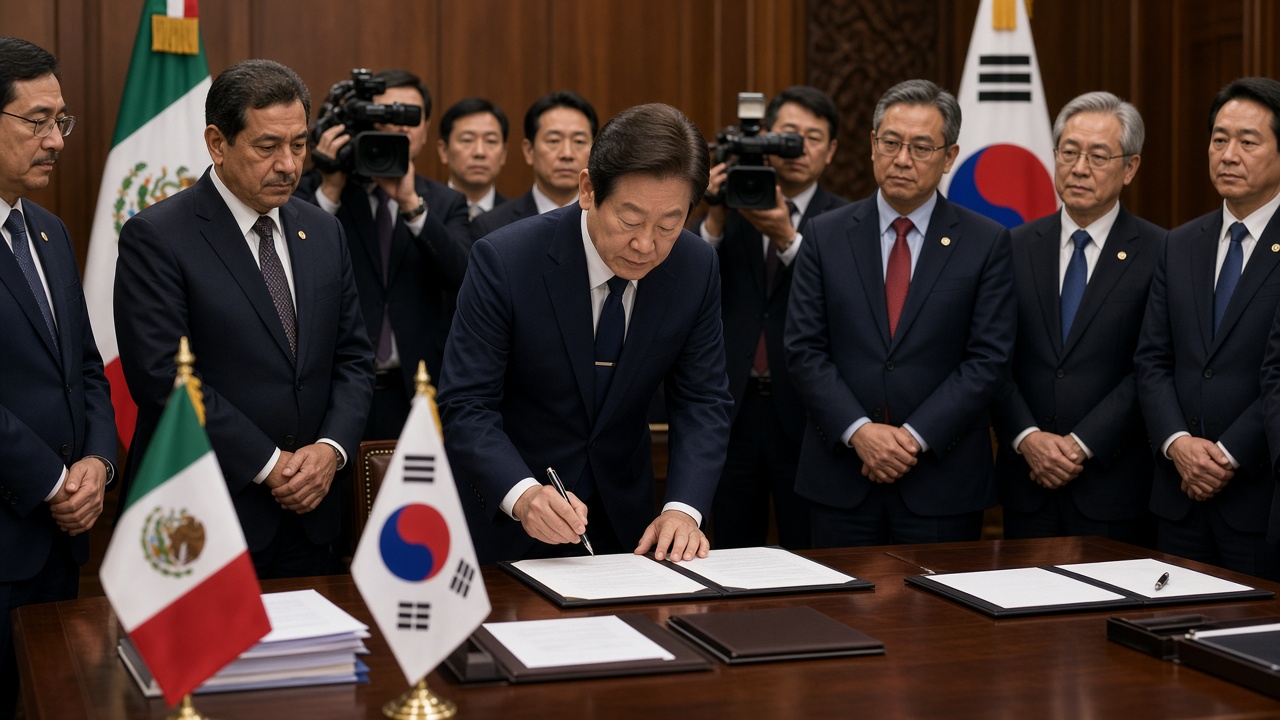
President Lee Jae-myung closed a state visit to Mexico on Saturday with 17 memorandums of understanding and a 2026–2030 Korea-Mexico Joint Action Plan, as Seoul pressed to accelerate a bilateral trade agreement that officials hope will anchor investment between the two manufacturing economies.
The MOUs cover artificial intelligence, aerospace, defense, intellectual property and tourism, among other areas, according to readouts from Yonhap and Korea JoongAng Daily. Lee returns home Sunday, Sept. 27. The joint action plan turns the visit’s headline count into a five-year work program, giving ministries and companies a calendar rather than a single signing photo.
What the 17 MOUs actually commit
Memorandums are not treaties. They are institutional signals: they tell agencies, trade associations and corporate strategy offices which doors are expected to open. The joint action plan is the more consequential document because it sets 2026–2030 as the horizon for cooperation in AI, aerospace, defense, IP and tourism. That matters for Korean companies that already use Mexico as a manufacturing and export platform and for those weighing whether to add capacity there.
The CEPA push is the investment anchor. A comprehensive economic partnership agreement would not be a simple tariff cut. For Korean firms, it would be a framework for rules of origin, services, investment protection and dispute procedures — the plumbing that determines whether a factory in Mexico can serve North American demand with Korean inputs. Seoul’s decision to keep CEPA on the front foot after the state visit suggests the government sees trade architecture, not just procurement, as the prize.
The chaebol table
The delegation mattered. LG Chairman Koo Kwang-mo was among about 30 business delegates, putting a listed conglomerate at the table even though the public deliverables were government-to-government. For Korea’s large business groups, Mexico is not a new market. It is a production base tied into North American supply chains, particularly for electronics, appliances, automotive components and batteries. A presidential visit gives affiliates a reason to compare notes on incentives, labor rules and logistics.
The voice-card question for listed firms is blunt: what did the group decide, and who inside the affiliate wins? The visit readouts do not name a specific LG investment or board approval. No DART filing was tied to the Mexico trip in the material reviewed. That leaves the operational test with the companies. An MOU can be signed by a ministry or a trade body; a factory, joint venture or supply contract usually requires an affiliate board, a budget line and eventually a disclosure if the amount is material. Investors should watch for those filings, not the signing ceremony.
LG’s presence still carries weight. When a chairman travels with a presidential delegation, affiliates get access to counterpart agencies and potential partners at a level that is hard to replicate through routine business development. The question is whether that access becomes a capital commitment. For now, the safe reading is that Korea’s conglomerates are keeping Mexico in the strategic pipeline while waiting for CEPA to clarify the rules.
CEPA as the investment anchor
Korea and Mexico already have an economic relationship, but it has been uneven. Mexico is a member of the USMCA, giving manufacturers preferential access to the United States and Canada. Korean companies that assemble in Mexico can qualify for those benefits if they meet content and labor rules. A Korea-Mexico CEPA would not replace USMCA, but it could reduce friction on Korean inputs and create a more predictable channel for bilateral investment.
That is why the joint action plan is broader than trade. AI cooperation can feed industrial automation. Aerospace and defense MOUs can support maintenance, parts and training. IP provisions matter for technology licensing. Tourism is lower-stakes but useful for people-to-people links. The package is designed to show that the relationship is not only about cars and appliances.
Seoul’s push also has a defensive logic. Global supply chains are being reorganized around friend-shoring, industrial policy and tariff risk. For a trade-dependent economy like Korea, locking in a Latin American manufacturing hub with preferential access to North America is a hedge. Mexico, for its part, wants capital and technology that can upgrade its industrial base. The two sides have complementary interests — if the legal framework can catch up.
What happens after the state visit
The hard work begins after Lee lands in Seoul. The 2026–2030 plan needs working groups, budgets and timelines. The CEPA track needs negotiating mandates and political follow-through in both capitals. Korean ministries will have to convert MOUs into implementing arrangements. Companies will decide whether to send teams, hire local staff or expand plants.
For the Korean business desk, the near-term watch list is straightforward. First, whether CEPA talks produce a formal round or a joint feasibility document. Second, whether any Korean listed affiliate discloses a Mexico-related investment, joint venture or supply agreement. Third, whether the AI, aerospace and defense MOUs produce named projects or remain memorandums of understanding. The 17 agreements give the visit a numerical headline. The joint action plan gives it a schedule. CEPA is the piece that would give it teeth.
Lee returns home Sunday, Sept. 27, with the state visit closed and the follow-up file open. The count is 17 MOUs. The test is what gets filed next.