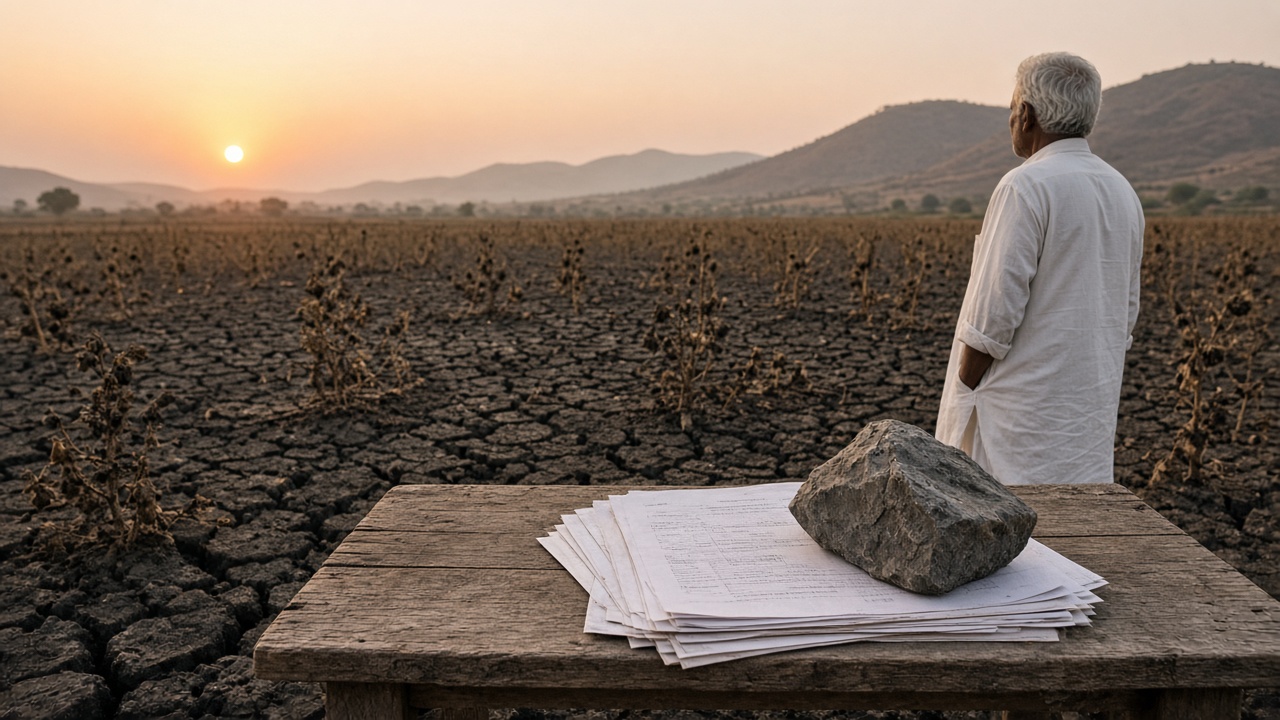
Maharashtra’s drought government resolution of September 26 recognises what farmers in Vidarbha, Marathwada and parts of Pune division already know: this kharif season has failed in large stretches. The GR covers 265 of 358 talukas. But a drought declaration is only a trigger. The test is whether it produces money in bank accounts before the next sowing season. That is why the GR must do more than name affected talukas. It must bind crop insurers to a published claims calendar, with fixed dates for intimation, loss assessment, yield-data reconciliation and final payout.
The facts are stark enough
The Hindu reports that the state declared drought in 265 of 358 talukas, across Vidarbha, Marathwada and Pune divisions. The same weather system that produced late-September rain over parts of the peninsula did not undo the season’s damage. In Andhra Pradesh, the monsoon deficit narrowed from 43% to 22% after a September 23–24 depression, according to IMD numbers reported on September 26. A narrower deficit is better than a wider one, but it is not a harvest. For Maharashtra’s notified talukas, the relevant fact is not the late rain; it is the crop that was already lost.
A deadline is a form of relief
Crop insurance claims are not settled by a single cheque-writing decision. They depend on crop-cutting experiments, yield estimates, revenue records, bank account seeding and verification. Every step can slip. A published calendar turns those steps into obligations. It should say when insurers must open intimation and publish documents in Marathi and English; when the agriculture department must complete crop-cutting experiments and upload yield data; when insurers must calculate and communicate individual payouts; and when money must reach bank accounts. District-wise progress should be public every week.
This is not micromanagement. It is the minimum transparency for a public programme that uses public money and private insurers. Farmers cannot plan the next season if they do not know whether a claim will be paid in November, January or after the next monsoon. Input dealers, cooperatives and rural lenders cannot plan either. A calendar would also reduce the space for middlemen who promise to speed up files for a fee, because every claimant could see the same sequence and the same delay.
Insurers have a fair objection — and it cuts both ways
Insurers will argue that they cannot pay until government yield data arrives. That is partly true. Crop loss assessment is not a private inspection that an insurer can complete alone. But the objection is not a reason to leave the system without dates. If the state’s own data pipeline is the bottleneck, then the state must bind itself to the same calendar. A GR that orders only insurers to be prompt, while leaving revenue and agriculture offices without deadlines, would be another circular that promises speed and delivers queues.
The objection also misunderstands what a calendar does. It does not ask insurers to pay before assessment. It asks them to publish when assessment will end. That distinction protects honest insurers from suspicion and gives farmers a basis to escalate. If an insurer misses a date, the reason should appear on a public dashboard: yield data pending, bank seeding failed, dispute over crop loss, or some other cause. Silence is not an explanation, and “processing” is not a date.
What the GR should require
The state should amend the drought GR within a week to add a taluka-wise claims calendar. The relief and rehabilitation department, agriculture department, district collectors and insurance companies should be named as responsible parties. The Maharashtra government should publish one dashboard, updated every Friday, showing claim status for each notified taluka. The Insurance Regulatory and Development Authority of India should require insurers to follow the same public schedule for these talukas, so that the regulator’s timelines and the state’s relief order do not move on separate tracks. Where a delay is caused by a state agency, the dashboard should say so and the responsible office should face a named consequence.
The 265-taluka drought GR is a necessary admission. It is not yet an enforceable promise. A published claims calendar would make the promise legible to every farmer with a claim, and it would make delay visible to every officer and insurer who causes it. That is what the next GR should deliver.