Taiwan's copper-foil and copper-clad laminate makers opened the week reading documents, not headlines. After the Trump–Xi summit, the paper trail matters more than the photo op — and the paper trail does not mention Taiwan.
The White House fact sheet released after the meeting lists rare earths and critical minerals supply-chain cooperation among the outcomes. Taiwan is not named in it. Beijing's readout of the same meeting stresses reunification and closer China–U.S. cooperation on emerging technologies. Two texts, two framings, and an island industry sitting in the middle of the chain both are describing.
What the fact sheet does — and doesn't — say
The minerals bullet is a supply-chain bullet. It treats rare earths and critical minerals as a cooperation goal between Washington and Beijing, not as a market-access commitment or a tariff schedule. That distinction is the whole ballgame for midstream processors. A cooperation goal can become a technical working group, a set of origin declarations, an export-licensing regime, or nothing at all. A tariff line would have been immediate; this is not that.
Taiwan's absence from the fact sheet fits the pattern the island's foreign ministry has been tracking since the summit. The Ministry of Foreign Affairs and the Mainland Affairs Council have not yet issued a formal read on the text. The Chinese readout does not mention Taiwan's processors either — it mentions reunification, which is a political frame, not a supply-chain one.
Where Taiwan actually sits
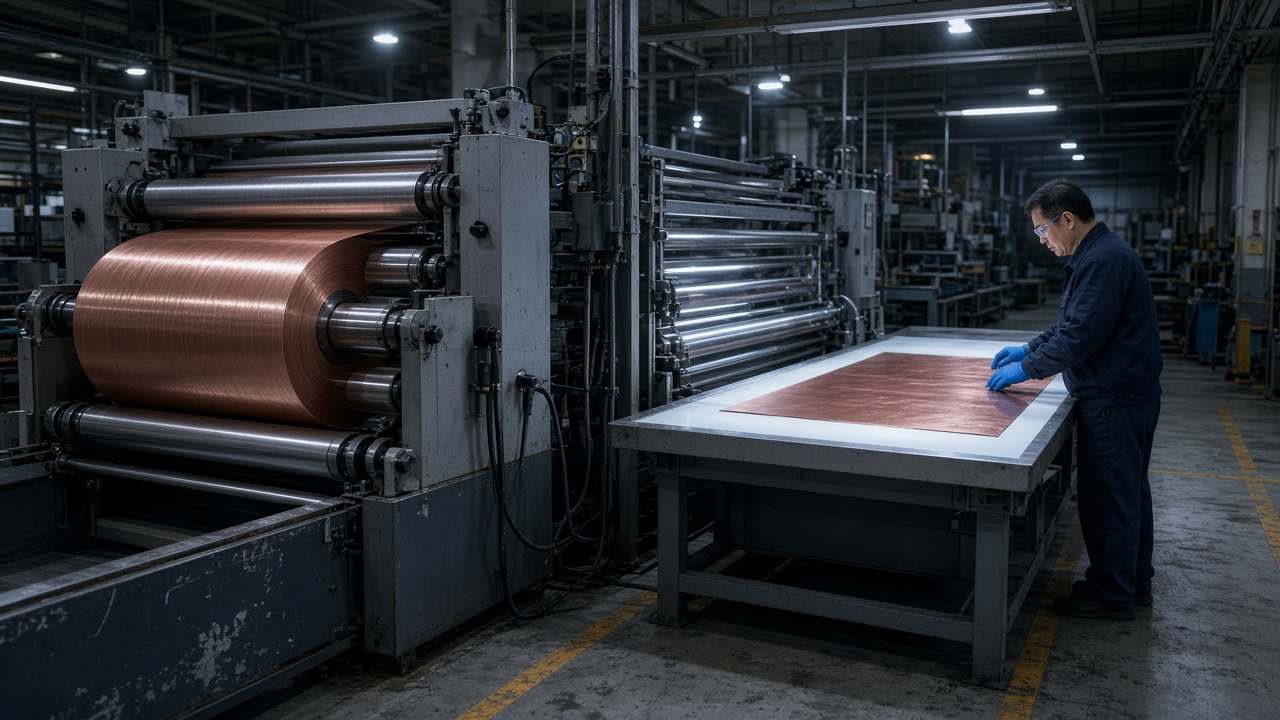
Taiwan does not mine copper or rare earths at scale. What it does is process. Copper foil — the thin, surface-treated sheet that becomes the conductive layer in copper-clad laminate, and from there the substrate in printed circuit boards, servers, and battery current collectors — is one of the island's quieter export strengths. The value is not in the ore. It is in thickness tolerance, adhesion treatment, and yield at volume.
That is why "critical minerals" language lands differently in Taipei than in Canberra or Jakarta. Australia and Indonesia worry about what leaves the ground. Taiwanese foil and laminate makers worry about what gets stamped on the shipping documents when a U.S. customer asks where the input came from and how it was processed.
The capex signal underneath
While the summit language was being parsed, the industry's own numbers kept moving. Economic Daily reported over the weekend that brokers remain constructive on the mid-to-long term on AI capital expenditure, with a 2027 earnings-growth view above 20%. In copper-clad laminate specifically, the same reporting flagged Doosan's ₩9.7 trillion expansion, ITEQ's plan to debottleneck toward 8.25 million sheets by 2028, and Ventec's NT$1.5 billion capex program.
Markets are closed for the holiday weekend, so none of this has been priced yet. Monday's reopen is the first test of whether investors read the minerals bullet as a Taiwan tailwind or a documentation headache.
The labeling pressure point
Here is the practical risk. If supply-chain cooperation on critical minerals gets implemented as traceability — origin declarations, processing-step disclosure, customer audits — Taiwanese foil and laminate exporters absorb the compliance cost, not the miners. Those requirements would sit on top of existing U.S. export-control expectations for advanced substrates and the customer-level paperwork that already travels with high-end laminate shipments.
Deputy Foreign Minister Francois Wu said on Sept. 26 that arms sales and semiconductors remain U.S. interests after the summit. That formulation is a reminder of where Taiwan's use actually lives. It is not in the ore body. It is in the process recipe and the yield curve, which is precisely the part that does not show up in a fact sheet.
What to watch
Three things over the next several weeks.
First, whether Taiwan appears in any implementing annex or technical working group that follows the summit's minerals language. Silence in the fact sheet does not necessarily mean silence in the follow-through.
Second, whether Taiwan's economic and foreign ministries issue exporter guidance. So far the official statement trail is thin, and thin guidance usually means the industry defaults to its customers' compliance departments.
Third, whether the capacity plans hold. ITEQ's debottleneck and Ventec's capex are bets on demand that predates this summit. A minerals regime that raises documentation costs on Asian processors without raising end prices is exactly the kind of policy that gets absorbed in the margin, quietly, over four quarters.
On the plant floor, the rollers keep turning and the foil keeps coming off at microns of tolerance. What changes with a summit like this is not the machine. It is the certificate that ships with the pallet — and right now, nobody in Taipei knows what it will say.