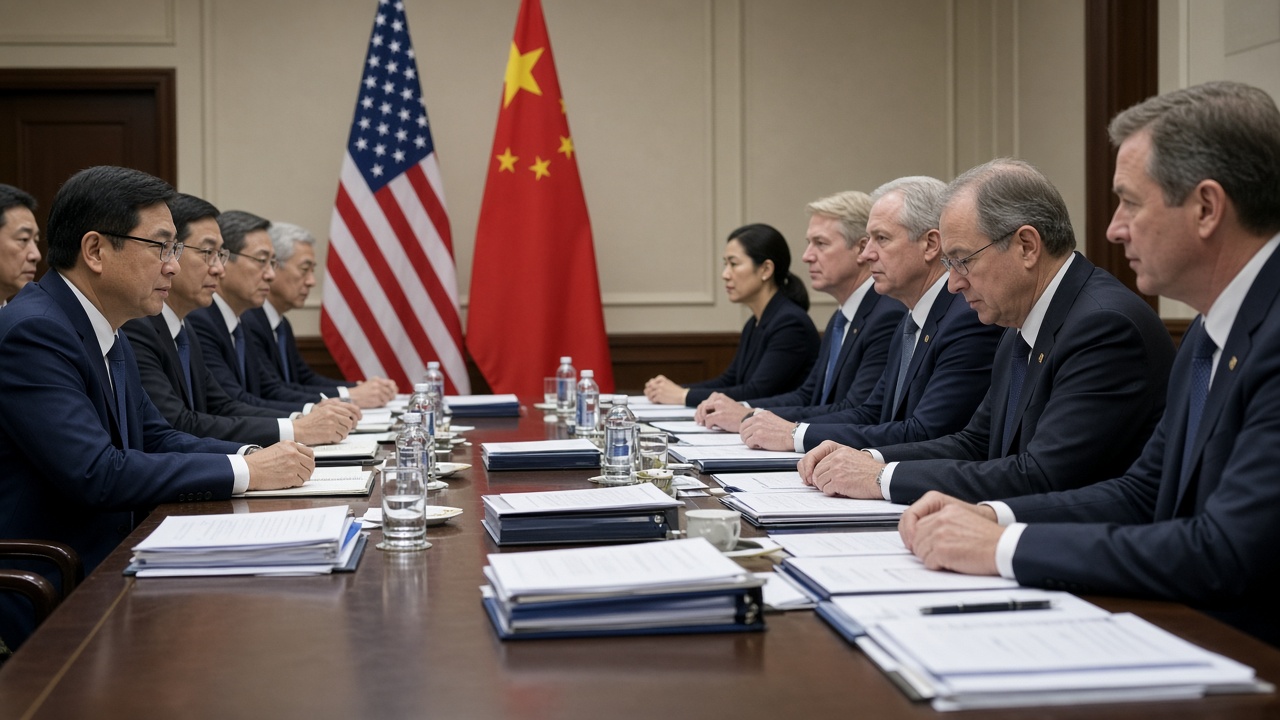
The United States and China agreed on reciprocal tariff cuts covering $30 billion of goods in each direction and a formal dialogue on artificial intelligence, capping a three-day Washington summit that had been billed as diplomacy first and detail later.
The White House said Friday that negotiators reached consensus on more favorable treatment for non-sensitive categories on both sides, routed through the U.S.-China Board of Trade that leaders operationalized during President Xi Jinping’s visit. U.S. exports slated for relief include agricultural products, seafood, logs and wood products, cosmetics and medical devices, while U.S. imports of Chinese-made small appliances, toys, holiday decorations and children’s car seats would also see preferential rates. China’s Foreign Ministry published an eight-point readout the same day, citing a new trade council, crisis-communication steps between the militaries and extensions of earlier Geneva-era understandings.
What the Board of Trade actually does
The board is not a symbolic commission. U.S. Trade Representative Jamieson Greer told reporters after September talks in New York that the channel is live and that teams would keep working product lists. Treasury Secretary Scott Bessent, who joined Greer and Chinese Vice Premier He Lifeng at those sessions, had already announced a two-month extension of the broader tariff truce that had been set to lapse on November 10, pushing the deadline into January 2027 while negotiators chase a larger framework.
Trade lawyers following the filings describe the structure as a matched “30 for 30” adapter: Washington modifies certain non-MFN duties on a fixed basket of Chinese goods while Beijing mirrors relief on a comparable U.S. list. Neither capital released line-item rates this weekend. The Office of the U.S. Trade Representative told industry groups to expect further product lists Monday, a timeline retailers and farm exporters will watch because holiday inventory and soybean shipments still face the higher baseline rates outside the board’s first tranche.
AI channel and the language shift
On technology, the two governments agreed to hold a dedicated dialogue on AI risks and benefits, with the next session scheduled for November, and to stand up a communication channel for AI-related incidents. The White House said leaders also agreed to use the term “super intelligence” in place of “artificial intelligence” in joint statements; Beijing’s ministry said it welcomed Washington’s wording. That phrasing change is cosmetic for engineers but matters for export-control lawyers who track how each capital describes frontier models in bilateral texts.
The AI piece lands beside, not instead of, chip and data fights. Bessent’s team still frames critical-minerals and technology access as separate tracks. Friday’s package nonetheless gives multinationals a narrow corridor to plan holiday consumer imports and gives both militaries a crisis hotline memorandum that did not exist before Xi’s arrival.
What happens next
Importers should treat the announcement as conditional relief until USTR publishes categories and effective dates. Agriculture groups noted that fish, timber and cosmetics made the U.S. export list, while toy associations flagged car seats and decorations on the import side. Beijing’s readout emphasized energy and agricultural purchases as part of the broader summit language, but the measurable tariff numbers this weekend are the $30 billion matched cuts and the truce extension Bessent outlined midweek.
Negotiators left open the possibility of additional board tranches if the January truce holds. For now, the summit produced written mechanisms—tariff baskets, a trade council, AI talks and military crisis communications—rather than a single headline tariff rate. Businesses get breathing room; neither government called the rivalry finished.