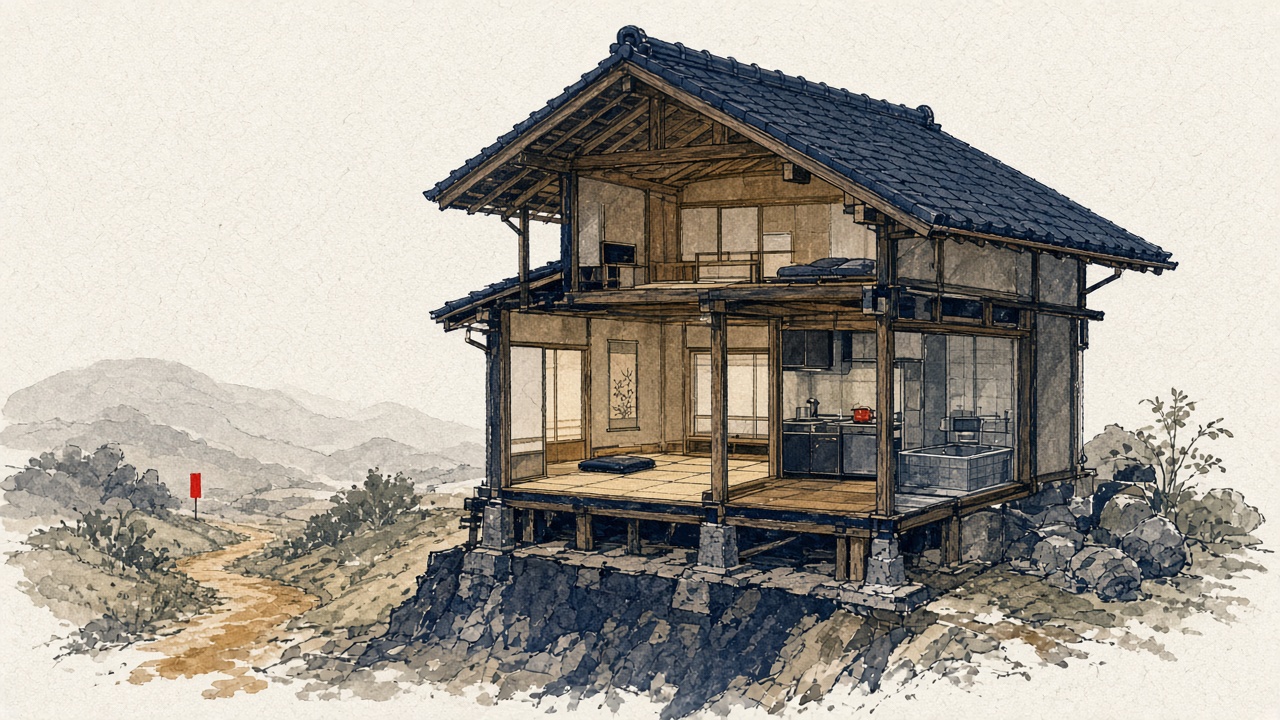
In April 2018, Kamiyama town in Tokushima Prefecture opened advance registration for vacant homes through its migration support center, working with the NPO Green Valley on a program locals call the O-ie Nagasaki Project. The point was to match empty wooden houses with people willing to move in and fix them. The houses on the registry still had roofs, floors, and wiring that worked. Yet when a buyer asks a bank for a mortgage on that kind of stock, the paperwork often splits the world in two: the land may still carry millions of yen in value, while the building line reads zero. The question is not whether the town can find takers. It is why the finance system treats the structure as worthless while people still live inside it.
The listing that still has a roof
Kamiyama is one of many municipalities trying to turn akiya into assets again. The same month the registry opened, Japan began enforcing amended rules on used-home sales under the Building Lots and Buildings Transaction Business Act, pushing sellers to document condition instead of treating older stock as a black box. On paper, that should make reused homes easier to trust.
Walk through the registry entry for a typical wooden house in the hills and the mismatch shows up at the loan desk, not in the living room. A detached house might sit on land the appraiser still values at tens of millions of yen. The building column is another story. Lenders answering Japan Housing Finance Agency surveys say they mostly use cost-based methods on the structure. When age crosses an internal threshold, many institutions stop counting the building as collateral at all, even if the owner has just replaced the roof.
The Kamiyama program sits in a national push that treats vacant stock as infrastructure worth cataloguing rather than bulldozing on sight. MLIT’s council materials describe advance registration with Green Valley as a way to line up buyers before rot and theft set in. That administrative work assumes the shell still has economic life. The finance channel often assumes the opposite once the building age field passes the same band where tax depreciation schedules finish for typical wooden frames.

That split feels insulting if you assume price equals quality. It starts to make sense only when you follow where the zero comes from. Three obvious suspects fail before the real one appears.
Suspect one: people only want new
The first explanation is cultural: Japanese buyers want new, so used houses must be junk. There is truth in the preference. The Ministry of Land, Infrastructure, Transport and Tourism noted in its 2008 white paper that almost all housing-market transactions concerned newly built homes, which keeps resale thin.
Thin resale is not the same as zero collateral, though. If demand alone set collateral, you would expect a discount, not a hard line at zero yen for the building. The circulation numbers also refuse to stay frozen. Existing homes remain a small slice of total turnover, but the share has wobbled in a narrow band for decades rather than collapsing to nothing.
When existing stock is only about 14.5 percent of circulation in the 2018 Housing and Land Survey framing, banks still see enough activity to write manuals. New-build bias shapes marketing, not the entire collateral rulebook. Even when existing share touched roughly 17.7 percent in 2005, it never approached the levels common in markets where resale dominates new construction. Japan’s pipeline of brand-new detached houses therefore keeps setting the reference price buyers remember, while the collateral manuals quietly age the building line on a separate calendar.
Suspect two: the house is falling apart
The second explanation is physical: wooden houses simply do not last. Post-1981 earthquake standards and better insulation did raise the bar for new construction. MLIT quality materials stress that gap.
National statistics cut against the idea that structures die young on average, however. Using the Housing and Land Survey, MLIT calculates that demolished homes had stood for 38.2 years on average by 2018, up from 26.3 years in 2003. Projections for newly built housing now reach 53.7 years of average lifespan in the same research series, and long-run models put 1980s wooden cohorts near 58.2 years.
Demolition age and expected lifespan are both rising. Kamiyama’s registrants are not bidding on ruins; they are bidding on houses the statistics say should have decades left. Something other than rot schedules the zero on the form. The earlier white-paper figure of about 30 years at demolition was already a policy embarrassment when written; the newer 38.2-year average shows owners and municipalities are stretching use even as loan forms shorten the building’s financial life.
Suspect three: banks are arbitrary
The third explanation blames bankers: they will not bother inspecting old stock, so they type zero and move on. The Japan Housing Finance Agency’s 2024 survey of 301 lenders, with a full response rate, is less flattering and less random than that.
Institutions overwhelmingly use cost-based appraisal on detached building collateral. The most common rule is blunt: once a house passes a set age, the building collateral value becomes zero yen. About 40 percent of lenders still adjust for maintenance, renovation, and individual condition, which shows the rule is policy, not physics. Average collateral haircuts on used homes cluster between just above 60 and 70 percent at many firms, another sign of standardized tables rather than case-by-case whimsy.

建物は経過年数が一定期間以上のものはすべて担保価値0円と評価している
Arbitrary is the wrong word. The banks are following a clock. The clock was printed by the tax agency decades earlier. Cost appraisal is not a mystery novel; it is arithmetic tied to acquisition cost minus accumulated depreciation. Once tax logic has written the structure down to zero on a 22-year wooden schedule, a bank that copies the table does not need to inspect the gutters to mark the building line at zero yen.
The tax table on the wall
Japan’s income-tax depreciation rules treat buildings as assets whose cost must be spread over a statutory useful life, not expensed the day you buy them. Land never enters that ledger; it is explicitly not depreciable. The National Tax Agency publishes the lives in its main depreciation table: a typical wooden shop or residence gets 22 years, while a reinforced-concrete home gets 47.
Since April 2016, newly acquired buildings must use straight-line depreciation, which walks the book value down evenly until it hits zero on that schedule. The table measures economic service life for tax, not the day the roof leaks. Yet cost-based bank models read the same numbers as if they were expiry dates on the wall.
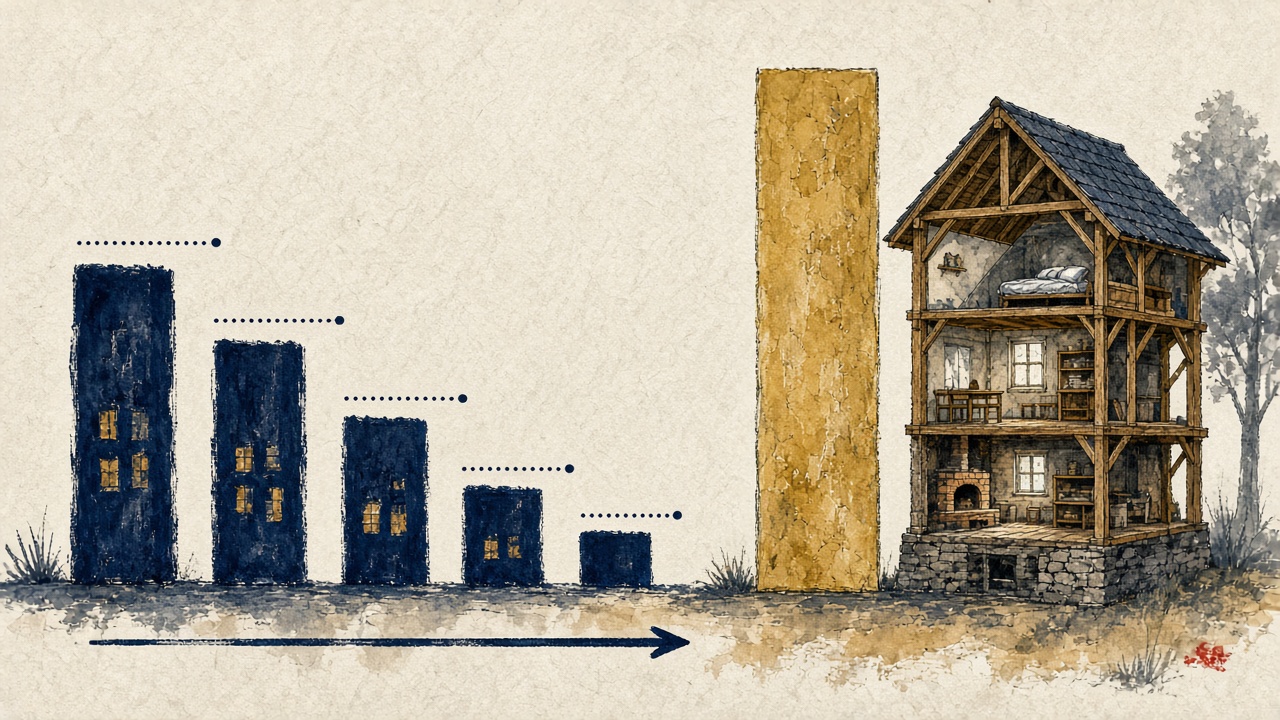
Connect the threads. Tax law writes the building down on a 22-year line for wood. Lenders using cost methods hit a zero building collateral line near the same age band. Buyers who want Kamiyama’s reused stock must finance land and renovation while the structure line stays blank, even when demolition statistics say the house could stand another generation. Reinforced-concrete condominiums carry a 47-year line in the same NTA table, which is why apartment collateral sometimes survives longer on paper even when owners complain about maintenance fees.
The Income Tax Act Enforcement Order table on e-Gov lists those lives structure by structure; the National Tax Agency’s plain-language guide points readers there whenever a building type is not on the short PDF table. None of those documents ask whether the kitchen was remodeled last year. They ask what material the frame is made of and how many years remain on the schedule.
What Kamiyama proves
Kamiyama’s registry is a reuse success story waiting on finance to catch up. The town, Green Valley, and the 2018 disclosure rules all treat the house as a durable object. The lending survey snapshot dated 30 June 2024 shows most institutions still treat aged detached buildings as zero collateral regardless of registry status.
Policy papers once framed the problem as demolition after only about 30 years. MLIT’s later survey work shows demolition age climbing toward 38.2 years, which should widen the window for reuse. Until collateral manuals decouple from tax useful life, that window stays narrow on the balance sheet even when it is wide in the real town. The February 2025 release of JHF’s lending survey makes the lender side visible at scale: 301 institutions, full response, and a blunt plurality zeroing buildings by age.
Counterarguments from housing-quality advocates still land. Buyers rightly worry about pre-1981 earthquake standards and about insulation that fails modern energy rules. MLIT’s lifespan projections incorporate those improvements for newer cohorts. They do not justify treating a maintained wooden house on the far side of the 22-year tax line as financially empty when the same agency’s demolition data show structures lasting far longer in practice.
In Japan, the average age of homes demolished is only 30 years old, shorter than that of homes in the United States.
Picture a registered Kamiyama house at night with lights on behind the curtains and the loan document on the table. The land line still shows a serious number. The building line still shows zero. The house is clearly occupied. The form insists the structure does not count. That is the puzzle Kamiyama exposes: the building is usable, the land is valuable, and the zero is an artifact of a tax clock banks treat as law today.
None of this means reuse is impossible. Cash buyers, regional banks with local knowledge, and loans that lean on land alone still move akiya projects forward. The zero building line matters because it is the default setting at large lenders, the ones JHF polls every summer. Kamiyama’s registrants are not abstract statistics; they are households betting that a maintained wooden house is an asset. The tax table and the collateral manual are betting it is a timed write-off. Closing that gap would mean letting inspection results and renovation receipts push against the depreciation schedule, not pretending wooden houses never age.