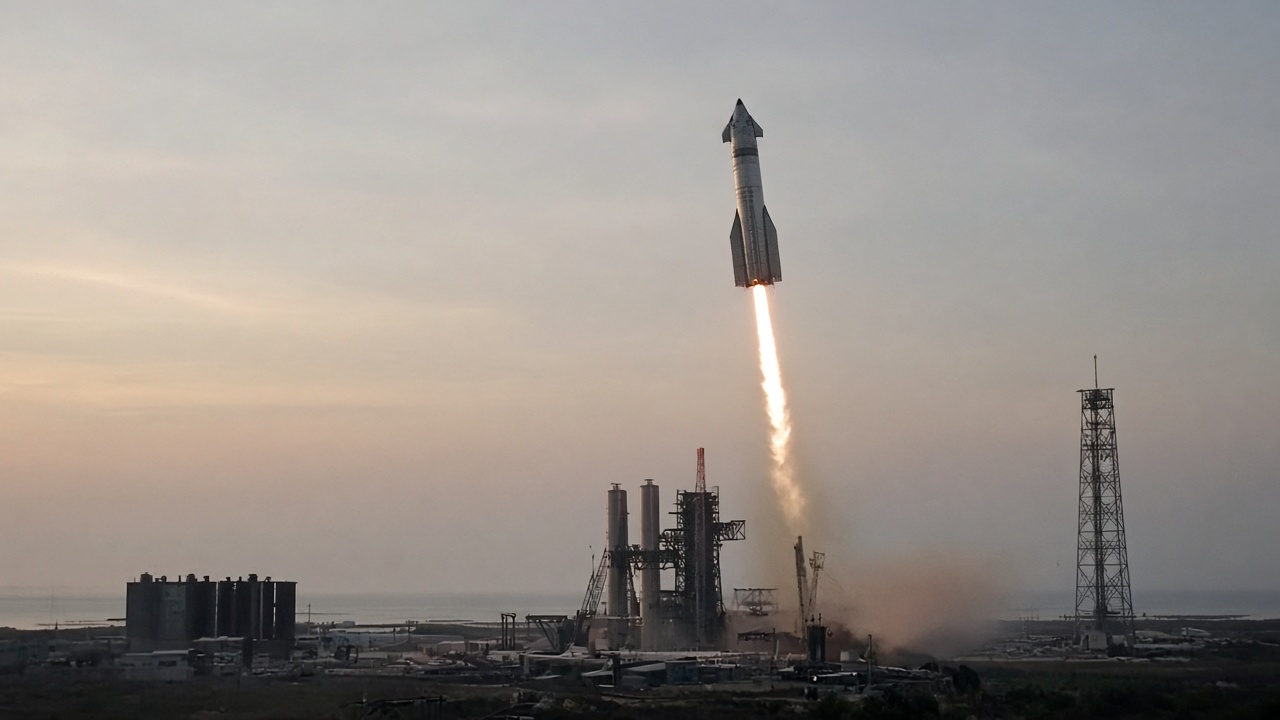
SpaceX’s Starship upper stage entered Earth orbit on Monday on the vehicle’s 14th integrated test flight, the first time the company has sent the full stack on a trajectory meant to circle the planet rather than fall back on a suborbital arc. Engineers at Starbase in Texas cheered when a live narrator declared, “Starship is in orbit,” after controllers decided the rocket could safely complete the burn despite losing an engine during ascent.
The launch left the pad at 7:48 a.m. local time in South Texas, lifting the roughly 120-meter-tall vehicle that pairs the Starship spacecraft with the Super Heavy booster. SpaceX had previously flown Starship in its complete configuration since 2023, but those missions stayed on suborbital paths that limited where debris would fall if the vehicle broke apart mid-flight. An orbital attempt raises the stakes because a malfunction can scatter hardware along a much wider ground track.
Controllers override abort talk after engine loss
Early telemetry suggested the orbit attempt might be scrubbed when one of the booster’s engines shut down on the way up. Instead, mission managers cleared Starship to fire its onboard engines for a burn that placed the stage on a planned orbital path. The company had aimed for the vehicle to climb to about 171 miles before looping the planet, though SpaceX later said it would bring the ship down sooner than the originally advertised multi-hour circuit, targeting a Pacific splashdown roughly three hours after liftoff.
For NASA and commercial customers watching the program, the decision chain mattered as much as the headline. Starship is the lander NASA selected for later Artemis moon missions, and a fully reusable super-heavy class rocket is central to SpaceX’s promise to cut launch costs. A flight that proves the upper stage can survive ascent, deploy payloads, and survive re-entry—even on a shortened timeline—feeds directly into certification conversations that had stalled after earlier test losses.
Booster recovery and satellite deploys still on the checklist
As on recent tests, SpaceX planned for Super Heavy to separate, flip, and head toward a controlled splashdown in the Gulf of Mexico rather than attempt the dramatic “chopstick” tower catch used on a 2024 flight. Engineers had reworked hardware and software after the previous mission, when icing clogged several booster engines and a landing burn fired with fewer than half of the intended thrusters, producing a hard water impact.
Once in space, Starship was scheduled to release next-generation Starlink satellites designed to unfurl antennas and raise their orbits with onboard propulsion. Three of the spacecraft carried cameras to photograph the heat shield during re-entry, data SpaceX wants before it commits Starship to crewed lunar profiles. Elon Musk’s long-stated goal remains a fully reusable transportation stack; Monday’s orbit insertion does not finish that work, but it crosses the line from experimental hops to operating as an orbital-class stage.
What analysts are watching next
University of Leicester astrophysicist Martin Barstow told reporters the result marks a shift “from the testing and development phase to becoming a working vehicle able to deliver the large payloads needed to return to the moon.” Investors have tracked the program closely since SpaceX’s June stock offering; successful milestones have tended to move sentiment even when the company warns that test schedules remain volatile.
SpaceX has not published a firm public manifest for the next Starship flight. Regulators and range safety officers will review debris models from this orbital profile before approving another full circuit. For now, the measurable change is simple: Starship is no longer confined to skimming the edge of space—it completed the velocity and altitude profile required to stay in orbit, if only long enough to begin proving the rest of the mission card.