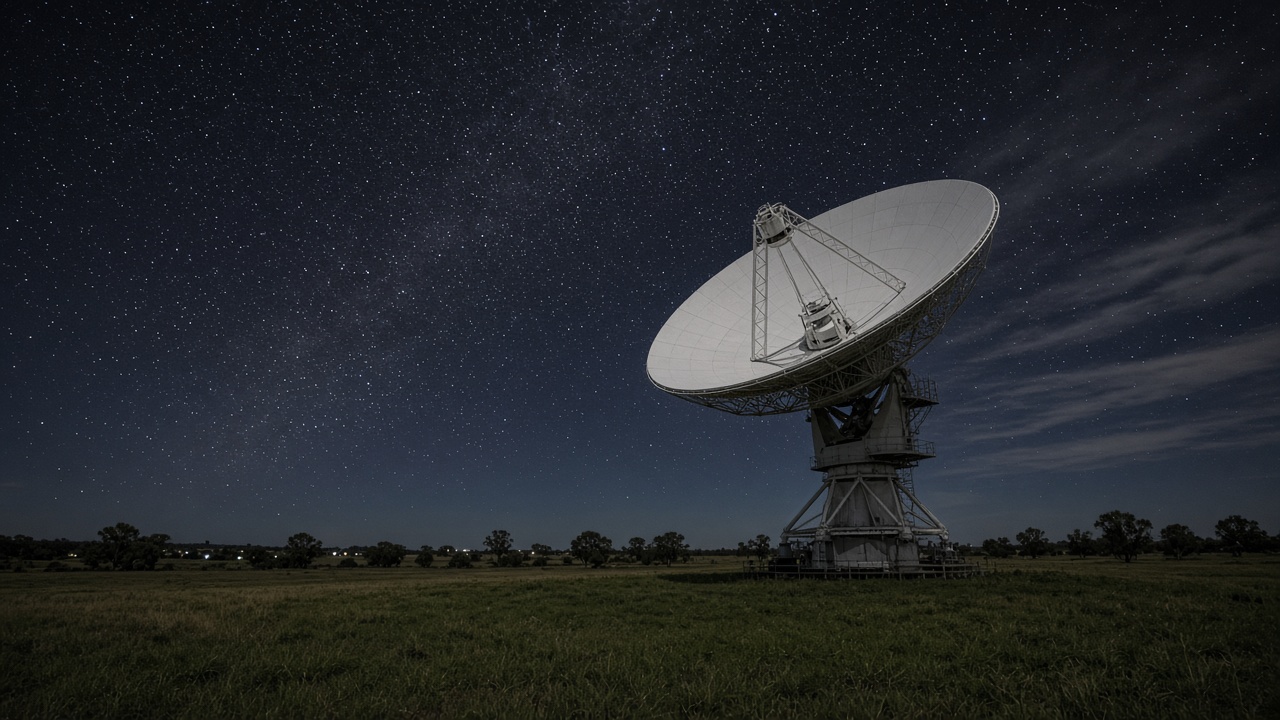
CSIRO astronomers captured a sudden spin-up glitch in a millisecond pulsar while monitoring a nearby magnetar outburst with the Parkes Murriyang radio telescope, according to a preprint posted Tuesday and timing data released through the Australia Telescope National Facility archive.
What observers saw
The pulsar, catalogued as PSR J1745–2900 in the galactic centre field, jumped its rotation frequency by a few parts per million over hours coinciding with X-ray flares from the magnetar SGR 1745–2900. Murriyang’s ultra-stable clocks recorded the event with microsecond precision, letting researchers test how superfluid interiors couple to rigid crusts when stressed by external magnetic fields.
Lead researcher Dr. Amara Singh said the observation was lucky timing: the team had scheduled follow-up after a smaller flare last month, keeping the 64-metre dish pointed during a window when weather over the central west New South Wales site remained clear.
Why glitches matter
Neutron stars are cosmic laboratories for extreme physics. Glitches—sudden changes in spin rate—hint that vortices in superfluid interiors occasionally unpin from the crust. Linking a glitch to a magnetar outburst supports theories that external magnetic torques can trigger internal rearrangements, not just gradual spin-down.
Instrument context
Murriyang, formerly known as Parkes, remains a workhorse despite newer arrays. Its single-dish sensitivity to bright pulsars complements the ASKAP survey telescopes on the same campus. Maintenance crews completed a cryogenic receiver upgrade in August, improving timing stability for exactly these events.
Peer review is expected before publication in a monthly notices journal. For Australian radio astronomy, the detection underscores why ongoing funding for Murriyang operations sits beside flashy square-kilometre array builds: some phenomena still need a trusted dish and a patient night shift.
Follow-up observations
The team scheduled additional Murriyang time on upcoming magnetar-quiet nights to see whether the pulsar's spin frequency relaxes back toward its pre-glitch baseline. Comparing relaxation timescales helps distinguish crust cracking from superfluid vortex rearrangements.
International collaborators on the European Pulsar Timing Array will fold the glitch into gravitational-wave background models, checking whether sudden spin changes inject noise into long-term timing residuals.
Outreach and training
CSIRO invited Wiradjuri elders to a campus briefing on Murriyang's cultural name and scientific role, continuing reconciliation commitments tied to the dish's rebranding. Graduate students from Western Sydney University joined the observation run as part of a radio-astronomy internship program.