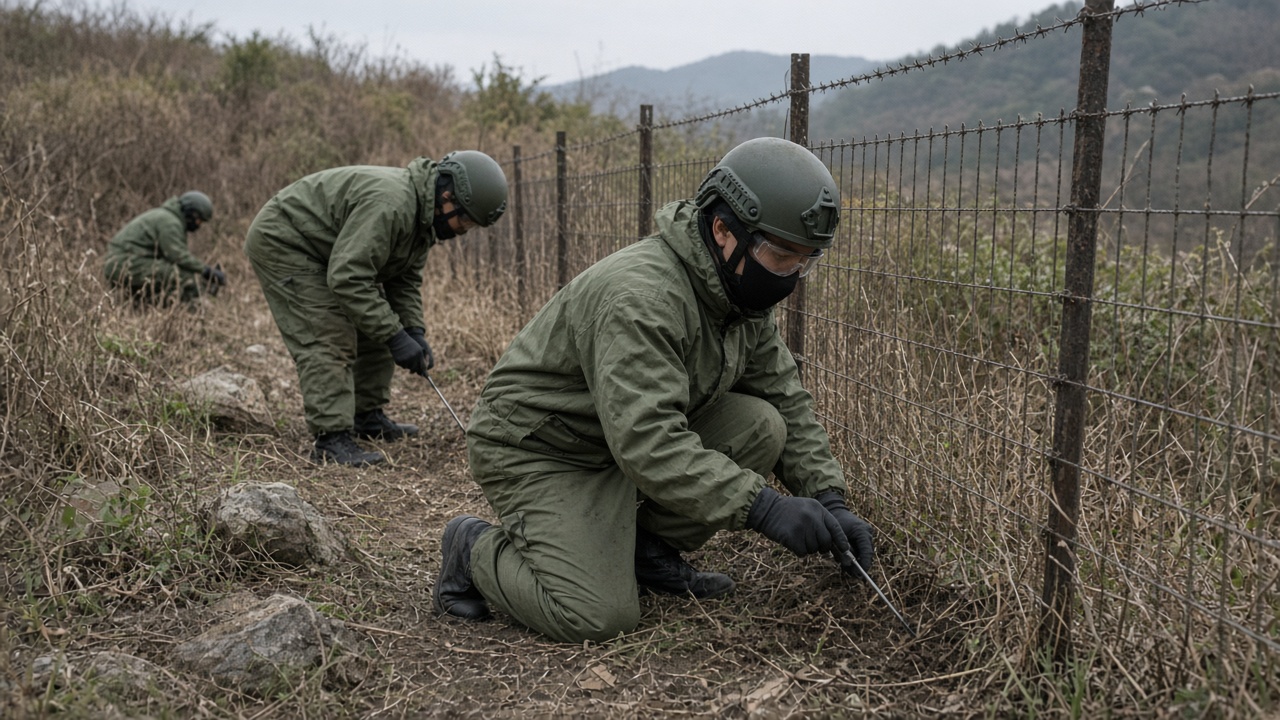
South Korea’s Joint Chiefs of Staff said Monday that North Korean land mines were “highly likely” responsible for a September 21 explosion inside the Demilitarized Zone that severely wounded two soldiers and lightly injured a third, citing TNT residue on gear, crater patterns and testimony that an undetonated wooden-box mine sat a meter from the blast site.
Army Lieutenant-General Kwon Dae-won, vice chairman of the Joint Chiefs, briefed reporters at the defense ministry after a two-day on-site investigation with the United Nations Command, which oversees the DMZ under the Korean War armistice. The probe reopened terrain about ten meters south of the Military Demarcation Line where Seoul said North Korean troops likely planted mines in violation of armistice rules.
What investigators found
According to Yonhap News Agency and Al Jazeera accounts of the briefing, investigators concluded that two mines detonated and a third failed to explode nearby. The National Forensic Service detected TNT components on equipment worn by the injured personnel, and brown foreign substances were recovered for further testing. South Korean officials said they have no record of planting mines in the sector, while satellite and ground observations showed North Korean activity altering terrain near the blast area as recently as last September.
Soldiers who witnessed the explosions told investigators the device resembled North Korea’s wooden-box antipersonnel mines, including plastic-like casing materials distinct from South Korea’s standard M14 and M16 mines. Military experts quoted by Yonhap said the severity of the injuries aligned more closely with North Korean stock than with older South Korean munitions that might remain from legacy deployments.
Why the patrol was there
The blast occurred during an operation to clear a path for a joint inspection by South Korean forces and the U.N. Command, part of Seoul’s effort to document reported North Korean mine-laying across the border. Relations between the Koreas have deteriorated since diplomacy stalled after the 2019 Hanoi summit between Kim Jong Un and U.S. President Donald Trump, and Pyongyang has resumed missile tests and harsh rhetoric against Seoul’s liberal government even as South Korea tries to revive dialogue channels.
North Korea has not publicly responded to Monday’s briefing. In past incidents along the DMZ, Pyongyang has denied armistice violations and said Seoul fabricated provocations.
Seoul’s next steps
Kwon said that if the final investigation confirms North Korean responsibility, “accountability rests entirely with North Korea” and the South Korean military “will take appropriate and corresponding measures,” without specifying whether that would mean public disclosure to the U.N. Command, reinforcement of demining units or diplomatic protests through allied channels.
Defense officials told lawmakers earlier in the day that the government would respond firmly if the mines are traced to North Korean units, according to SBS coverage of the National Assembly session. The United Nations Command said it participated in the site revisit and would review findings under armistice enforcement procedures.
For troops patrolling one of the world’s most heavily mined borders, Monday’s assessment does not end the danger: demining teams must still secure the unexploded device and map adjacent fields before routine patrols resume. But the briefing marked the first time Seoul’s top uniformed leadership publicly pointed to forensic evidence tying the injuries to North Korean munitions, raising the political stakes for both inter-Korean talks and U.S.-led efforts to restart nuclear diplomacy.