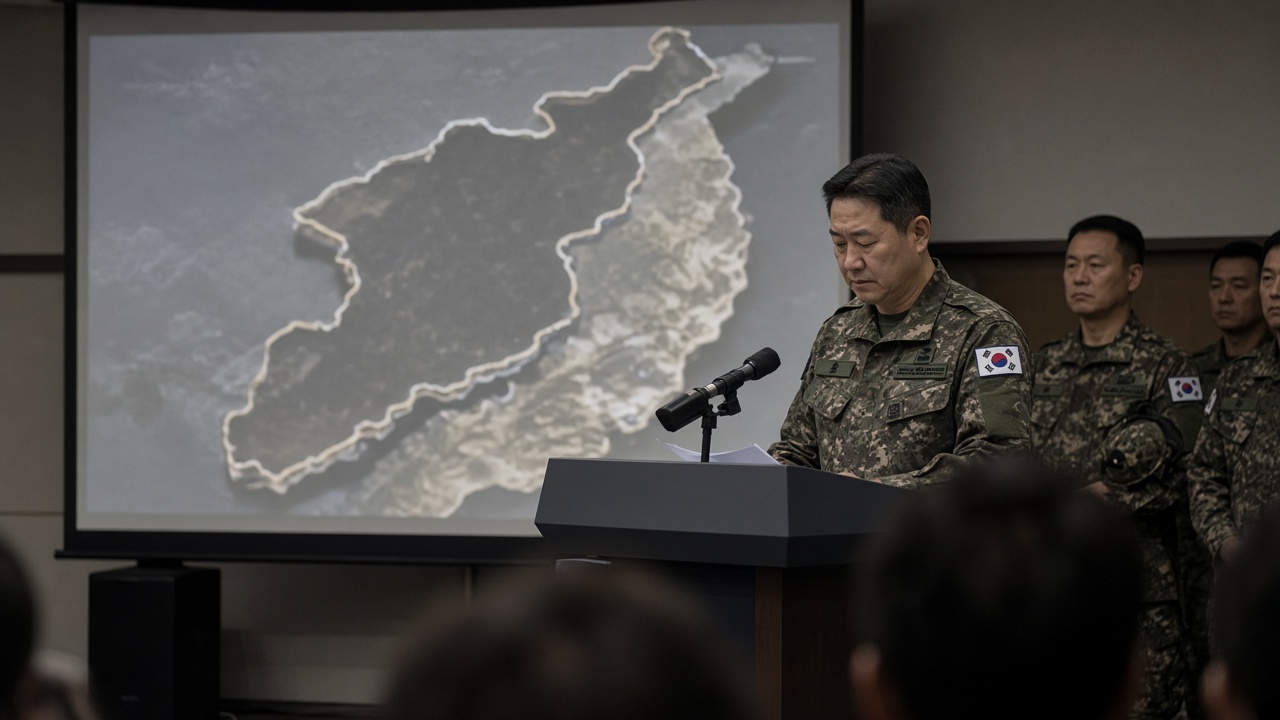
South Korea’s Joint Chiefs of Staff said Monday that explosions that wounded three service members inside the Demilitarized Zone on Sept. 21 were “highly suspected” to have been caused by North Korean landmines, citing crater shape, burn patterns and troop testimony gathered during a joint investigation with the United Nations Command.
Lt. Gen. Kwon Dae-won, vice chairman of the Joint Chiefs, told a televised briefing that two mines detonated and a third unexploded device was found as personnel withdrew from the western sector blast site. The incident occurred roughly 10 meters south of the Military Demarcation Line while South Korean forces were clearing a reconnaissance route for a joint inspection aimed at verifying allegations that the North had buried mines north of the line in violation of the armistice that halted the 1950–53 Korean War.
Forensics still running, but Seoul signals resolve
Kwon emphasized that the UNC-led probe is not finished. Investigators are still matching fragments and crater dimensions to known mine types. Even so, he said terrain changes near the blast point and prior surveillance suggesting North Korean activity in the area contributed to the preliminary assessment. Defense Minister Kang Shin-chul, arriving at his office Monday, told reporters the military would take “appropriate and corresponding measures” if the final report confirms Pyongyang planted the charges.
Soldiers on the ground told investigators they saw a wooden-box style mine near the crater, a detail that matters because Seoul has accused the North in the past of using such devices along the border. Two personnel suffered severe wounds and a third minor injuries—casualties that experts said are more consistent with anti-personnel mines than with some older South Korean stockpiles routinely cleared in the zone.
A border frozen in armistice, not peace
The DMZ stretches about 248 kilometers across the peninsula, buffered by fences, sensors and millions of legacy mines laid by both sides over decades. Operations south of the MDL are tightly choreographed with the UNC, which oversees armistice compliance. Any injury inside the zone therefore carries both tactical and diplomatic weight, especially when Seoul is trying to deter North Korean provocations while keeping communication channels from collapsing entirely.
If the UNC investigation ultimately attributes the blast to newly laid North Korean mines, it would be the first time South Korean troops were hurt by such devices in the DMZ since 2015, when two soldiers were maimed by wooden-box mines Seoul also blamed on Pyongyang. The North has not issued a fresh statement responding to Monday’s briefing; it routinely denies armistice violations when accused.
What Seoul has not announced
Officials declined to specify what “corresponding measures” could entail, leaving room for diplomatic protests, suspended military exchanges or louder public messaging ahead of winter training cycles. The government has not raised the alert status for frontline units in public remarks tied to the briefing, suggesting commanders want forensic certainty before escalating rhetoric.
For families of the wounded troops and for UNC partners, the immediate question is whether the joint inspection that prompted the route clearing will continue on schedule. Kwon said South Korea will release additional findings when the UNC concurs on conclusions. Until then, the border remains what it has been for seven decades—a heavily armed pause, where a few meters of crater geometry can reopen the peninsula’s most dangerous conversation.