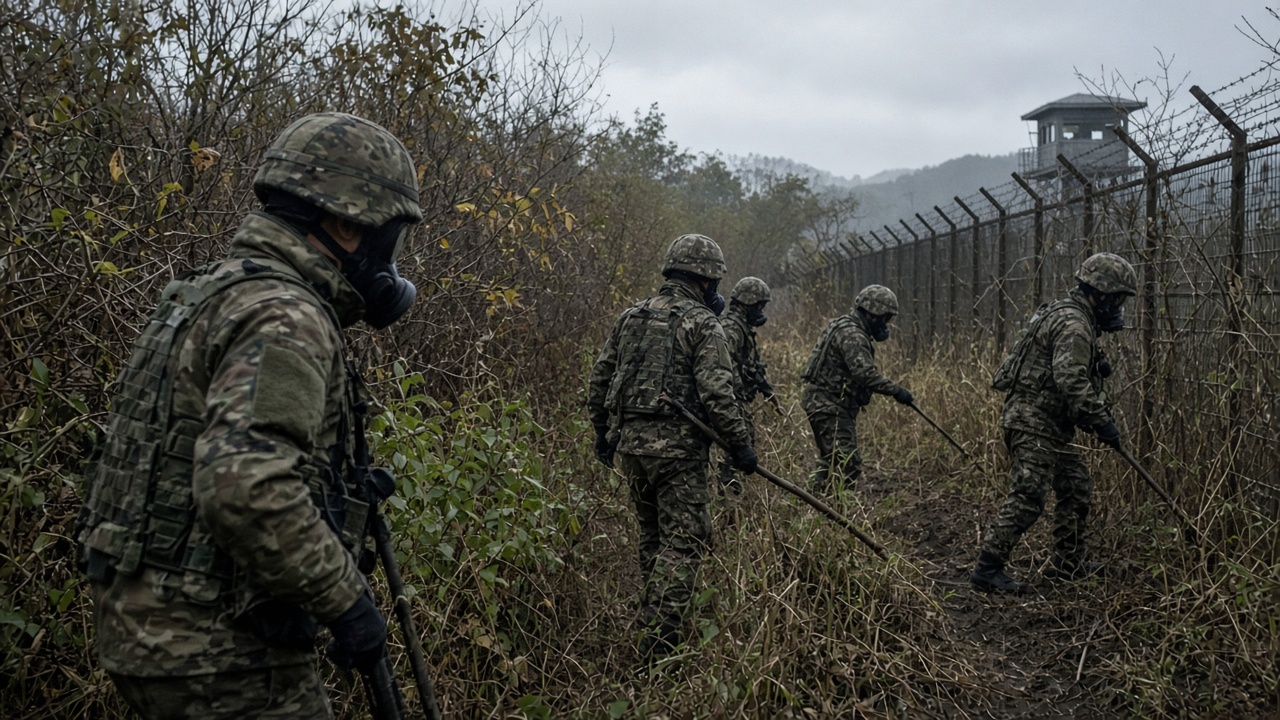
South Korea’s military concluded Monday that North Korean land mines were “highly likely” responsible for twin explosions inside the Demilitarized Zone on Sept. 21 that seriously wounded two soldiers and lightly injured a third, after a joint team with the United Nations Command finally reached the blast craters and collected residue from protective gear.
What investigators found
Army Lt. Gen. Kwon Dae-won, vice chairman of the Joint Chiefs of Staff, told reporters that the National Forensic Service detected traces of TNT and brown synthetic material on equipment recovered from the scene but no metal fragments consistent with South Korean-issue mines. Witnesses reported seeing a brown, rectangular object resembling a North Korean antipersonnel mine about one meter from the first detonation, he said.
Kwon said blast craters, flame patterns and the severity of injuries matched antipersonnel munitions rather than South Korean stocks. Personnel involved in the operation believed three mines were buried at the site, including two that detonated and a third spotted as troops withdrew. Investigators on Monday approached within about two meters of the second explosion point after an earlier attempt was cut short by daylight and safety limits.
Where the blasts occurred
The detonations happened roughly 10 meters south of the Military Demarcation Line in the western sector of the DMZ, Kwon said, and about the same distance from terrain changes that Seoul links to recent North Korean mine-laying activity. The soldiers were clearing a new search route toward the line ahead of a planned on-site inspection with the UNC when the mines exploded.
All 18 personnel on the operation were evacuated; fifteen have since been discharged from the Armed Forces Capital Hospital while the three wounded remain under treatment. The UNC issued a statement backing the joint probe and said additional site work would continue as conditions allow.
Pyongyang’s silence and Seoul’s warning
North Korea’s state media has not commented on the incident. Inter-Korean tensions have been elevated since leader Kim Jong Un described the South as his country’s “principal enemy” in 2024, and the DMZ remains one of the most heavily mined borders in the world despite the 1953 armistice that paused the Korean War without a peace treaty.
Kwon said that if the final investigation confirms North Korean responsibility, it would amount to an attack on troops lawfully operating south of the MDL. “Our military will take appropriate and corresponding measures,” he said, without specifying whether those steps would be diplomatic, operational or both. Defense officials said they still need to examine an unexploded device and surrounding terrain to determine whether mines were deliberately pushed across the line or displaced by weather.
What happens next
Seoul is expected to brief lawmakers this week as the forensic report is finalized. Allied officials in Washington and at the UNC will watch whether South Korea limits its response to statements or escalates surveillance and counter-mine operations along the western corridor where the blasts occurred.
For troops patrolling the DMZ, the preliminary finding changes little on the ground: clearance teams will move more slowly, and commanders will treat any fresh soil disturbance near suspected North Korean activity as a live hazard until the unexploded munition is rendered safe.