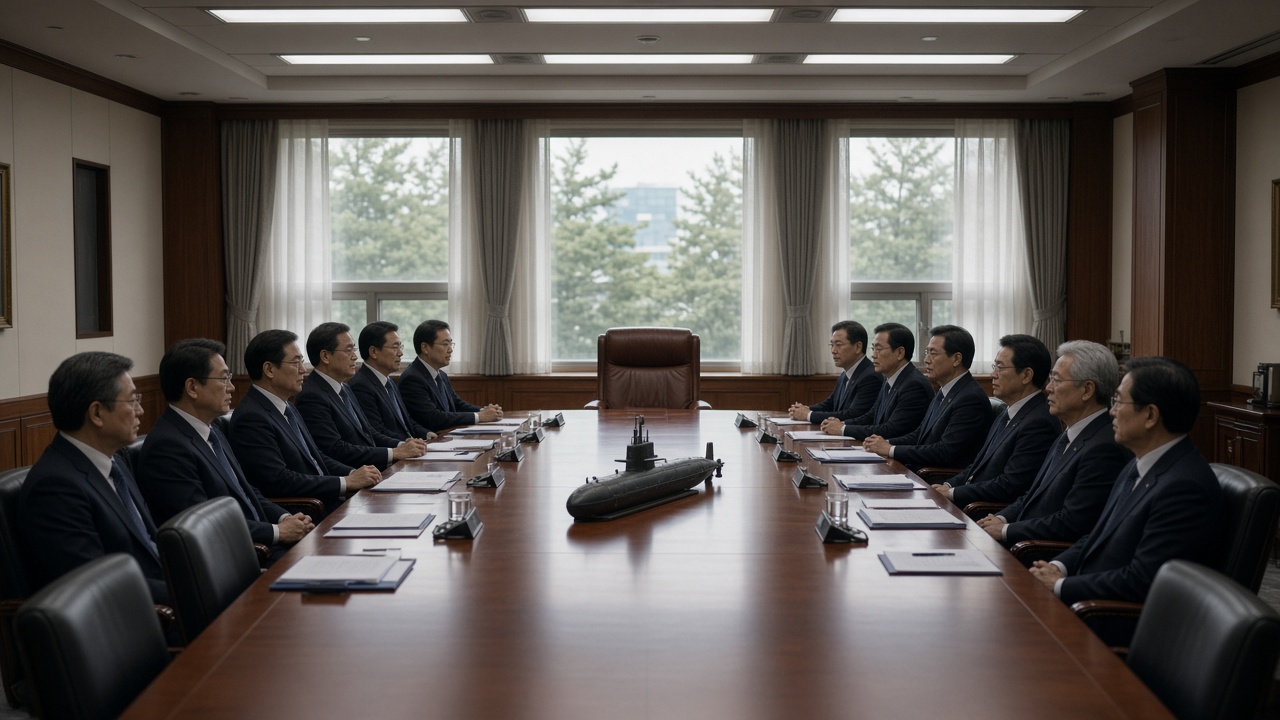
President Lee Jae Myung’s cabinet approved a special bill on Tuesday that sets the legal framework for introducing and operating nuclear-powered submarines, sending the measure to the National Assembly as Seoul tries to lock in a decades-long undersea deterrent project.
The legislation passed at a Cheong Wa Dae cabinet meeting chaired by Lee. Officials said the act is meant to enable systematic management of the submarine program, support self-reliant defense, and channel industrial investment into shipyards and suppliers that already build conventional boats for the Republic of Korea Navy.
What the bill would authorize
Because the project pairs a weapons platform with nuclear energy for the first time in South Korea, the bill includes special provisions on acquisition, operation, and safety rules for nuclear materials aboard warships. The government has publicly targeted enactment before the end of 2026, with a lead submarine in the mid-2030s and a domestically built nuclear-powered hull in the late 2030s.
Defense planners argue nuclear propulsion would let attack submarines stay submerged longer and patrol farther from the peninsula without surfacing to recharge batteries — a capability North Korea’s growing submarine-launched missile force has made more urgent in allied war games. Critics in the assembly will probe cost, non-proliferation commitments, and whether the navy can absorb crew training timelines alongside conventional fleet upgrades.
Assembly politics and alliance coordination
Lee’s Democratic Party does not hold a supermajority, so the bill will need support from conservative lawmakers or defections to clear committee and plenary votes. Past submarine debates have split along lines of fiscal discipline versus deterrence, with Hanwha Ocean and other yards lobbying for workshare guarantees.
Washington closely monitors any ROK move toward naval reactors because of the 123 Agreement on peaceful nuclear cooperation. U.S. officials typically insist on stringent safeguards and consultation before South Korea enriches or reprocesses fuel, even for military propulsion. Japanese and Australian security officials will also track whether the program shifts underwater balance in the East China Sea and South China Sea lanes.
Industrial and safety stakes
Shipbuilders that already export conventional submarines to Poland and other buyers see nuclear expertise as a future export line, though proliferation law would block most foreign sales. Regulators at the Nuclear Safety and Security Commission will face pressure to write reactor rules that satisfy both the navy’s operational tempo and public anxiety after Fukushima-era memories across Northeast Asia.
Next steps in Seoul
Parliamentary defense and trade committees are expected to request classified briefings on reactor design choices — likely pressurized-water derivatives similar to allied naval plants — and on how spent fuel would be handled ashore. If the special act stalls, the administration could fold pieces into the annual defense budget bill, but Lee’s aides have said a standalone law gives industry the certainty to sign long-lead contracts this winter.