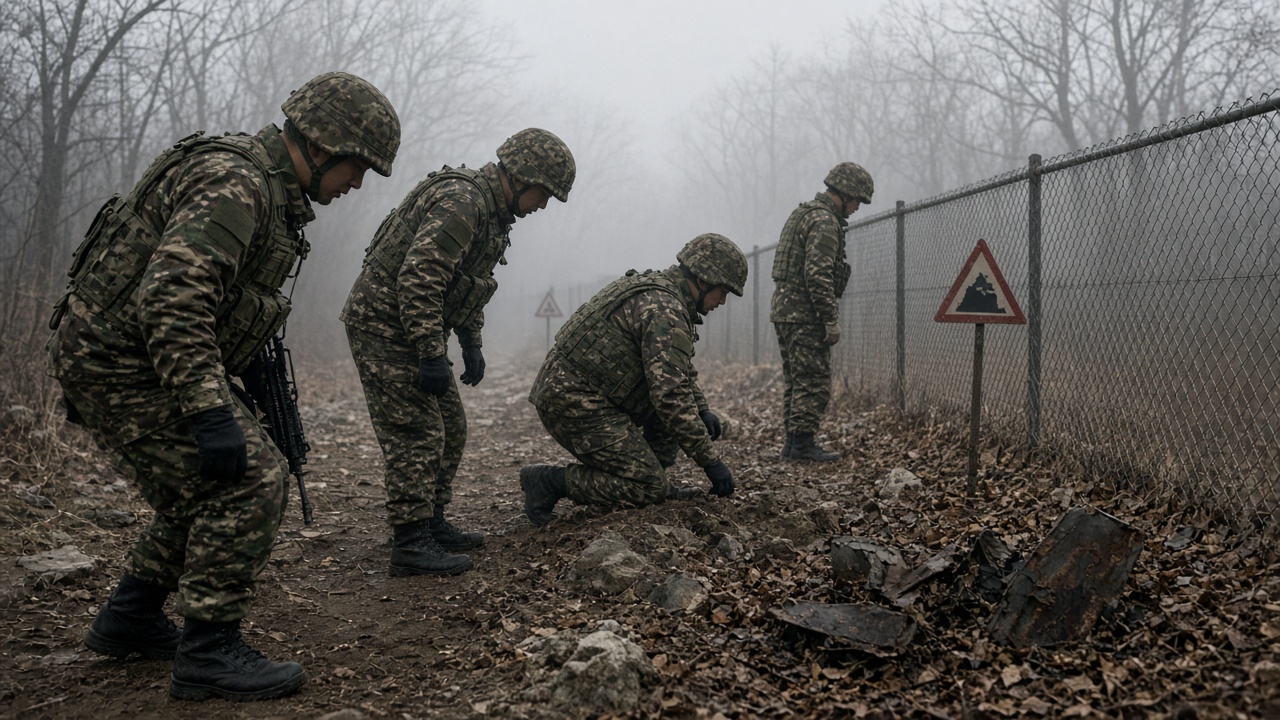
Kim Yo-jong, the influential sister of North Korean leader Kim Jong Un, issued a statement carried Wednesday by state media rejecting Seoul’s finding that a North Korean land mine caused an explosion in the western Demilitarized Zone on Sept. 21 that wounded three South Korean soldiers. She called the probe a “self-staged farce” designed to justify political and military provocation against Pyongyang.
The statement landed one day after the Joint Chiefs of Staff said an on-site inspection made it “highly likely” that North Korean mines caused the blast, citing an intact North Korean resin-bodied antipersonnel mine found near the crater. Defense Minister Kang Shin-chul told lawmakers Tuesday that the device appeared deliberately placed rather than washed in by flooding as North Korea has sometimes claimed in past border incidents.
Pyongyang’s counter-narrative
Kim said northern engineers are reinforcing barriers in southern border areas as a sovereign project unrelated to offensive plans, and she accused South Korean troops of harassing workers with warning broadcasts and shots. She compared the current investigation to the 2015 wooden-box mine episode that seriously injured two South Korean soldiers, which Seoul also blamed on the North — a case that briefly raised tensions before talks lowered the temperature.
State media quoted her saying southern “armed gangsters” were fabricating results to create a pretext for “appropriate and corresponding measures,” language that mirrors past cycles where border incidents precede artillery drills or missile tests. She did not offer an alternative explanation for the Sept. 21 detonation beyond denying northern involvement.
Retaliation warnings
Kim warned that if South Korean forces fire live rounds at northern soldiers working on border fortifications — as opposed to warning shots — border units would retaliate “immediately and mercilessly.” She added that continued “malicious accusation and provocation” could produce “a situation that has not yet been experienced,” a phrase analysts read as a hint toward heavier weapons or broader strikes along the 248-kilometer DMZ.
She also said the Korean People’s Army would strengthen tactical counterstrike assets facing the South’s Third Corps sector, where she alleged harassment had intensified. Seoul’s military has not publicly detailed any plan to shoot at workers but has said it will respond proportionally if the mine placement is confirmed.
Where the investigation stands
South Korean investigators believe at least four North Korean mines were present at the blast site, including the two that exploded. The JCS has not released a final attribution report; a confirmation would trigger discussions in the National Security Council about sanctions, loudspeaker broadcasts, or live-fire drills that Pyongyang routinely condemns.
United Nations Command personnel sometimes join DMZ probes when incidents touch the Military Demarcation Line, though Tuesday’s statements came from national channels on both sides. Civilian tour routes near the western front remain restricted while engineers clear adjacent fields.
What happens next
Seoul must decide whether to publicize forensic evidence — shrapnel analysis, fuse types, or migration patterns — to rebut Kim’s staged-act claim without revealing surveillance sources. Pyongyang may follow the statement with a weapons test or border artillery exercise, a pattern Kim Yo-jong has used after past DMZ disputes.
Washington and Tokyo will watch for any spillover that complicates trilateral coordination on North Korea policy, while Beijing typically urges restraint. For Korean units on the line, the immediate risk is miscalculation: warning shots misread as live fire, or a new mine strike during clearance operations. The politics are loud; the border is still live.