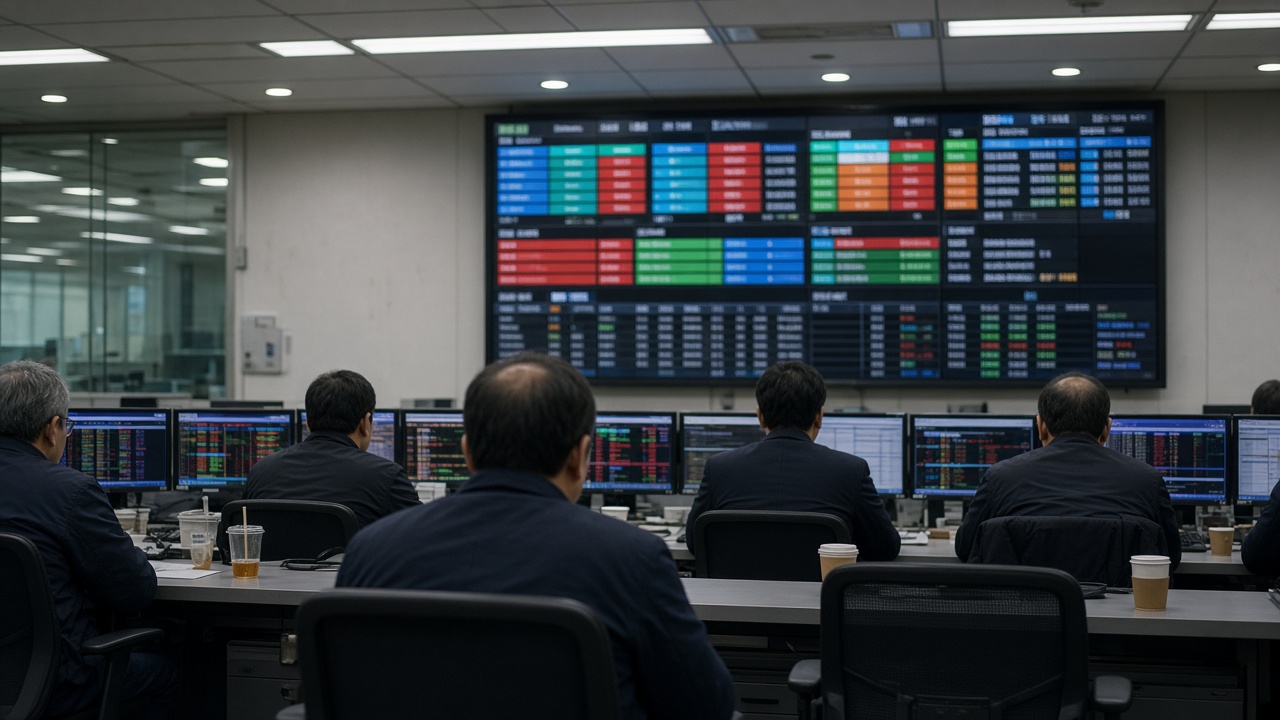
South Korea’s Kospi gave back an early rally and closed down 1.38 percent at 6,598.87 on Sept. 30, shedding 92.03 points after an intraday push through 6,750 that marked a fresh session high. Foreign investors sold a net 1.4563 trillion won on the main board, overwhelming net purchases of 1.1878 trillion won by individuals and 283.7 billion won by institutions, exchange data showed.
The session opened with momentum from strong U.S. big-tech earnings, lifting the index above 6,600. Gains faded as traders priced in a sharper climb in international oil after reports that Washington would tighten maritime pressure on Iran, and as the Federal Open Market Committee kept a hawkish tone on inflation risks. The combination revived the “higher for longer” rate worry that has hit chip-heavy benchmarks worldwide.
Who sold and who bought
Foreigners have been the swing factor in Seoul all month. Tuesday’s 1.46 trillion won net sale extended a pattern of overseas funds trimming Korea exposure after the Chuseok break, when combined foreign and institutional selling in Samsung Electronics and SK hynix had already dragged the index off the 7,000 handle. Retail investors again acted as the buffer, stepping in as the Kospi slid from its high.
Institutions joined individuals on the buy side but with far smaller tickets. That split suggests domestic pensions and asset managers are still selective rather than aggressive dip buyers, leaving the market sensitive to the next foreign flow print.
Chip leaders in the crosshairs
Samsung Electronics and SK hynix remain the gravitational center for the Kospi’s foreign order flow. When overseas accounts reduce semiconductor overweight positions, the index rarely holds an intraday breakout even if earnings headlines are positive. Traders noted that Samsung had managed firmer prints on recent sessions despite ex-dividend mechanics, but Tuesday’s reversal showed macro overlays—oil, rates, and geopolitics—can still swamp stock-specific stories.
The Kosdaq fell 2.29 percent to 1,192.35 on the same day. There, foreigners sold a net 211.2 billion won and institutions 304.5 billion won while individuals bought 553.2 billion won, a reminder that risk-off days can hit growth boards even when the main index’s damage is concentrated in a handful of mega caps.
Macro overlays
Energy prices acted as the immediate trigger for the afternoon fade. Brent’s move fed straight into Korea’s import bill and reinforced fears that central banks may keep policy tight into 2027. At the same time, the won’s trading band near recent levels added a currency hedging incentive for foreign funds to lighten Korean equities.
Analysts cited in local market wraps pointed to U.S. Treasury yields and oil in the same breath—classic late-cycle risk-off pairing for a market that exports memory and imports crude.
What the tape implies
A close at 6,598.87 after tagging 6,750 intraday leaves a technical air pocket under the morning breakout. Short-term traders will watch whether foreigners return on the next session or extend the streak that has pressured Seoul since the holiday reopening.
Longer term, the episode underscores how dependent Korea’s headline index remains on a thin set of chip names and on offshore liquidity that can reverse within hours. Until foreign selling eases, intraday highs may keep turning into distribution zones rather than launch pads.
Flows and hedging
Exchange data on program trading and swap books will be parsed over the next sessions to see whether Tuesday’s foreign sale was discretionary risk reduction or month-end rebalancing tied to dollar funding costs. Korean pension funds have increased overseas allocation targets, but their domestic equity sleeves still lean on the same chip duo foreigners were exiting, which can amplify volatility when both sides adjust at once.
Derivative desks noted put skew steepening into the close as the Kospi fell from 6,750, a sign hedgers were paying up for downside protection after the failed breakout. If oil retreats or the Fed’s rhetoric softens, the same foreign accounts that sold into strength may need to chase exposure back—a pattern that has whipsawed Seoul several times in 2026.