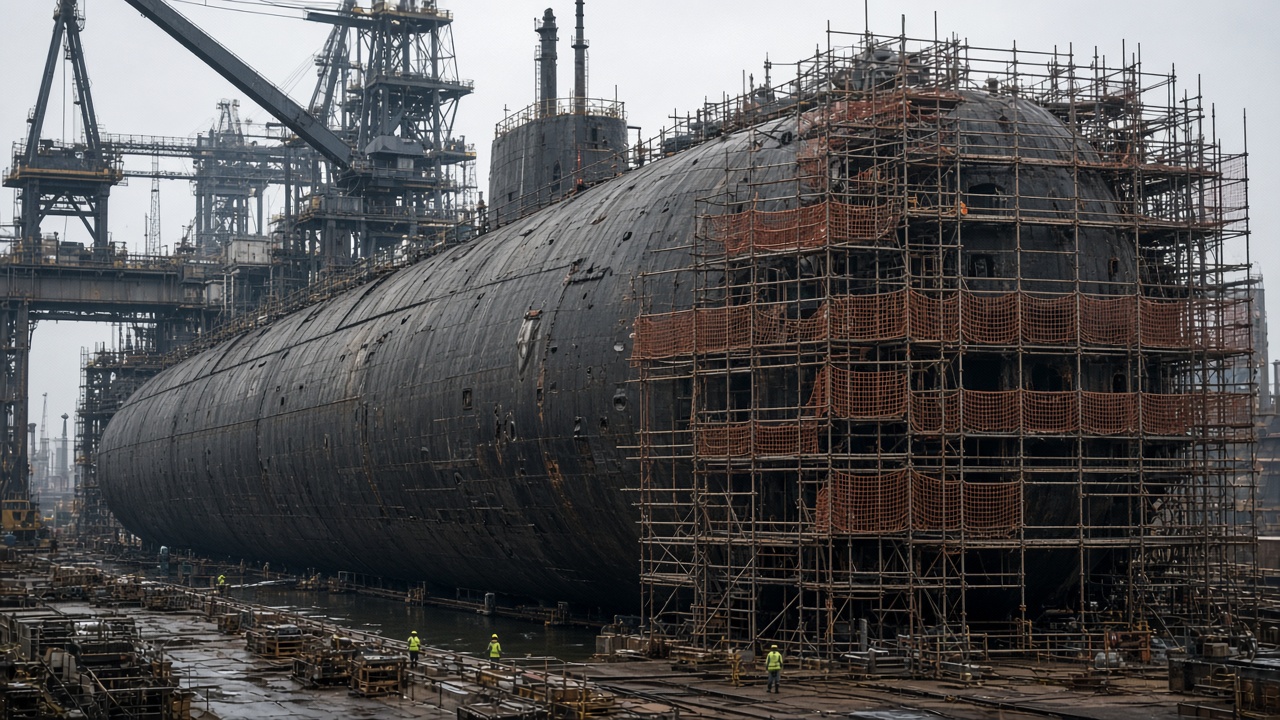
President Lee Jae Myung’s Cabinet on Sept. 29 approved a special act governing the acquisition, operation, and nuclear safety of Korea’s planned nuclear-powered attack submarines, along with 14 related presidential decrees, moving the Jangbogo-N project from ministry drafts to a bill the government intends to submit to the National Assembly before year-end.
What the bill covers
The Ministry of National Defense argued that patchwork amendments to the Defense Acquisition Act or the Nuclear Safety Act could not carry a reactor-backed fleet with export scrutiny attached. The special act instead creates dedicated authority for procurement exceptions, operating standards, safety management, and program governance. Presidential decrees spell out organizational roles the ministries had circulated during the summer legislative notice period that closed in early September.
In the Cabinet session, Lee called nuclear submarines a core of independent defense and linked the package to accelerated work on advanced missiles, framing both as protection for citizens and national interest. Officials repeated non-proliferation language from the draft: the program is not for weapons development, nuclear material must not be diverted, and commitments under the Nuclear Non-Proliferation Treaty and IAEA safeguards remain binding.
Jangbogo-N timeline
The government’s public schedule still targets a lead boat in the mid-2030s and operational deployment in the late 2030s under the Korean-style nuclear attack submarine label—wording Seoul prefers over “nuclear submarine” to stress peaceful propulsion. The Republic of Korea Navy has treated the effort as a successor to conventional Jangbogo-class boats stretched by regional undersea competition.
Industry teams watch whether the act unlocks long-lead reactor and pressure-hull contracts domestic yards have been modeling since the 2025 U.S.–ROK joint fact sheet language approving attack submarine construction in principle.
IAEA and Washington lanes
Parallel to domestic law, South Korea has formally notified the International Atomic Energy Agency of intent to consult on an arrangement under Article 14 of its Comprehensive Safeguards Agreement—the channel non-weapon states use for naval nuclear propulsion. IAEA Director General Rafael Grossi said Seoul submitted declarations and reaffirmed NPT and Additional Protocol obligations, with talks expected to continue transparently.
That step does not replace a bilateral fuel and technology understanding with the United States. Negotiations on implementation details—including whether fuel can resemble power-reactor grades—reportedly lagged after summer security talks slowed. Analysts note submarine cores are not limited to weapons-grade uranium, but export control politics still gate Korean access to enriched material and certain components.
Assembly politics ahead
Government planners want enactment within 2026, yet opposition and some governing coalition members will probe cost, coastal community safety, and whether the special act concentrates too much discretion in the executive. Debates will also revisit how much program information can stay classified while satisfying IAEA verification expectations.
Shipbuilders and tier-two suppliers have lobbied for clauses that keep domestic workshare high without violating alliance technology transfer rules—a balance the decrees only partially address pending parliamentary markup.
What changes for readers this week
Until the Assembly acts, the Cabinet clearance is authorization to file, not a construction start order. Budget lines in the 2027 defense plan will be the next visible milestone, along with any revised joint statements with Washington if summit diplomacy resumes.
Coastal communities from Geoje to Jinhae will watch environmental impact chapters the decrees reference, even though reactor cores will not be assembled locally for years. Labor unions at Hanwha Ocean and HD Hyundai Heavy Industries have asked for clarity on which yards receive pressure-hull segments versus reactor-module integration, a split that determines hiring waves.
For peninsula security watchers, the Sept. 29 vote marks the moment nuclear submarines became a named statutory program rather than a planning assumption—binding future administrations to a legal frame whether they accelerate or stretch the fleet goal. North Korea’s expanding fissile material production, highlighted again in recent IAEA briefings on Yongbyon, gives Seoul’s proponents a public rationale even as critics demand diplomatic offsets.