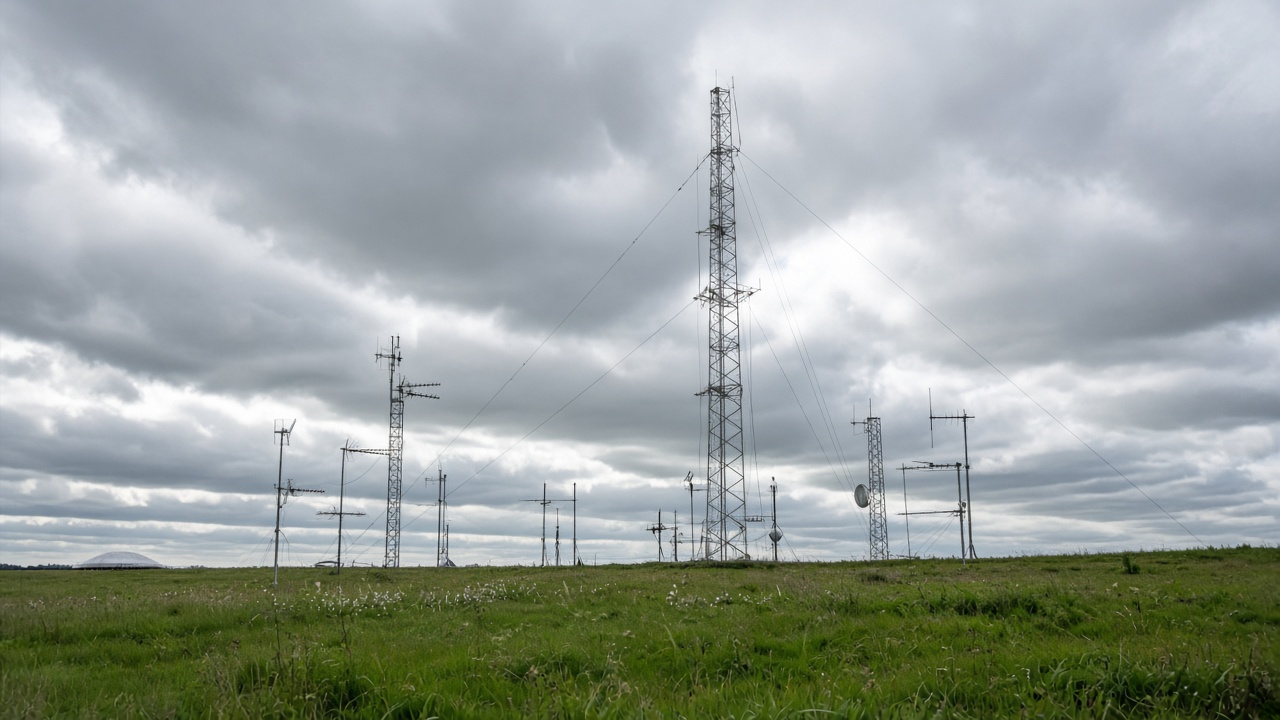
Instruments at the Science and Technology Facilities Council’s Rutherford Appleton Laboratory logged a sharp magnetopause compression on 28 September, researchers said Tuesday, following an X-class solar flare and subsequent coronal mass ejection.
What the sensors saw
Ground magnetometers in Oxfordshire registered a sudden impulse consistent with the solar wind ram pressure doubling for several hours. Satellite operators received Met Office space-weather alerts at G3 storm levels, prompting some geostationary operators to postpone thruster firings.
The boundary between Earth’s magnetic field and the solar wind moved inward by roughly 1,200 kilometres at peak, according to models cross-checked with European Space Agency solar wind monitors.
Why it matters
Moderate storms rarely threaten life on the surface, but they can induce currents in long power lines and degrade high-frequency aviation communications on polar routes. National Grid said contingency teams monitored transformer loads but reported no customer outages in Britain.
September’s flare cluster was the strongest since May, ending a quiet summer for ionospheric disturbances.Research payoff
STFC teams will fold the event into open data sets used to train eruption-forecast models. Better lead times help satellite firms schedule safe-mode transitions before particles arrive.
Airlines rerouted a handful of transpolar cargo flights as a precaution, a reminder that space weather is an operational cost even when headlines focus on sunspot counts.
With solar cycle 25 approaching maximum, operators should expect more September-style weeks—quiet for pedestrians, expensive for anyone flying or orbiting through the auroral zone.
Aviation reroutes
Air traffic control memos reviewed by industry groups showed polar cargo flights shifted south by up to four degrees latitude during the storm’s peak, adding fuel burn but avoiding the worst ionospheric interference.
Amateur radio operators documented aurora sightings as far south as Norfolk, a tourist curiosity with little economic impact but a useful public reminder that space weather is not only a satellite problem.
Insurance underwriters said satellite policies written this year increasingly include space-weather exclusions unless operators demonstrate hardened command links—a market shift accelerated by 2024’s storm season.