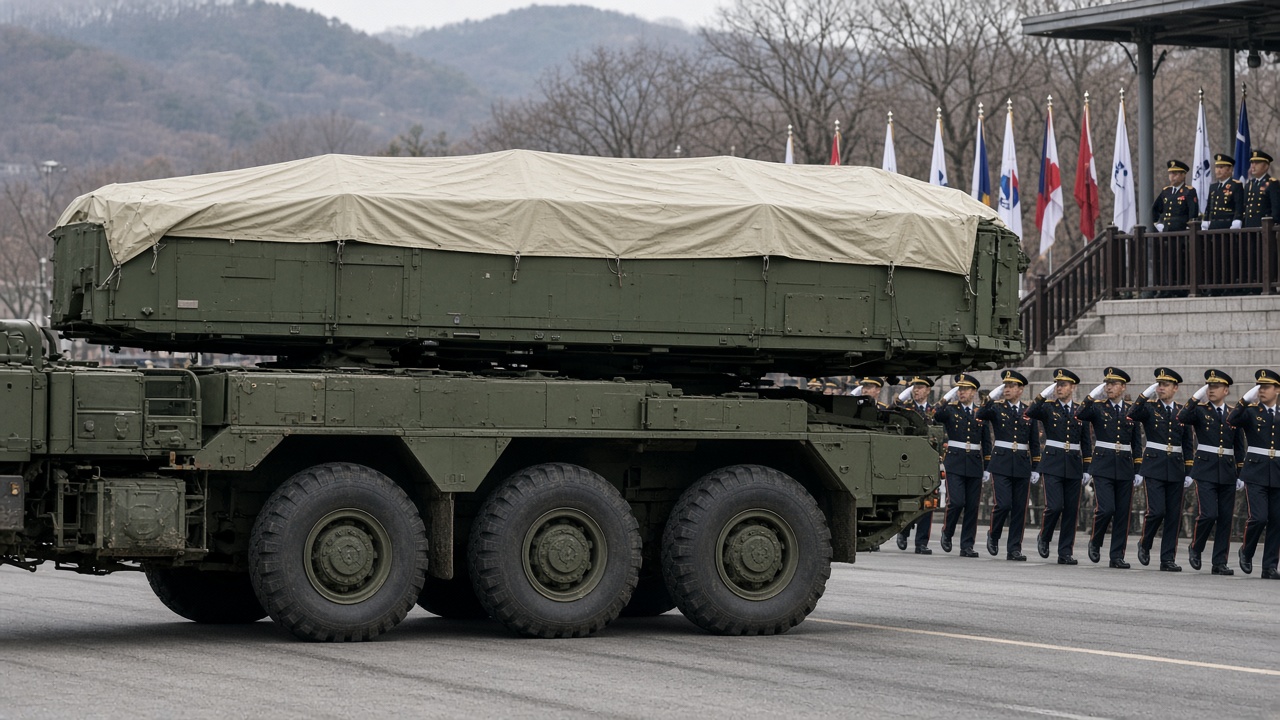
South Korea rolled out its heaviest conventional strike missile and a live laser intercept demonstration at Thursday’s Armed Forces Day parade in Gyeryong, pairing a public show of firepower with President Lee Jae Myung’s appeal for Pyongyang to resume talks after a land-mine explosion along the border left three soldiers wounded.
The 78th anniversary event featured 46 weapon types and about 70 platforms, according to the presidential office, under the theme of building a “smart, elite and strong” military. Crowds watched the Hyunmoo-5 ballistic missile—publicly nicknamed for its eight-ton warhead—alongside KF-21 fighters, K2 tanks and Chunmoo rocket artillery already familiar from past displays.
Cheongwang laser shoots down a drone on the field
The centerpiece novelty was a live-fire segment in which the domestically developed Cheongwang high-energy laser engaged a target drone. Defense officials describe Cheongwang as a counter-unmanned-aircraft system meant to burn through inexpensive drones that can swarm conventional air defenses. Thursday’s demonstration ended with the drone falling from the sky, a visual Lee’s aides hope will reassure voters that Seoul is investing in asymmetric answers to North Korean UAV probes.
Future-warfare exhibits also included AI-enabled swarm drones, interceptor drones and multipurpose unmanned ground vehicles, signaling how much of the modernization budget is shifting from legacy platforms to software-defined kill chains.
Lee’s dual message on deterrence and dialogue
In his address, Lee pledged to accelerate high-power missiles, laser weapons and artificial-intelligence command systems while repeating that his government would “consistently pursue practical measures to reduce military tensions” with the North. The remarks came a day after South Korea’s Joint Chiefs and the U.N. Command concluded that North Korean mines detonated south of the Military Demarcation Line, a finding Pyongyang’s leadership has rejected through Kim Yo Jong’s statements this week.
Lee said inter-Korean ties remain knotted but argued patience could loosen them “one by one.” He also reaffirmed plans to field indigenous nuclear-powered submarines by the mid-2030s and to complete the transfer of wartime operational control from U.S. forces—longstanding goals that Thursday’s hardware display was meant to underpin.
What the parade signals regionally
Analysts in Seoul said showcasing Hyunmoo-5 alongside directed-energy weapons sends a deterrence message distinct from the mine crisis: South Korea is betting on precision mass and new domains, not just troop numbers. U.S. officials watching the event will note the continued emphasis on allied interoperability even as Seoul talks about greater self-reliance.
For North Korea, the optics are unlikely to soften its rhetoric after the DMZ injuries. Yet Lee’s speech leaves open a diplomatic lane if Pyongyang chooses to test it—provided the next provocation does not arrive first.