
In the first Certificate of Entitlement exercise of September 2026, anyone bidding for a larger private car in Singapore was chasing 934 licences. The Land Transport Authority's open-data release shows 1333 bids arrived for that Category B round. The quota premium—the price every winner would pay—cleared at S$135001. That figure is not the Toyota's import value, not the Additional Registration Fee, and not a dealer markup. It is the auction price of a ten-year right to register a vehicle on an island that refuses to let the car fleet grow with incomes.
Dealer quotations bundle COE with metal and taxes, which is why the certificate feels like another line of GST. It is legally and mechanically different: a tradable registration slot awarded by twice-monthly bidding against a published quota. When demand runs ahead of supply, the licence can cost more than the car it is bolted to. Understanding that split is the difference between cursing "Singapore car prices" and seeing a market designed to ration registrations, not imports.
The line item that is not the car
Category B covers the cars most households picture when they say "family car": non-fully electric models above 1600cc or above 97kW, and higher-output electric cars above 110kW, under rules LTA has published since the May 2022 bidding exercise. In the September 2026 first round, 910 bids were marked successful in the dataset, leaving hundreds of bidders empty-handed despite six-figure offers.
That gap between bids received and quotas granted is the market. You can import the vehicle, insure it, even park it in a showroom, but without a COE the Registrar will not register it for road use. Dealers therefore quote "COE inclusive" prices because the certificate is the gating item, not the leather seats.
The premium is uniform. LTA's bidding guide states plainly that all successful bidders in a category pay the same quota premium, even if they were willing to go higher. You are not buying secrecy; you are buying a rank in a queue that ends when the quota is exhausted.
Compare that clearing price with the open-category peak the dataset already holds: S$158004 for a Category E premium in October 2023's second round, when only 138 open licences were on offer. The categories differ, but the pattern repeats. Scarce paper, enthusiastic bidders, prices that read like property down payments.
What Singapore actually sells you
Before you can register any vehicle, you must place a bid for a Certificate of Entitlement in the matching category, according to LTA's OneMotoring guidance. A successful bid grants the right to own a vehicle that can be used on the road for 10 years. At the end of that decade you may deregister, or renew by paying the Prevailing Quota Premium, defined as the moving average of COE prices over the prior three months—no new auction required.
The Vehicle Quota System caps how many new vehicles may be registered. LTA describes it as working together with Electronic Road Pricing as one of the key pillars in traffic management strategies. ERP charges for using roads; COE charges for the right to put another car on them in the first place.

Categories A, B and D COEs cannot be transferred between bidders, which matters when you hear about "COE cars" in the resale market: what trades is often the vehicle with months left on an existing certificate, not a fresh slip you can move at will. The quota itself is refreshed every three months, blending deregistrations, allowable growth, taxi adjustments and commercial-vehicle turnover schemes that LTA publishes before each exercise.
Deregister early and you may receive a rebate on unused COE months; keep the car past ten years and you pay the Prevailing Quota Premium instead of facing a fresh auction. Those two exit ramps mean the headline premium is only the entry fee. The decade that follows can be cheap or costly depending on how the moving average moves.
Inside the twice-monthly auction
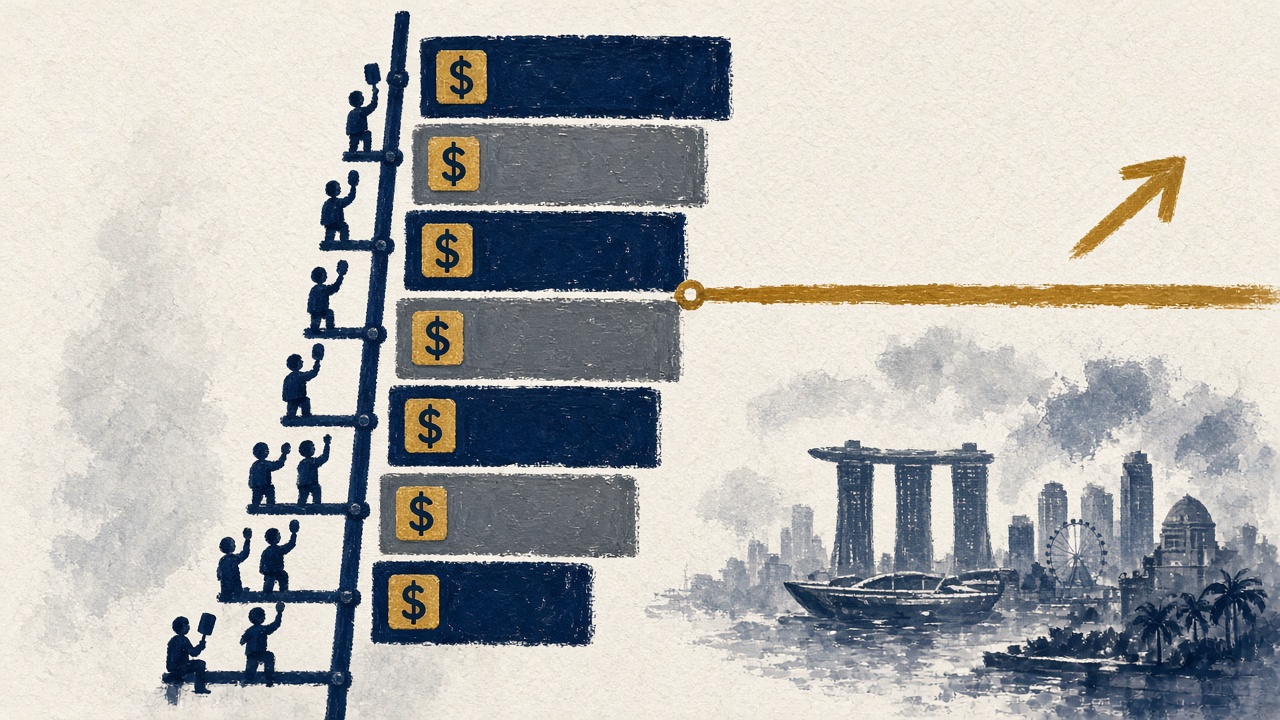
There are two COE open bidding exercises in a month, typically starting at noon on the first and third Monday and closing on Wednesday afternoon unless a holiday intervenes. Before each exercise LTA announces the vehicle quota per category. Bidders submit a reserve price, the maximum they will pay. The system's Current COE Price is the highest unsuccessful bid plus S$1, rising in one-dollar steps until the number of bidders willing to pay at least that price equals the quota.
Once your bid is accepted, your bank deducts the bid deposit and an administration fee, and you cannot withdraw. Individuals may submit only one bid per exercise using their own identity and bank account; companies may file multiple bids. If your bid is successful, the vehicle can only be registered under the bidder ID you used, LTA warns in its bidding checklist. The process is deliberately impersonal: the clearing price, not your neighbour's budget, sets the bill.
LTA illustrates the clearing logic with a three-licence example where the quota premium clears at S$71. Real exercises involve hundreds of licences and thousands of reserves, but the marginal-dollar rule is the same one that produced S$135001 in September 2026.
All successful bidders in the vehicle category will pay the same Quota Premium for that category.
Why taxes alone were not enough
Singapore did not start with auctions. Until May 1990, car ownership was squeezed mainly through import duties, registration fees, Additional Registration Fee percentages and road taxes, tools that could make any showroom sticker wince. Yet motor cars registered still climbed from 164500 in 1980 to 271200 in 1989, and persons per private motor car fell from 15.8 to 10.0, according to a peer-reviewed 1996 article in Transport Policy by economists Sock-Yong Phang, Wing-Keung Wong and Ngee-Choon Chia.
The scrap-car rebate made the politics harder. Owners could profit from cheap cars whose paper values rose with yen appreciation and tax changes, a distortion Parliament debated in 1989. A Select Committee on Land Transport recommended quotas after National University of Singapore economists showed demand was more income-elastic than price-elastic, meaning richer households could absorb tax hikes and keep buying. On 26 February 1990 the government accepted quotas in principle as a more effective, more predictable, and more reliable method, as recorded in the same paper's citation of Singapore Parliamentary Debates.
Implementation differed from the committee draft in one crucial way: all purchasers of new cars must bid for a licence, rather than granting existing owners a perpetual entitlement. The vehicle quota system took effect on 1 May 1990; the first COE bidding exercise was held on 2 April 1990. A 1994 working paper by Koh and Lee at the National University of Singapore called the scheme the first of its kind worldwide, a laboratory other congested cities watched.
Phang's later review noted that cheaper Eastern European makes had found buyers partly because scrap values could approach purchase prices, undermining the tax wall. Quotas were meant to kill that loophole by making the right to register explicit and finite. Luxury marques eventually dominated sales again, but only within the number of certificates LTA released.
A capped fleet, a volatile price
If COE were merely a tax, you might expect it to rise with car prices while the fleet expands. The fleet did not. LTA's annual population tables list 401638 private cars in 2005, 511125 in 2010, 519132 in 2020 and 524418 in 2024. The stock barely moved in the 2010s and 2020s even as average Category B premiums, computed from open bidding data, jumped from about S$39834 in 2010 to about S$123562 in 2026 through September.
Premiums collapsed in the late 2010s, averaging near S$35345 in 2018, then roared back in the 2022 and 2023 exercises visible in the open-data series. The car population barely noticed. Quota supply, locked to deregistrations and policy growth bands, decoupled the registration market from global factory output. Renewal via the Prevailing Quota Premium spreads those spikes forward for owners who keep ageing metal on the road.
Category E, the open licence that can register any vehicle type except motorcycles, still posts the wildest peaks: S$158004 in October 2023's second round shows how thin supply in a small bucket can push paper prices above even Category B family cars. Dealers watch every exercise because a swing of tens of thousands of dollars changes the down payment overnight, even when the manufacturer's list price is unchanged.
Who pays for certainty on the roads
Workers' Party MP Jamus Lim, in a 2023 parliamentary motion on the cost of living, argued that policymakers consciously traded smooth traffic for volatile ownership costs, and that vehicle quotas were locked near post-1990 registration levels with only incremental growth tweaks, amplifying price swings when sentiment shifts. The government side would answer that volatility is preferable to gridlock in a city with no hinterland to absorb rush-hour spillover.
Lim's speech is useful precisely because it does not dispute the congestion goal. It questions who bears the risk when certificate prices become the main household shock, especially for buyers who saved for metal and discovered the auction mattered more. ERP still charges for driving; COE charges for the right to join the queue at all.
Both sides agree on the mechanism: COE is not a hidden markup inside car import prices. It is an auction for a finite registration right, paired with ERP tolls once you drive. Aspiring owners pay the premium; incumbent owners with years left on a certificate watch paper wealth rise and fall with every exercise.
Nothing in that bargain promises affordability. It promises a ceiling on how many new cars join the fleet each quarter, announced in advance so planners can model road demand. The certificate price is what spills over when thousands of households want the same few hundred slots.
Back at September 2026's Category B exercise, the 135001 premium will sit on windscreens for a decade, unless the owner deregisters early for a rebate on unused months. The metal will depreciate. The licence that made registration legal will have been the expensive half of the story—and the part Singapore designed to be expensive on purpose.