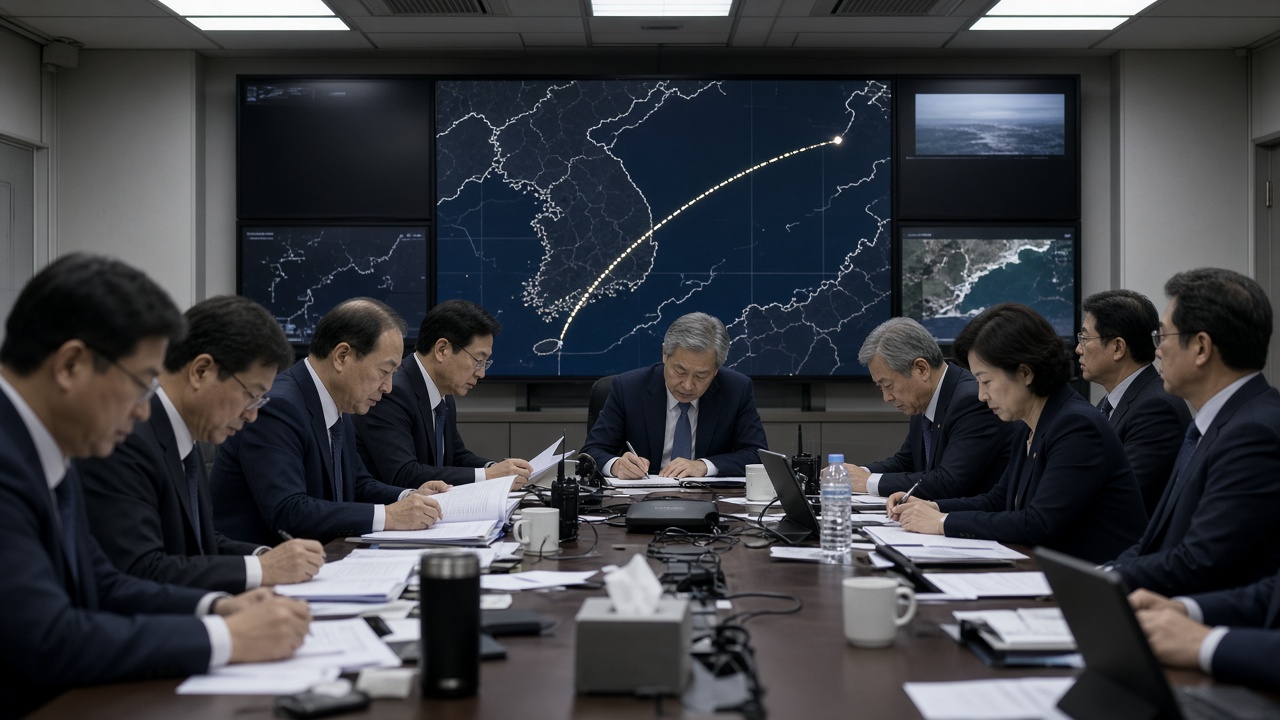
South Korea’s presidential National Security Office held an emergency session Saturday after the military detected at least one ballistic missile fired from the Wonsan area toward the East Sea, Cheong Wa Dae said. The office called the launch a violation of United Nations Security Council resolutions and urged North Korea to halt further provocations.
Launch profile and allied coordination
The Joint Chiefs of Staff said the missile was detected early Saturday morning. South Korean and U.S. authorities were analyzing the flight data, including range and apogee, to classify the system. Japan’s government also reported the launch and said it was studying the trajectory.
Senior diplomats from South Korea, the United States and Japan held a joint phone call to discuss responses, Seoul’s foreign ministry said. Baek Yong-jin, director general for Korean Peninsula policy, spoke with David Wilezol, deputy assistant secretary for Northeast Asia at the U.S. State Department, and Takashi Ariyoshi, a senior Japanese foreign ministry official, the ministry added.
Pyongyang’s AI claim
Hours after the detection, Kim Yo-jong, the sister of North Korean leader Kim Jong Un, said the morning test involved an intermediate-range strategic missile. She claimed the projectile can change its flight path at low altitude and that artificial intelligence was incorporated into the system, without offering technical evidence or imagery.
Western and South Korean analysts have long tracked North Korean efforts to maneuver warheads and confuse missile defenses, but independent verification of an “AI-guided” flight is difficult without telemetry or debris. Seoul typically refrains from endorsing Pyongyang’s weapons branding until allied review is complete.
DMZ tensions in the background
The launch followed a bitter exchange over a land-mine blast inside the Demilitarized Zone that wounded three South Korean soldiers last month. Seoul and the U.S.-led United Nations Command said North Korean mines planted south of the military demarcation line caused the explosion. Pyongyang, through Kim Yo-jong, rejected responsibility and mocked Seoul’s demand for an apology.
President Lee Jae Myung had used a national speech Thursday to call for steps to ease tensions and restore dialogue, even as his military pressed for accountability over the DMZ incident. Saturday’s missile test is the latest in a series of North Korean launches this year and comes as Lee’s government tries to balance outreach with readiness exercises alongside U.S. forces.
Domestic readiness
Cheong Wa Dae said the National Security Office reviewed allied detection assets and instructed the military to maintain heightened vigilance. Public alerts in South Korea were not raised beyond standard monitoring, but opposition lawmakers were expected to demand a fuller briefing when the National Assembly returns from the Gaecheonjeol holiday.
Officials did not announce new unilateral sanctions Saturday. Any additional U.S. or Japanese steps would likely be coordinated after allied analysis concludes. For now, Seoul’s message remained a familiar pairing: condemnation of the launch and a call for Pyongyang to return to diplomacy without preconditions tied to the DMZ dispute.