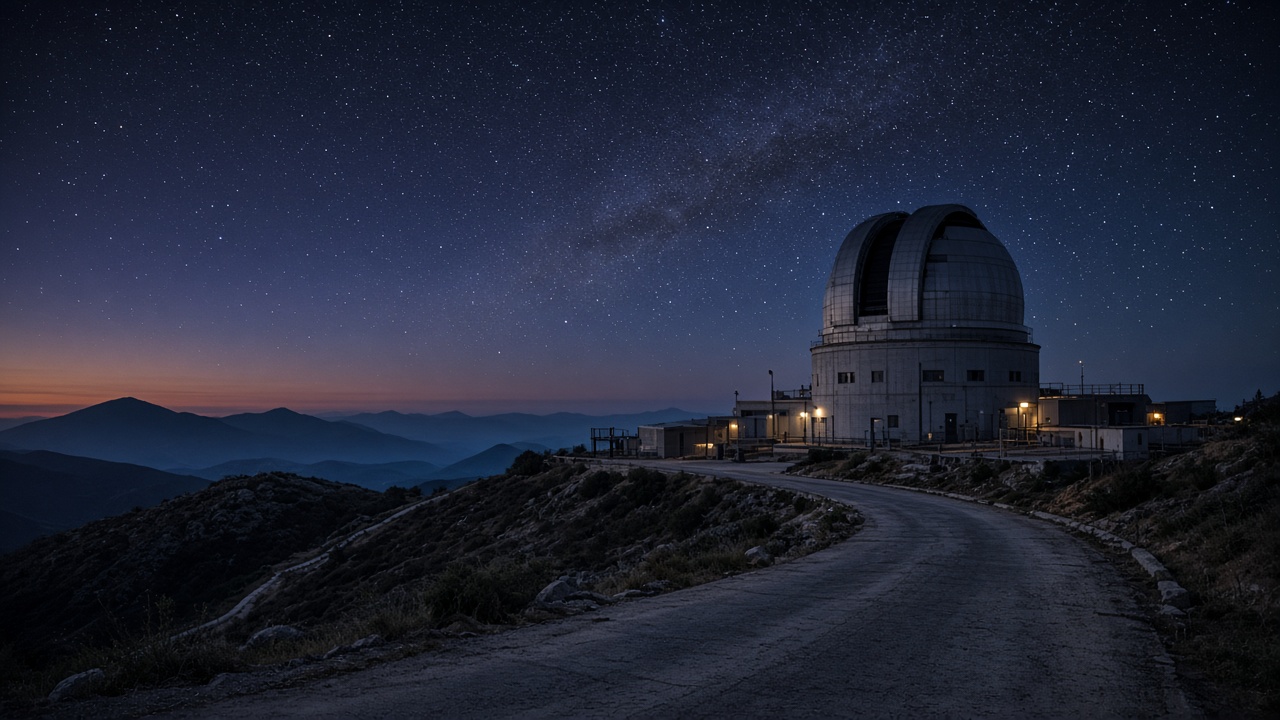
Researchers at Durham University's Institute for Computational Cosmology have published a tighter bound on how quickly dark energy might drift over cosmic time, using commissioning exposures from the Vera C. Rubin Observatory in Chile that UK partners helped calibrate.
The result does not overturn the standard lambda-cold-dark-matter model, but it shrinks the error bars on a parameter that governs how fast the universe's expansion accelerates. For British astronomers who fought for access time on Rubin's Legacy Survey of Space and Time, the paper is proof that early data can support fundamental physics—not just asteroid catalogs.
What Rubin is measuring
Rubin's 8.4-metre Simonyi Survey Telescope will repeatedly image the southern sky, building a motion picture of variable objects and weak gravitational lensing signals. Weak lensing—tiny distortions in galaxy shapes caused by intervening mass—traces the growth of cosmic structure and, indirectly, the behaviour of dark energy. Commissioning frames taken while engineers tuned the camera delivered a sneak preview of depth and seeing conditions.
Durham's team combined those frames with simulations run on the DiRAC national supercomputing facility, testing whether dark energy's equation of state could evolve without breaking fits to other probes such as the cosmic microwave background. The drift limit they report is consistent with a constant dark energy component, but it excludes some exotic models that had survived looser priors.
UK role
UK scientists contribute detector expertise, data pipelines and survey strategy through the Rubin Observatory Corporation. STFC funding lines tie Durham, Edinburgh and Cambridge groups to processing petabytes of alerts each night. Publishing on commissioning data signals that British teams are not waiting for year-three releases to ship science.
Peer reviewers asked for careful systematics checks because commissioning exposures lack the final photometric calibration. The authors document flat-field residuals and point-spread-function modelling choices so follow-up teams can reproduce the bound before the main survey begins.
Why it matters beyond academia
Dark-energy drift is not a kitchen-table topic, but the instrumentation behind Rubin is. UK firms built optics components and software stacks that will filter alerts for supernovae, near-Earth objects and stellar streams. Skills honed on Rubin feed into Earth-observation startups and defence sensing programmes that hire physics graduates in Harwell and Glasgow.
The next step is cross-correlating Rubin lensing maps with spectroscopic surveys such as DESI and Euclid. If drift parameters move when datasets combine, cosmologists will face another decade of model tension. For now, Durham's estimate gives theorists a sharper fence—and gives taxpayers a tangible return on Chilean mirror time negotiated in Whitehall grant councils.
Undergraduate physics societies at Durham and Newcastle plan public lectures on the result, tying abstract cosmology parameters to concrete engineering stories from the Rubin camera team.