Chemists at the University of Manchester and partner labs in Germany reported the first isolable uranium Fischer-type carbyne, a compound featuring a uranium–carbon triple bond stable enough to study in detail.
The result, published in Nature Chemistry, ends a long-standing challenge in actinide science: creating a triple bond between uranium and carbon that survives outside fleeting reaction intermediates. Researchers used a carbon-atom transfer strategy to build a molecule they could characterise with crystallography and computational models, revealing electron sharing that resembles but does not mirror transition-metal bonding.
Why the bond matters
Actinide elements sit at the bottom of the periodic table and underpin nuclear fuel cycles, waste processing and fundamental questions about heavy-element chemistry. Most textbooks treat uranium–carbon multiple bonds as too reactive to isolate; proving otherwise gives experimentalists a platform to test catalyst concepts and bonding theories that were previously speculative.
Quantum crystallography measured a uranium–carbon distance near 2.38 ångströms, short enough to support triple-bond character even though classical pictures would demand even tighter spacing. The team described orthogonal one-electron interactions between metal and ligand, a pattern rare in lighter elements.
From bench to broader science policy
UK university chemistry departments have faced steady pressure to justify blue-sky work against applied funding missions. Results like this feed both narratives: they advance nuclear stewardship knowledge while demonstrating British leadership in fundamental science post-Brexit collaboration rules.
Manchester's press office noted the eight-year effort behind the synthesis, highlighting shared facilities for air-sensitive compounds. PhD students trained on those methods often move into national laboratories or industry roles handling nuclear materials, where precise bonding models inform safety cases.
What comes next
Follow-up studies will probe whether related carbynes can be tuned for catalysis or for separating actinides in reprocessing streams. For now, the paper gives spectroscopists a concrete target to compare against theoretical predictions, a step chemists compare to finally photographing a predicted orbital interaction rather than inferring it from side reactions.
Safety culture around air-sensitive synthesis
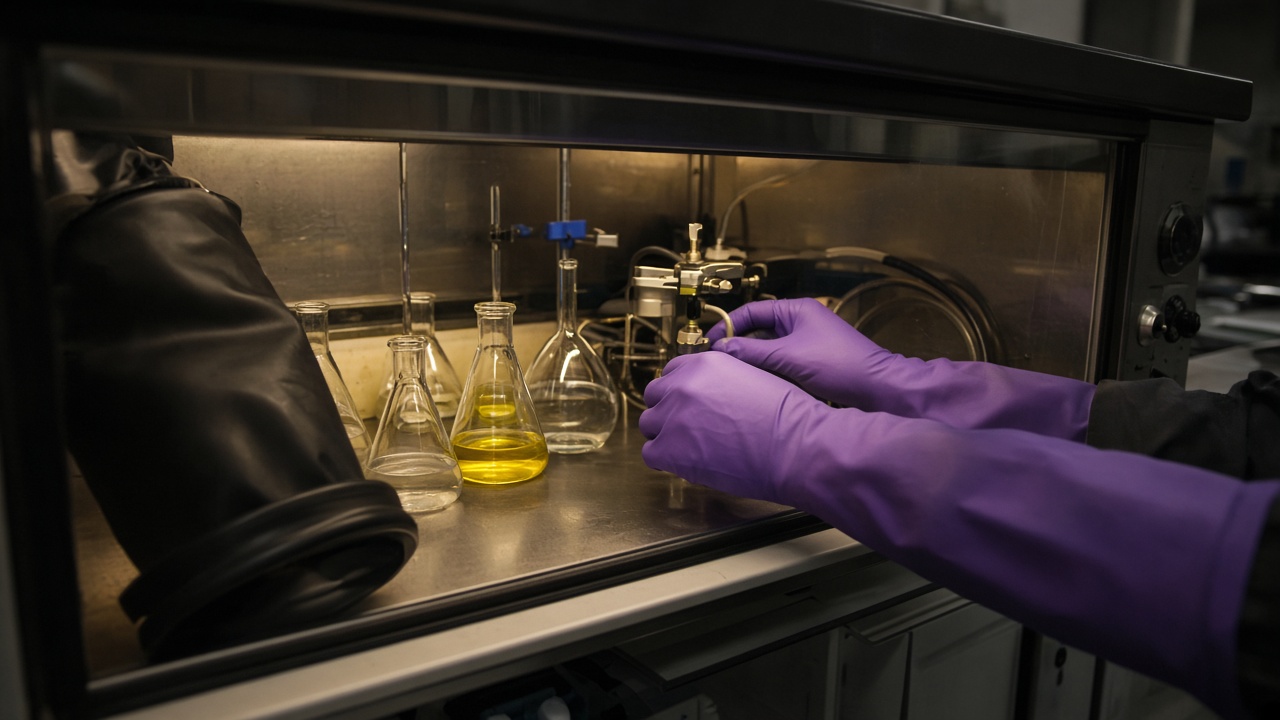
Organometallic labs that handle uranium compounds operate under strict radiological controls and inert-atmosphere glove boxes, constraints that limit how many groups can attempt similar experiments. Manchester's collaboration with German partners allowed shared expertise on carbene precursors while keeping waste handling within national regulations.
Industry readers may ask whether the chemistry has near-term fuel-cycle applications or remains a fundamental milestone. The authors emphasised knowledge gain for waste form design and for predicting how actinides bind carbon in legacy ponds, areas where small bonding surprises can change environmental risk models.
Teaching and collaboration
Graduate students involved in the project gained experience with single-crystal X-ray diffraction under radiation-aware protocols, skills transferable to national nuclear laboratories and to companies developing medical isotopes. Manchester's Dalton Nuclear Institute has promoted the result in outreach sessions for local schools, framing actinide chemistry as part of the UK's net-zero and energy-security conversation rather than a niche academic curiosity.
Peer reviewers asked the authors to compare their bonding model with recent thorium and neptunium carbene literature, ensuring the uranium result fits a broader periodic trend. That context will guide the next round of synthesis attempts targeting even heavier elements where experimental data remain sparse.