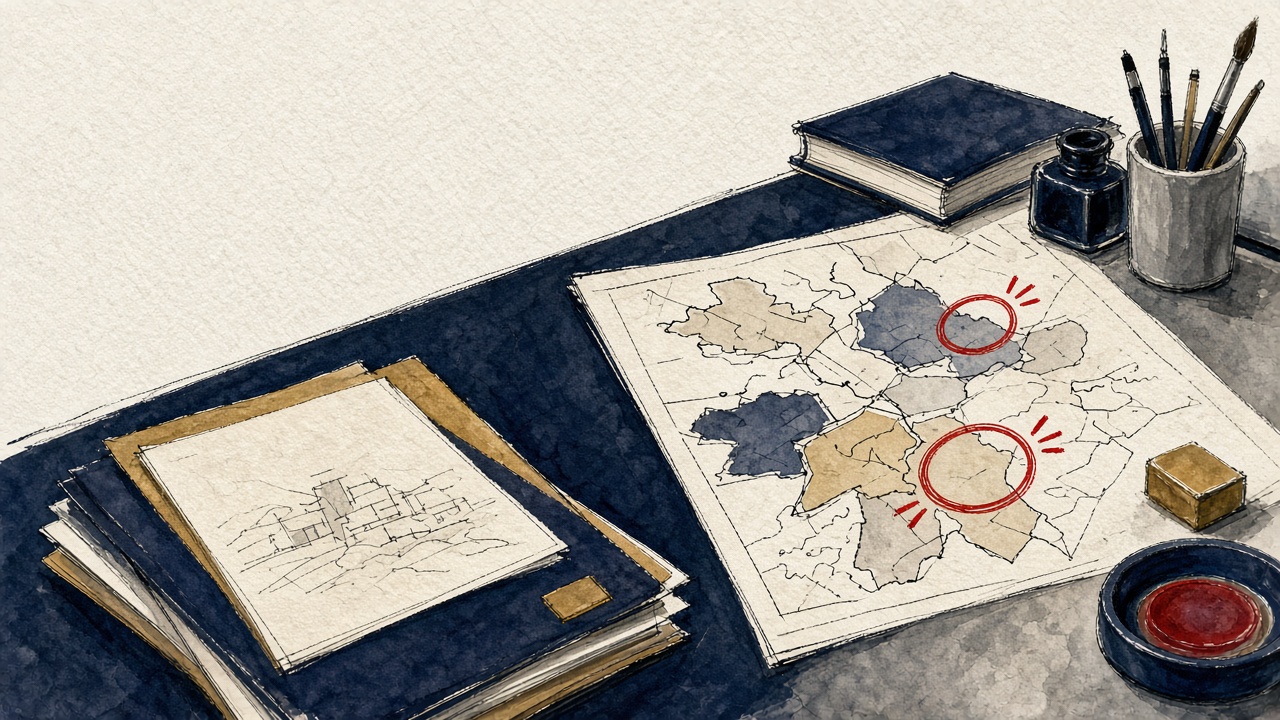
On 8 April 2025 the National Property Administration told budget planners that Taiwan's national land was worth more than NT$5.3631 trillion on the government's own ledgers for 2024. The same press release, citing Ministry of the Interior land data, added a second figure: if announced land values tracked fair market value, that portfolio would be closer to NT$27.3767 trillion. The gap is not a rounding error. It is how the state prices the same dirt twice.
A portfolio priced two ways
The catalog covers about 2.24 million hectares of national land, roughly 90% of it public-use parcels managed by agencies from the forestry service to national universities. When acquisition cost is unknown, the finance ministry records land at declared values tied to the announced land price series, not at what a buyer would pay tomorrow.
Interior's land department puts that series near one-fifth of market. The property administration translated the ratio into money: announced land values represented 19.59% of fair market value in 2024. Divide the declared stack into the implied market stack and the arithmetic lands almost exactly on that percentage.
Total national property in the catalog, land plus buildings and other assets, was about NT$12.0073 trillion. The land valuation alone therefore captures only a slice of what taxpayers might think government wealth means when they watch auction prices in Taipei or Taoyuan. The catalog submission went to the Directorate General of Budget, Accounting and Statistics on 10 March 2025, the annual ritual that feeds the central government's budget books.
The bill that does not match the sale
Homeowners feel the split every autumn. Trade press covering the 2024 land-price cycle noted that land-value tax bills would go out around 1 November, keyed to announced land prices that had just been reset. The notice shows a government land price that bears little resemblance to the number on a recent sale contract or mortgage appraisal. Neighbors compare the two figures over tea and assume someone in city hall made a typo. The typo story is comforting because it implies one clerical fix would align tax with reality.
That is because the annual land-value tax uses announced land price (公告地價), not the transfer benchmark printed on deed paperwork. The Ministry of the Interior said plainly in a 2021 release that announced land price is the assessment base for land-value tax, set by each county after weighing local market moves and what residents can afford to pay.
Wrong answer: officials simply will not update
The lazy story is stale data. Taiwan, in this version, refuses to mark property to market the way a bank would, so holding taxes stay artificially low while prices soar.
Stale is the wrong diagnosis. Since 1 July 2020 both buyer and seller must declare transaction prices when they register a sale, a change the interior ministry highlighted in its 2022 annual report as a way to improve accuracy and speed disclosure. The same report noted that 219 thousand building transactions were published through the real-price registration system in 2018 alone, long before the two-sided declaration rule.

Officials are not flying blind on market levels. Announced current land value, the series used when property changes hands, rose an average of 2.50% nationally between 2021 and 2022 according to the ministry's English-language outline. Announced land price, the holding-tax series, rose an average of 2.68% over the same 2020–2022 window in that report, a reminder that both numbers move, just not toward the same target.
The interior ministry has compiled urban land price indices since 1989, publishing them twice a year so local committees can see neighborhood trends before they reset values. The machinery to watch market prices exists. The complaint homeowners voice at tax time is not missing market data. It is which official number their particular tax uses.
Wrong answer: Taiwan taxes property at punishing rates
A second guess points to high statutory rates. House Tax 2.0, which took effect on 1 July 2024, raised the political temperature by stacking rates on people who own many homes. Under the finance ministry's published examples, an owner with seven or more non-owner-occupied homes nationwide pays 4.8% on all of those units, not just the marginal one.
Yet the tax still multiplies a rate by an assessed house value that counties rebuild from construction type, depreciation and location factors, not from the last open-market sale. The finance ministry publishes the formula as standard unit price times one minus depreciation, times a location rate, times area. A newer concrete high-rise on a busy commercial strip therefore carries a higher assessed value than an aging row house on a quiet lane, even if both sold for similar prices per ping last month.
Building tax can bite harder after 2024, especially for portfolios, without fixing the low land-price base underneath the lot. A landlord who crosses the seventh home threshold sees every unit in that portfolio taxed at 4.8%, yet still owes land-value tax on each parcel's announced land price, which nationally remains near one-fifth of market.
The turn: two land values on one map
Taiwan maintains two land benchmarks on the same cadastral map. Announced current land value (公告土地現值) is the one that tracks normal transaction prices for transfers, inheritance and compensation. Announced land price (公告地價) is the one that feeds the annual land-value tax.
Interior statistics compiled by National Chengchi University's real estate research center show how far the transfer benchmark has converged on market prices. Nationally, announced current land value was 81.48% of normal transaction prices in 2011 and 93.01% in 2024, reaching 93.31% in 2025. Taipei City hit 100% in 2022.
The land-value tax series did not take that ride. The ministry's 2022 outline put the ratio of announced land price to regular transaction prices at 19.68% for 2022, barely changed from 19.79% in 2020. The 2024 national property catalog used 19.59%. Holding tax therefore still sits on a floor near one-fifth of market even while transfer tax chases nine-tenths of the price.
How counties keep the land tax base low
Counties do not set either series in a vacuum. Before the January 2022 land-price reset, the interior ministry summoned local governments and told them to gather transaction prices and urban land price indices, then document their land-price committee meetings online. The same 2021 release reminded mayors that the Control Yuan had scolded Taichung for cutting 2020 announced land prices by about 20%, a move the ministry said unfairly benefited a thin slice of taxpayers.
公告地價為地價稅的核課基礎,依規定是由縣市政府綜合考量地方土地市價變動、民眾負擔能力等因素後評定。

Politics shows up in the adjustment calendar. National announced land price is reset every two years rather than annually, a rhythm local news traced to rule changes beginning in 2018. When the 2024 cycle landed, the national average increase was 5.78%, the steepest in seven years according to MOI statistics republished by the research center. Taoyuan led major cities at 14.78%; New Taipei's average move was 10.44%.
Even aggressive-looking hikes start from a low base. Hualien County once told residents its announced land price was only about 14% to 15% of normal transaction prices, among the lowest on the island. When the national average announced land price jumped 5.78% in the 2024 cycle, headlines focused on the percentage move, not the level underneath. A double-digit increase on a 15% base still leaves the tax far below what a sale would imply.
Interior's Chinese-language 2022 yearbook repeated the national ratio for announced land price at 19.68% of normal transaction prices in 2022, almost unchanged from 19.79% in 2020. That stability is the point. Committees are allowed to nudge the holding-tax benchmark upward, but not to let it chase the 93% transfer series.
The land-value tax is therefore a holding charge on a deliberately discounted number, not on the price a developer would pay. Counties that cut too aggressively face central scrutiny; counties that raise too quickly hear from retirees on fixed incomes. The MOI press release framed the balance as 民眾負擔能力, taxpayer capacity, sitting alongside market data in the same sentence as fairness.
Buildings caught in House Tax 2.0
Reformers who want more revenue from real estate have lately aimed at buildings, not land alone. House Tax 2.0 redefined owner-occupied treatment around household registration, limiting preferential rates to homes where owners, spouses or lineal relatives actually live and are registered. It also nationalized the count for investment homes, so a landlord's tier depends on total units owned across Taiwan.

The finance ministry still calculates house tax as assessed house value times rate, using a formula that knocks value down for age and materials before a location factor is applied. Owner-occupied relief now requires the owner, spouse or lineal relatives to live in the home and hold household registration there, aligning house tax with the residency tests long used in land-value tax debates.
Non-owner-occupied homes are counted on a nationwide basis, so a Taipei apartment plus a Kaohsiung studio plus a Taichung parking conversion add up before the rate tier is chosen. That design targets people who treat housing as a spread of bets, not families stretching to afford one roof.
House Tax 2.0 is a different machinery from land-value tax, but the policy direction is similar: tighten building charges where political resistance to marking land at market has been fiercest. Land still enters the picture through the lot beneath each building, taxed on announced land price while the structure above faces the new residential tiers.
Back on the national ledger
Return to the April 2025 property catalog. Budget officials received national land at NT$5.3631 trillion because statute tells them to use announced land price for most parcels. They also received an implied market near NT$27.3767 trillion because interior publishes what that series would be worth if it tracked fair value. Same hectares, two prices, two purposes.
Until those series merge, a homeowner can live in a market where sales prices are visible in every neighborhood chat group while the land tax bill still multiplies a rate by a number the ministry itself places near one-fifth of that conversation. The National Property Administration made both figures public on the same page. The puzzle was never hidden. It was split, and the split is written into which tax form asks for which official price.