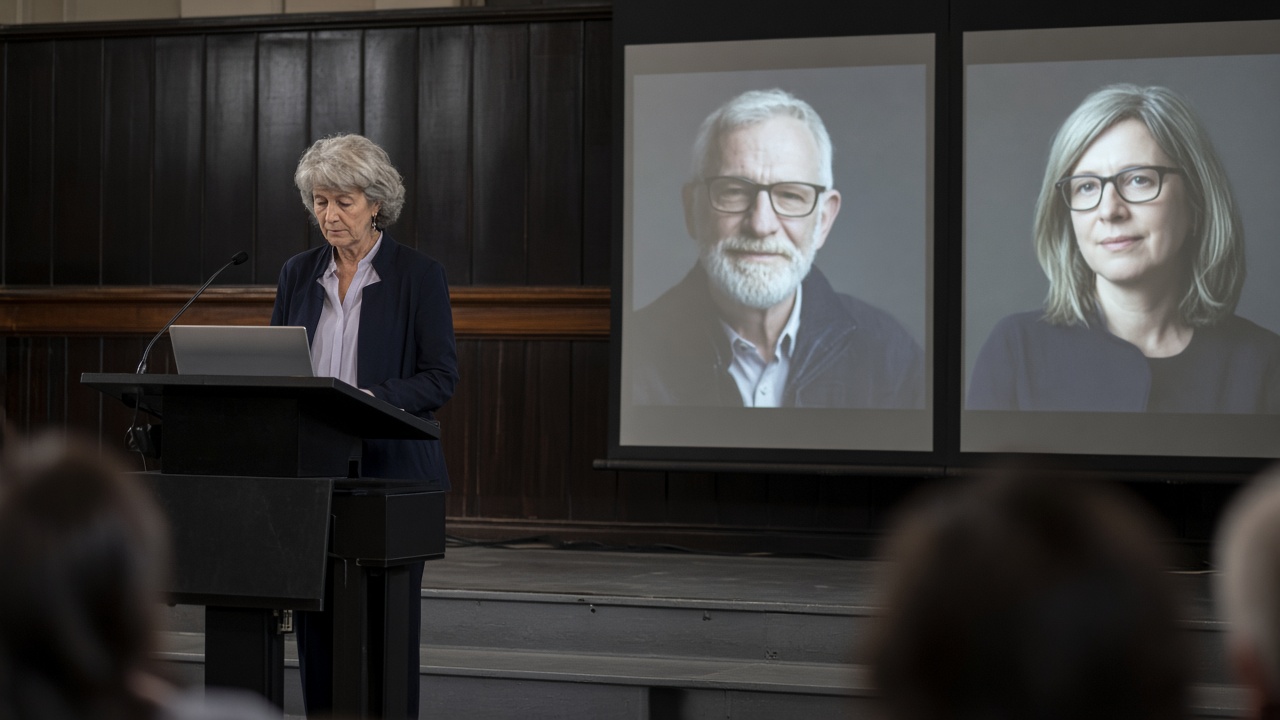
The Royal Swedish Academy of Sciences awarded the 2026 Nobel Prize in Chemistry on Wednesday to Henri B. Kagan of France and Kenso Soai of Japan for work that shows how chemical reactions can amplify a single mirror-image form of a molecule until a mixture becomes almost entirely one-handed — a route chemists have sought for more than a century to explain why biology uses only one chirality.
Chair of the Nobel Committee for Chemistry Heiner Linke said Kagan and Soai had answered a puzzle dating to Louis Pasteur: how homochirality — the dominance of one molecular handedness in amino acids, sugars and drugs — could arise without a living cell already present to sort the variants.
From nonlinear effects to a self-amplifying reaction
Kagan’s decisive step came in 1985, when he found a way to push asymmetric organic synthesis beyond the small excess of one mirror image that chemists thought was the practical ceiling. By exploiting what became known as nonlinear effects, he could steer reactions so that tiny imbalances in catalysts or reagents snowballed into much larger preferences for one product.
Soai, born in Hiroshima and trained at the University of Tokyo, extended that logic toward autocatalysis — reactions in which the product helps make more of itself. In 1995 he published a design for a reaction that could, in principle, become fully homochiral. Eight years later, in 2003, he reported a system in which only one of two possible mirror images formed, the first time researchers had achieved that outcome outside living organisms.
The academy cited both laureates “for the discovery of non-linear effects and autocatalysis in asymmetric organic synthesis.” The Royal Society of Chemistry noted that the reactions are now tools for pharmaceutical labs that must produce single-enantiomer drugs, where the wrong mirror image can be inactive or toxic.
Why the mirror matters in medicine and origins research
Many drug molecules exist as pairs of nonsuperimposable mirror images, yet a human body typically interacts with only one. Chemists therefore spend enormous effort separating or synthesizing the active hand. The Soai reaction and related autocatalytic pathways offer a conceptual bridge between prebiotic chemistry and the uniform chirality seen in proteins and DNA.
Soai is professor emeritus at Tokyo University of Science. Kagan is associated with Université Paris-Sud. Each receives half of the prize purse, a diploma and a medal at ceremonies in Stockholm in December.
Linke called the laureates’ reactions “spectacular,” adding that they had provided a solution to a chemical mystery more than a century old. The announcement continues a week of Nobel disclosures; physiology or medicine and physics prizes were awarded earlier in the cycle.
For synthetic chemists, the prize formalizes a line of research that moved from curiosity about Pasteur’s crystals to industrial asymmetric catalysis. For biologists studying the origin of life, it offers a plausible chemical mechanism — not proof, but a tested pathway — for how a planet’s primordial soup might have tipped toward the single handedness that defines terrestrial biochemistry.