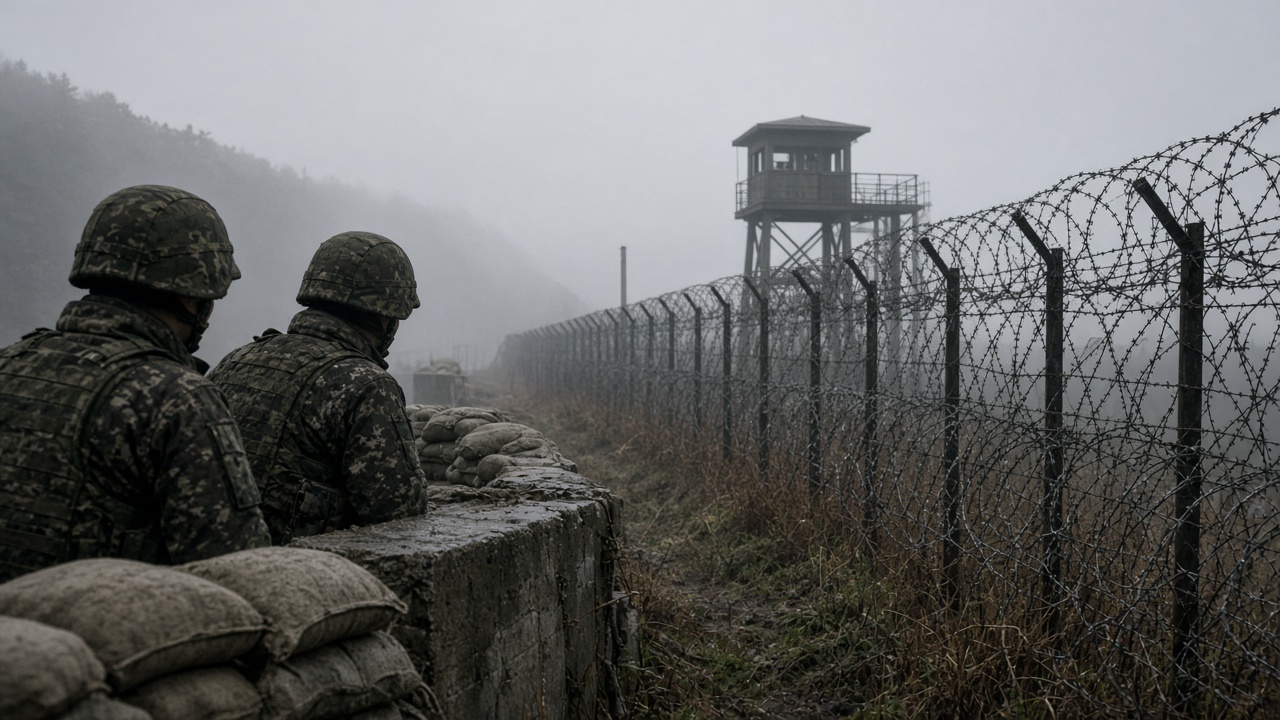
North Korea’s Foreign Ministry said Tuesday that South Korean troops must not cross the heavily fortified border “by even a millimeter,” warning that border guard units would take “immediate and powerful counteraction” if a jackboot or spark of fire from the South violated Northern territory.
The statement, carried by state-run Korean Central News Agency, came as Seoul pressed ahead with mine-clearing work along the Demilitarized Zone after three South Korean soldiers were wounded in a blast last month. South Korea’s military said Monday that the device was a North Korean landmine, a finding Pyongyang dismissed as a fabrication aimed at justifying incursions.
Seoul’s clearing operation
Defense officials in Seoul have described the demining push as a safety measure for personnel patrolling front-line sectors where vegetation and seasonal rains can expose old ordnance. The operation followed public outrage in the South after the September blast, which left two soldiers with leg injuries and a third with shrapnel wounds.
North Korea “categorically rejects the despicable attempt” to blame the North, the Foreign Ministry said, adding that Pyongyang would “exercise its just sovereign rights in a more resolute and bold manner to ensure the security of the southern border.” The language mirrors earlier KCNA denials that Northern units planted fresh mines in the area where the soldiers were hurt.
Warning to Washington and Taipei
In a separate commentary published the same day, North Korean state media criticized U.S. weapons sales to Taiwan and said Washington was acting “rashly” in the Asia-Pacific. The piece asserted that “no one should question” China’s ability to defend its sovereignty, linking peninsula tensions to broader great-power competition even as inter-Korean hotlines remain largely dormant.
South Korea’s Unification Ministry had no immediate public response to the millimeter warning as of Wednesday morning in Seoul. Joint Chiefs officials reiterated that demining teams are operating on the southern side of the Military Demarcation Line under existing rules of engagement and are not staging cross-border raids.
What front-line units watch
Analysts in Seoul said the Foreign Ministry’s phrasing is calibrated to deter any accidental spillover during clearing work without committing to a specific military timetable. Still, the threat of “immediate” retaliation raises the stakes for engineers working within sight of Northern guard posts at places like the Imjingak area, where tourists and veterans gather within earshot of loudspeaker broadcasts.
With U.S.–South Korea exercises continuing on a reduced schedule this autumn, commanders on both sides of the DMZ are tracking whether Pyongyang pairs rhetoric with artillery drills or drone probes. Veterans groups in the South have urged the government to finish clearing known hazard zones before winter training cycles intensify, while human-rights monitors warn that escalatory language can make accidental incidents harder to de-escalate once shots are fired.
For now, the exchange is diplomatic: Seoul insists the mine was Northern; Pyongyang insists any Southern boot that strays will be treated as an invasion measured in millimeters, not kilometers.