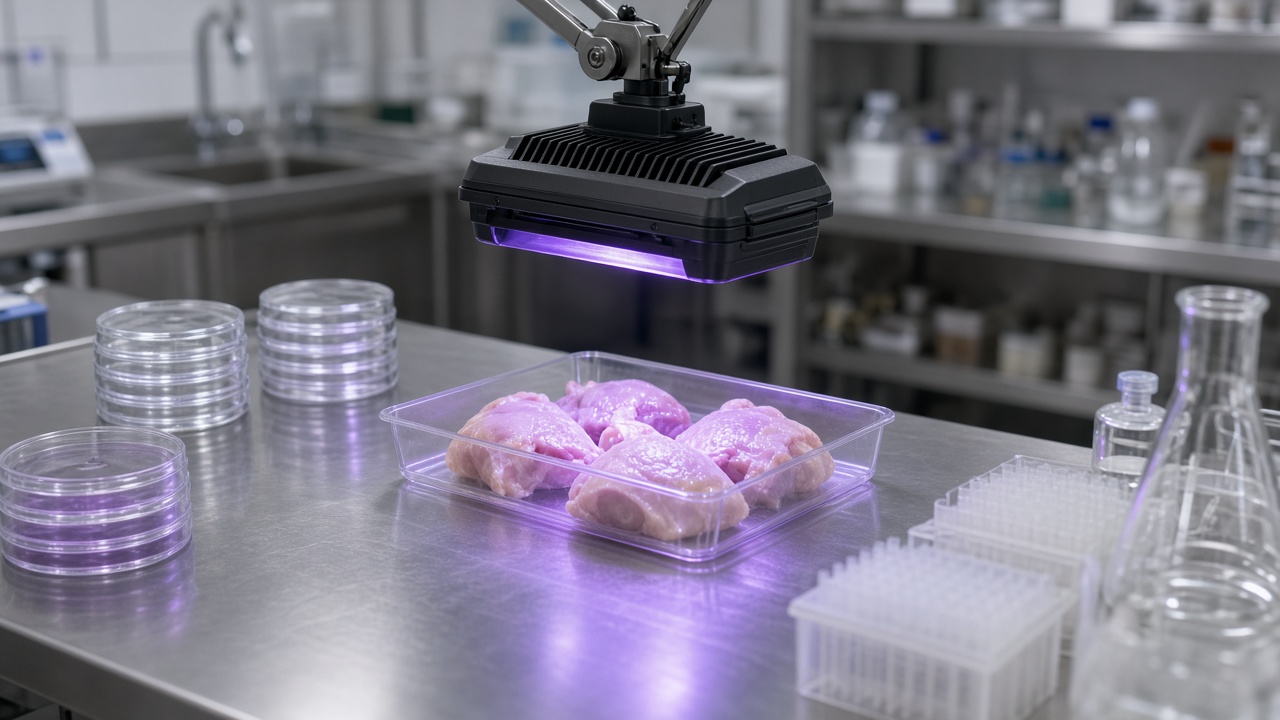
Researchers at the University of Reading and the Animal and Plant Health Agency killed every Campylobacter strain they tested using low-power violet-blue photodynamic inactivation, according to a study published on 6 October in the journal Microbiology. The work matters because Campylobacter contaminates roughly three quarters of raw chicken sold in Britain and causes tens of thousands of confirmed food-poisoning cases each year.
How the treatment works
Violet-blue photodynamic inactivation, or VB-PDI, uses specific wavelengths to excite molecules that damage bacterial cells without the high heat of traditional cooking. The team challenged 64 strains drawn from APHA surveillance, spanning species and antibiotic-resistance profiles seen in UK processing plants. All died under the lab protocol, and repeated exposure over 15 cycles did not produce tolerant mutants in the experiment.
Path to the plant floor
Co-lead Samuel Connelly of APHA said the simplicity of the kit could allow deployment at multiple points in the supply chain, though trials on naturally contaminated carcasses in commercial lines are still required. Reading scientists previously identified molecular reasons Campylobacter is unusually sensitive to violet-blue light, which could help engineers tune lamps for abattoir conveyor speeds without scalding meat surfaces.
Public health stakes
NHS laboratories see seasonal spikes in Campylobacter admissions linked to undercooked barbecues and cross-contaminated kitchen surfaces. Any intervention that cuts bacterial load before packaging could complement existing chiller controls and consumer education campaigns. Regulators would need to sign off on chemical residues, worker eye-safety protocols, and energy use before plants retrofit lines.
What comes next
The study stops at controlled lab conditions; industry pilots will determine whether VB-PDI can beat chlorine washes on cost and whether retailers will market the technology to anxious parents. For now, food scientists have a rare uniform result across diverse strains—a promising signal that still demands factory-scale proof.
UK burden of illness
UK Health Security Agency statistics show Campylobacter as the leading bacterial cause of foodborne illness, with peaks after summer barbecues and Christmas turkey handling errors. Any processing intervention that lowers bacterial loads on carcasses could ease pressure on GP appointments during winter vomiting outbreaks, though vaccination programmes remain unrelated to poultry contamination.
Retail and regulator view
Major supermarkets said they would await Food Standards Agency guidance before commenting on in-plant light systems. Consumer groups welcomed any science that reduces kitchen cross-contamination but stressed that cooking chicken to 70°C at the centre remains non-negotiable.
Environmental groups noted energy use of continuous LED arrays and asked whether abattoirs could power lamps from on-site solar during daylight shifts.