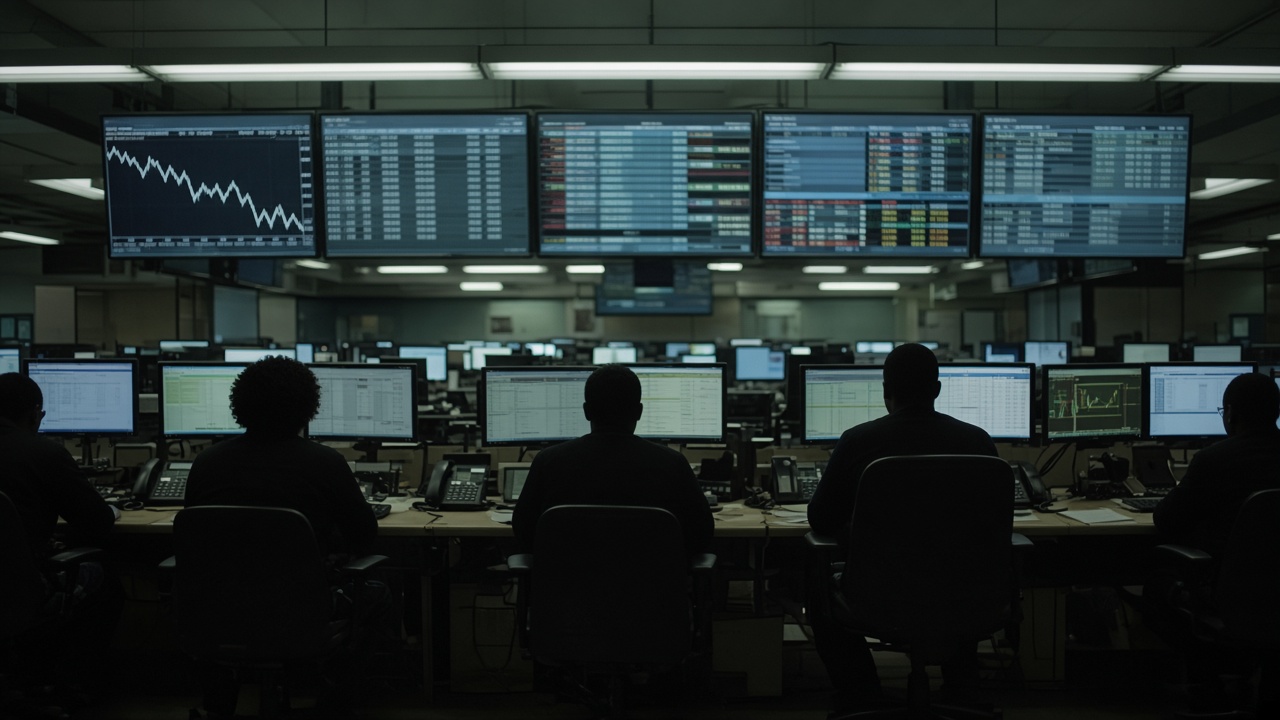
South Korea’s benchmark opened softer Thursday as three overlapping catalysts hit the same session: the release of U.S. Federal Reserve meeting minutes in the early hours, monthly index options expiration, and Samsung Electronics’ preliminary third-quarter earnings. Foreign investors extended the net selling that had already pushed the Kospi to 6,803.90 on Wednesday, while retail accounts again provided dip-buying support in large-cap tech names.
Wednesday’s close set the tone
The Kospi fell 137.49 points, or 1.98 percent, on Wednesday, its second consecutive decline, while the Kosdaq dropped 2.34 percent to 898.43. Semiconductor leaders led the slide ahead of Samsung’s guide, and LG Electronics tumbled double digits after its own preliminary profit estimate disappointed. KB Securities researcher Im Jeong-eun warned in a note that volatility could widen once the FOMC minutes and options expiry aligned with the earnings headline.
Flows and positioning
Exchange data showed foreigners unloading hundreds of billions of won in Samsung and SK hynix into the close Wednesday, continuing a pattern that began with a more than 1.7 trillion won net sell a day earlier. Institutions joined on the sell side, while retail investors bought a net 502.9 billion won of Kosdaq shares alone, reflecting the familiar split between offshore funds de-risking and domestic households averaging into chip exposure.
Options expiry adds mechanical pressure: dealers hedging gamma on the 6,800 strike can amplify moves in either direction when the underlying hugs a round number. Traders said implied volatility on near-dated Kospi calls rose into Wednesday’s close, a sign desks expected a larger post-earnings range than a typical midweek session.
Macro cross-currents
The September FOMC minutes arrived after U.S. equities had already set fresh records, leaving Seoul to interpret whether policymakers still see room to hold rates steady while oil and Treasury yields climb. Korea Investment & Securities told clients this week it expects the Kospi to trade between 6,400 and 7,600 in October, with sector dispersion rather than a broad beta rally.
The won strengthened slightly against the dollar into Wednesday’s close, which helps exporters’ translated earnings but can trim won-denominated index gains when multinationals are the leaders. Kosdaq names tied to semiconductor equipment, including Jusung Engineering and Wonik IPS, fell harder than the benchmark, suggesting beta to memory sentiment remains high on the junior board.
Samsung as the session’s pivot
Even before the preliminary filing, consensus clustered near 106 trillion won of operating profit and revenue above 200 trillion won. A guide in that band was unlikely to re-rate the stock on its own; disappointment would have been the tail risk. The market’s reaction therefore hinged on whether foreigners treated the print as a reason to cover shorts or to keep reducing exposure into year-end window dressing.
LG Energy Solution and battery-material names offered a partial offset Wednesday, but the index weight of memory giants dominates. Samsung Electro-Mechanics, a parts supplier, saw after-hours buying that trimmed its daytime loss, a hint that some investors were separating handset supply chain names from pure memory beta.
What desks watch next
Beyond Thursday, attention shifts to U.S. mega-cap tech earnings and to whether Korean exporters’ October shipment data confirm a fourth-quarter memory price path. Domestic policy headlines from the National Assembly audit season have been secondary to global rates in recent weeks.
For session traders, the combination of derivatives expiry and a trillion-won-scale earnings guide is a liquidity event: volumes typically spike in the first hour, then compress once hedges roll off. The Kospi’s ability to hold the 6,800 area into the close will be read as a signal on whether the October down-leg is a correction within a range or the start of a deeper foreign outflow phase.