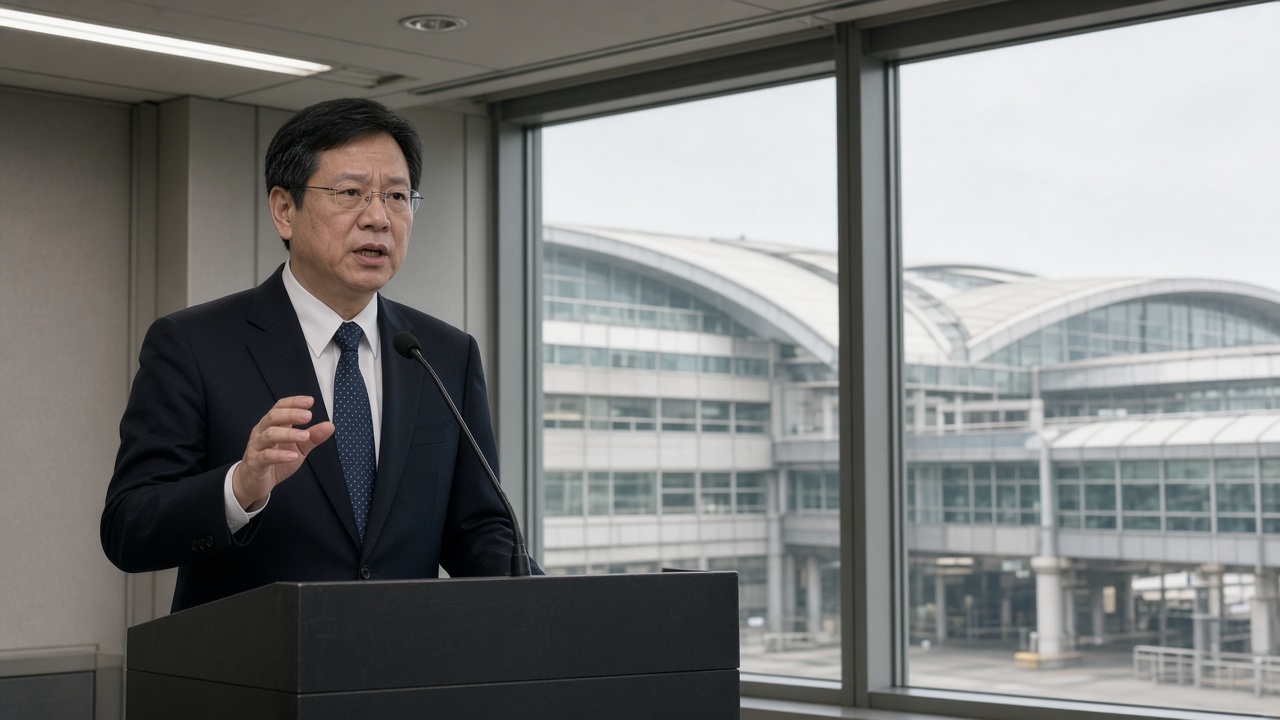
Taipei Mayor Chiang Wan-an said Thursday that he wants to relocate Songshan Airport and redevelop its downtown footprint into a Taipei AI campus, arguing that surging investor interest in artificial intelligence has left the capital short of large parcels even as Nvidia and other firms scout expansion sites.
Chiang told a city hall briefing that his administration has spent its term courting Nvidia’s regional presence and that companies now “want to invest more in Taipei but have nowhere to put it.” Moving civilian flights out of Songshan, he said, would “open Taipei” for labs, offices, and supporting infrastructure tied to the AI supply chain.
How the plan would connect the north
The mayor described Songshan’s relocation as more than a municipal land swap. He said future light-rail and expressway links would tie the site to New Taipei districts such as Luzhou, Wugu, Banqiao, and Tucheng, and connect outward to the “Taoyuan-Hsinchu-Miaoli great silicon valley” program, Keelung’s smart technology zone, and Yilan’s science park. Chiang framed the package as an eight-county “capital technology corridor” integrating air, sea, and highway links.
Legislators from the Kuomintang attended the briefing, including Luo Chih-cheng, Lee Yen-hsiu, Wang Hung-wei, and Lai Shyh-bao, along with Legislator Ko Ju-chun. Chiang did not present a binding budget or legislative proposal Thursday; he portrayed the announcement as a strategic direction that would require coordination with the Civil Aeronautics Administration, the defense ministry’s Songshan command post, and carriers that rely on the airport’s proximity to central Taipei.
Timing and Taoyuan capacity
Reporters asked whether Chiang could finish relocation before his term ends. He pointed to Taoyuan International Airport’s third terminal, which he said is scheduled to open in 2027, and a third runway slated for 2033, arguing that expanded capacity in Taoyuan could absorb Songshan traffic over a six-year window if planning starts now. Chiang acknowledged that moving the airport touches military airspace and the Songshan base garrison, saying those issues would be “planned together with the central government” even though the political direction is set.
What still has to be decided
Songshan remains one of Asia’s few downtown airports, handling business shuttles and domestic routes that executives use to avoid the hour-long trip to Taoyuan. Airlines, residents in flight paths, and defense officials have blocked similar relocation debates for decades. Chiang’s AI campus pitch reframes the conversation around land scarcity during an AI investment boom, but any closure would need cabinet-level approvals, environmental reviews, and compensation frameworks that Taipei cannot unilaterally order.
For Taiwan’s tech policy, the immediate effect is messaging: Taipei is signaling that it will compete with Hsinchu and Taoyuan for AI tenants by offering a rare urban mega-site if aviation functions shift west. Until the central government responds, Songshan’s runways stay open, and Chiang’s AI park exists chiefly as a land-use vision backed by his party allies rather than a scheduled construction start.