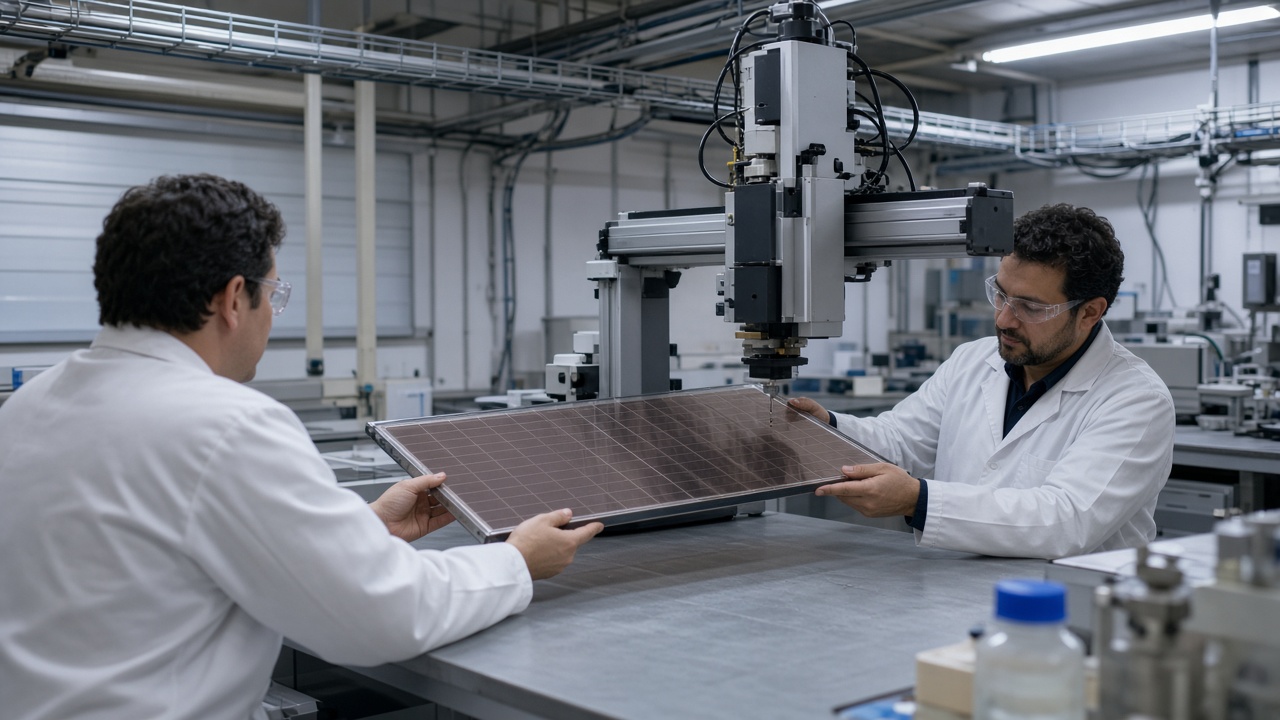
Engineers at UNSW Sydney and industry partner UtmoLight have set a certified stabilised power conversion efficiency of 23.5 percent on a 676-square-centimetre perovskite solar submodule, edging the previous large-area benchmark by 0.6 percentage points. The result matters because it closes part of the gap between tiny laboratory cells—often about a square centimetre—and modules large enough to manufacture commercially.
Scientia Professor Xiaojing Hao’s team achieved the mark on a 30-by-30-centimetre submodule, a size that forces engineers to solve uniformity and stability problems that do not appear at chip scale. Independent certification verified that efficiency held under stabilised testing, not just a flash measurement.
Removing nickel oxide
A parallel breakthrough removed the conventional nickel oxide layer often used in perovskite stacks to prevent short circuits. Eliminating that layer can simplify manufacturing if reliability holds at scale. UtmoLight’s production line allowed UNSW to test ideas on commercial equipment rather than only on benchtop cells.
ARENA recently awarded Hao’s group $6.3 million to continue improving perovskite-silicon tandem cells, which stack perovskite atop conventional silicon to capture more of the solar spectrum. Australia’s manufacturing policy increasingly treats advanced PV as both an export opportunity and a way to decarbonise heavy industry.
Why large-area records count
Investors have seen a decade of perovskite hype followed by durability setbacks. Large-area certified efficiency is one metric that separates academic curiosity from factory feasibility. If the 2.8-square-metre test scheduled for the coming months reproduces the submodule gains, Australian manufacturers could pitch tandem products into markets that already buy long-life silicon.
Grid operators wrestling with data-centre load growth also want modular solar that can be deployed quickly on warehouse roofs. Higher efficiency per square metre reduces land and mounting costs—relevant as state governments tighten planning rules on greenfield solar farms.
The record will be peer-reviewed and challenged, as all benchmarks are. For now, Kensington’s labs have shown that perovskite can scale beyond the microscope slide—and that industry co-location accelerates the path from paper to production line. ARENA will track whether the next module size retains the same stabilised efficiency under outdoor testing.
UtmoLight’s commercialisation roadmap includes supplying tandem modules to rooftop installers in New South Wales and Queensland, where high retail power prices improve payback periods. Competitors in the United States and China will scrutinise the certification documents for testing protocols that they can replicate in their own fabs.