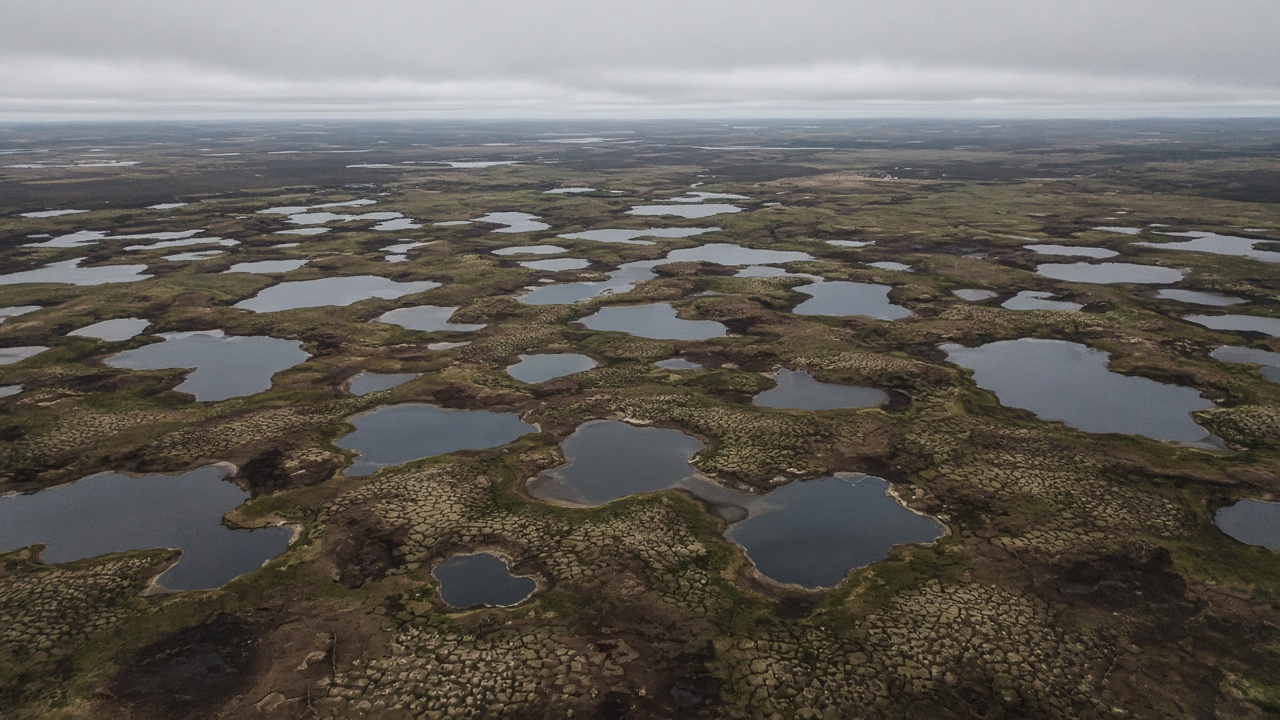
Natural systems could add between 0.2 and 0.4 degrees Celsius of extra warming by 2100 through greenhouse gases that escape as the planet heats up, according to a study published Thursday in Environmental Research Letters. The authors say those warming-induced emissions are large enough to amplify post-2020 anthropogenic warming by roughly 20 to 30 percent, yet remain largely absent from the Earth system models that governments use to set carbon budgets.
What the paper measured
Led by Sam Abernethy of Spark Climate Solutions, the team combined process-based estimates for four major feedback loops—permafrost thaw, wetlands, inland freshwaters and wildfires—across three Shared Socioeconomic Pathways. They linked rising global temperature to emission rates, then ran the MAGICC climate model to see how much additional heat those releases would produce.
Methane from the combined natural sources increased at an estimated 97 ± 6 teragrams per year for each degree Celsius of warming across all three scenarios, the paper reports. Carbon dioxide from permafrost and wildfire together rose at about 7 ± 1 petagrams of CO2 per year per degree in the mid- and high-emission pathways. By 2100, the extra warming from these feedbacks split roughly evenly between CO2 and methane, with combined uncertainty of about ±0.2 degrees Celsius on the added warming.
Why policymakers should care
Under the relatively ambitious SSP1-2.6 pathway, warming-induced emissions could still add about 0.2 degrees Celsius by 2100. Under the higher SSP4-6.0 track, the midpoint estimate reaches 0.4 degrees Celsius—enough to narrow the margin between 1.5- and 2-degree targets that ice sheets, coral reefs and crop regions are already straining to meet.
Co-author Christina Schädel of the Woodwell Climate Research Center, whose work focuses on permafrost carbon, said thawing soils account for roughly half of the projected feedback emissions in the study. Stanford’s Robert Jackson, who chairs the Global Carbon Project, said the numbers confirm that permafrost, wetlands, freshwaters and wildfires are already responding to temperature in ways that standard mitigation scenarios undercount.
What happens next in the science
The authors argue the gap is structural: because most integrated assessment models omit or simplify warming-induced emissions, remaining carbon budgets may be overstated and national pledges understated relative to real-world risk. Spark Climate’s Ben Poulter said a coordinated model intercomparison effort, sometimes referred to as WIEMIP, is now underway to test how different Earth system models represent these feedbacks ahead of future Intergovernmental Panel on Climate Change assessments.
Abernethy said the team was struck by the size of the multiplier effect. Cutting fossil fuel emissions faster, the authors emphasize, still limits how severe the natural feedbacks become because the feedback strength scales with the warming humans cause. The paper was published online 10 September 2026 with DOI 10.1088/1748-9326/ae9e24.