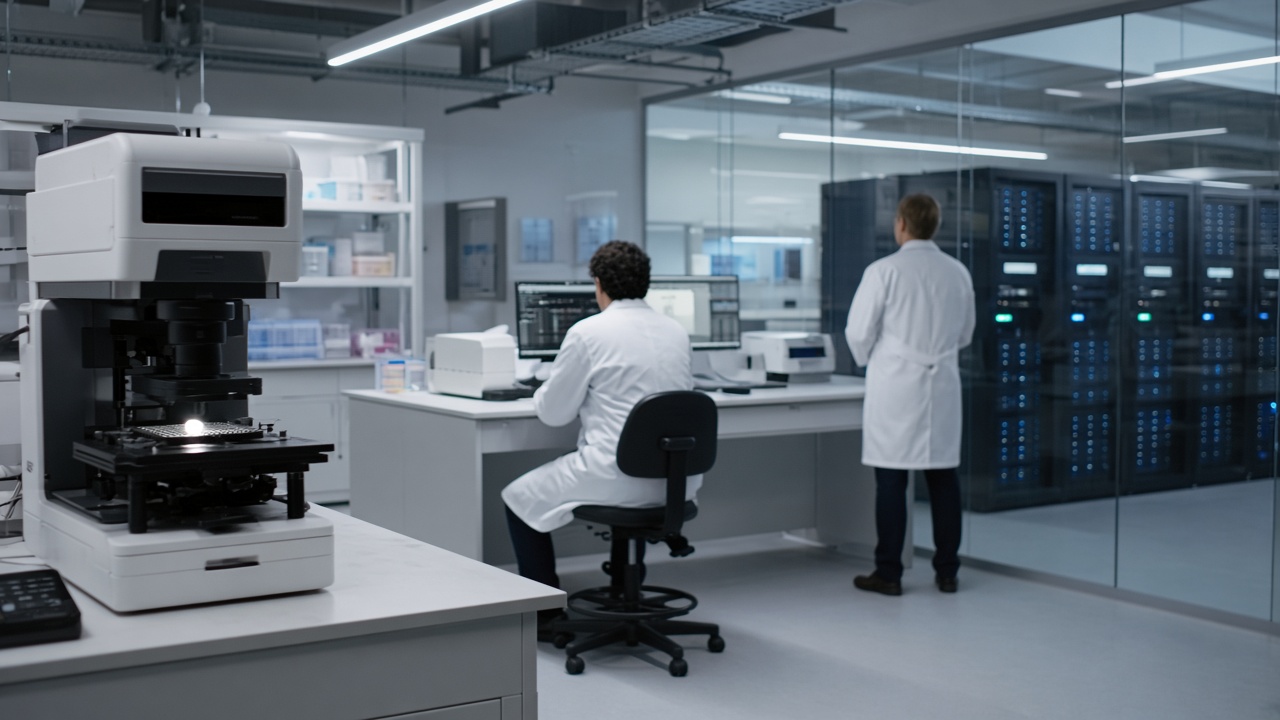
Isomorphic Labs expanded its Cambridge protein-science bench this month, posting a dozen structural-biology roles as the Google-backed drug-discovery company scales wet-lab capacity alongside the AI folding models that made headlines at King’s Cross and DeepMind’s London headquarters.
Owen Griffiths writes: the hiring push is a concrete sign that Britain’s frontier-AI story is not only about chatbots and data-centre planning rows. Isomorphic, spun out of DeepMind in 2021, pairs AlphaFold-class predictions with medicinal chemistry to design small molecules and biologics — work that sits squarely in the UK’s life-sciences corridor between Cambridge and London.
What the roles imply
Job listings reviewed by this desk emphasise cryo-electron microscopy, X-ray crystallography, and high-throughput assay design. Several mention collaboration with NHS trusts on oncology and cardiometabolic targets, though specific programmes remain confidential under research contracts.
The company already operates a significant footprint in Switzerland and maintains partnerships with Eli Lilly and Novartis. Cambridge expansion suggests Isomorphic wants discovery teams closer to university talent pools and the Babraham Research Campus ecosystem, rather than relying solely on continental sites.
Policy backdrop
Ministers have touted AI-enabled drug discovery as a Brexit-era growth pillar, even as DSIT reorganisation delays some safety legislation. The AI Security Institute continues voluntary testing with model vendors; Isomorphic’s models fall outside that regime but face MHRA scrutiny if candidates reach clinical trials.
NHS England’s research directorate has encouraged trusts to standardise data-sharing agreements for algorithmic discovery, wary of repeating the friction that slowed early genomics pilots. A spokesperson said any Isomorphic collaboration would require explicit patient consent and independent ethics review.
Competition for talent
Cambridge already hosts AstraZeneca’s discovery units, Bicycle Therapeutics, and a cluster of CRISPR toolmakers. Recruiters report six-figure packages for senior protein scientists, with signing bonuses reappearing after a 2024 pause.
Universities are responding: the University of Cambridge’s chemistry department opened additional GPU time for postgraduate folding projects, partly funded by UKRI. Imperial College London runs a joint seminar series with DeepMind researchers, a pipeline Isomorphic appears to be tapping.
Commercial path
Isomorphic does not disclose revenue; it funds operations through Alphabet and partnership milestones. Analysts at Jefferies said successful Cambridge hiring could accelerate preclinical candidates toward 2028 IND filings, a timeline that would test whether UK manufacturing capacity can keep pace.
For patients, the near-term impact is indirect. Folding accuracy gains shorten discovery cycles, but regulatory review and NHS reimbursement decisions still dominate time-to-treatment. Still, every hired crystallographer in Cambridgeshire is a bet that AI hype can translate into bench science — not just slide decks.
What to watch
Look for grant filings with the Medicines Discovery Catapult and for GPU procurement notices tied to the Stephenson Institute network. If Isomorphic co-locates with existing DeepMind alumni startups, Cambridge could become the UK’s clearest example of an AI-to-molecule pipeline that is hiring in pounds, not just raising in dollars.