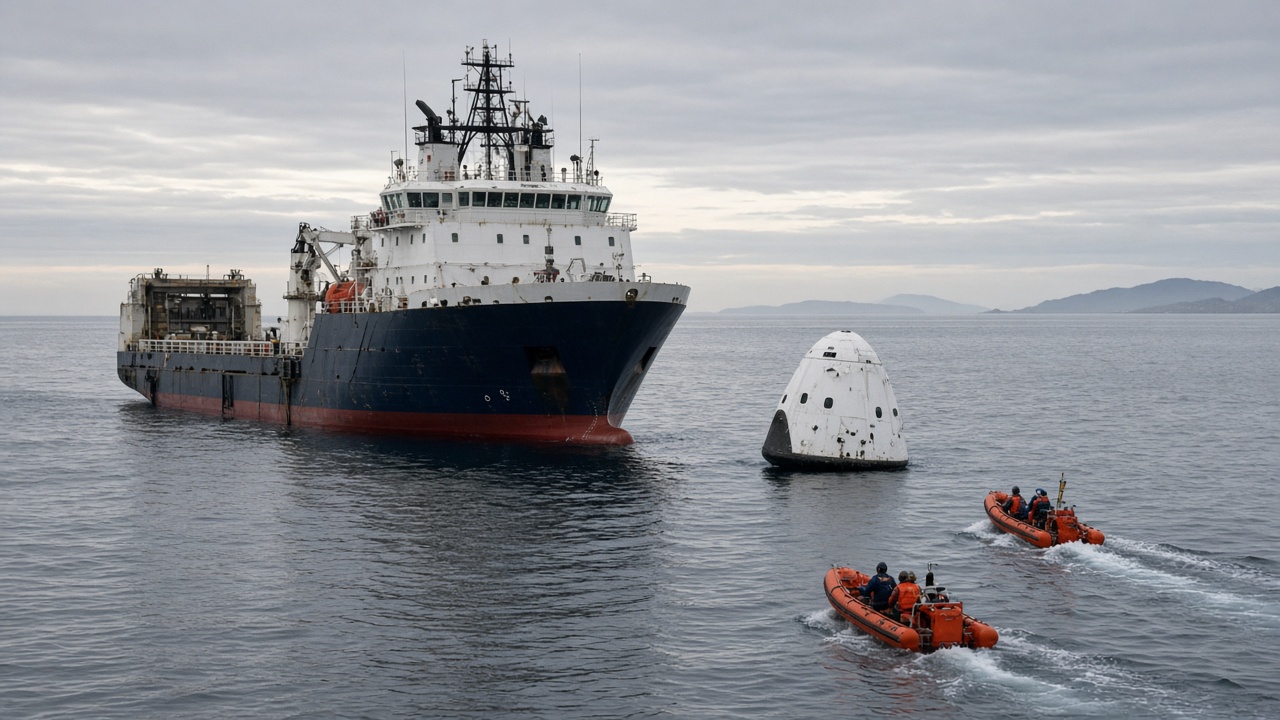
NASA astronaut Jessica Meir and three crewmates rode a SpaceX Dragon capsule into the Pacific Ocean off the Los Angeles coast on Thursday morning, closing a 237-day stay aboard the International Space Station and lifting Meir into NASA’s top ten for total time in space.
The Crew-12 spacecraft, named Freedom, touched down at 8:34 a.m. Pacific time, NASA said. Recovery teams aboard SpaceX vessels secured the capsule and helped Meir, pilot Jack Hathaway, European Space Agency astronaut Sophie Adenot and Roscosmos cosmonaut Andrey Fedyaev exit after medical checks on deck.
What the numbers show
Meir has now logged about 440 days across two long-duration flights, NASA said in its splashdown blog, placing her among the agency’s most experienced fliers still on active duty. Hathaway and Adenot completed their first spaceflights on Crew-12; Fedyaev was on his second.
The crew undocked from the station on Wednesday and spent roughly 27 hours in transit, shedding orbital speed through a guided re-entry that NASA and ESA both described in standard postflight terms: drogue chutes, then four main parachutes, then a gentle water landing tracked by fast boats.
Science and spacewalks
During the mission, which began with a February launch from Florida, the four conducted dozens of experiments NASA listed in its release, including work on stem cells, crystal growth and bone loss in microgravity. The crew also completed four spacewalks, extending station maintenance and upgrade tasks that station managers had queued before their departure.
Adenot’s return marked the end of ESA’s epsilon mission branding for her first flight. ESA posted splashdown imagery showing recovery crews opening Dragon’s side hatch and assisting each flier in turn, with Adenot smiling as she left the spacecraft third in the exit order.
What happens next
NASA said the crew would fly to shore by helicopter, then board a NASA aircraft to Ellington Field near Johnson Space Center in Houston for debriefs and rehabilitation. A broader science briefing for the mission is scheduled for Oct. 15 in Houston, the agency’s news release said.
Station staffing continues with successors already aboard or en route under NASA’s commercial crew rotation with SpaceX. For Meir, the immediate work is physiological recovery and data handover from experiments that will keep producing results on the ground for months.
Thursday’s splashdown was the 20th crewed orbital flight SpaceX has flown for NASA under the commercial crew program, according to NPR’s account of the return, which described re-entry heating near 3,500 degrees Fahrenheit before parachutes slowed the capsule to about 16 mph at impact.