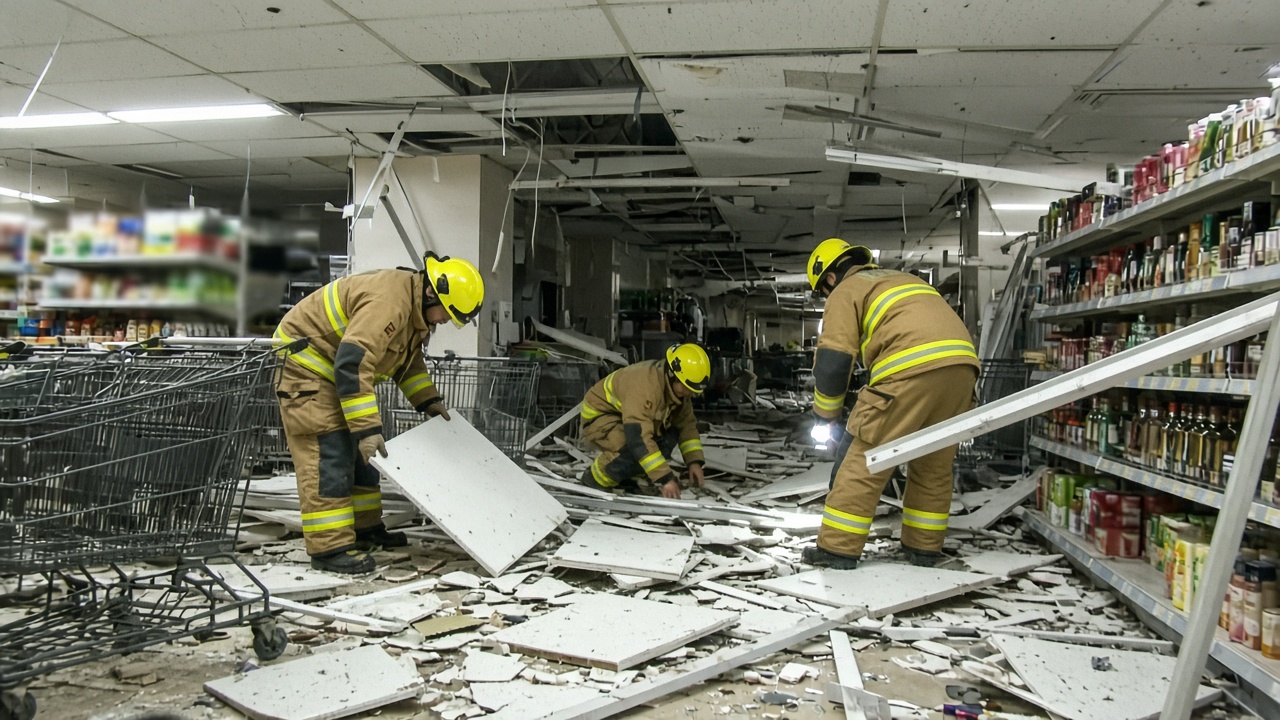
Sections of a plaster ceiling collapsed onto shoppers at a grocery store in Daegu’s Buk-gu district on Saturday morning, injuring 38 people and forcing 66 others to evacuate a four-story building that houses retail space on its upper floors. South Korea’s fire service said the failure struck around 10:16 a.m. local time and that emergency crews did not believe anyone remained trapped beneath the debris.
What responders saw
The Daegu Fire Department said the collapse occurred on the second floor of the market, showering aisles with ceiling panels and dust. Nine people were taken to hospitals for treatment; the rest were assessed at the scene. Fire official Yoon Jong-mi told reporters that while the injury count could rise as more visitors come forward, responders on site considered it highly unlikely that anyone had suffered serious or life-threatening harm.
Photographs distributed by Yonhap showed rescue workers in helmets picking through fallen panels and shelving. The building’s lower levels were cleared methodically while engineers began inspecting whether hanging utilities or water damage had weakened the ceiling structure. Authorities had not announced a definitive cause by midday.
Presidential office steps in
President Lee Jae Myung received a briefing from acting National Police Agency Commissioner General Kim Jong-cheol and directed agencies to prioritize rescue and aftercare, according to senior presidential spokesperson Kang Yu-jung. The instruction mirrors how the Blue House has handled recent industrial accidents: rapid public messaging even when casualties appear limited, to head off criticism that the government was slow to mobilize inspectors.
Local police said they would work with the Ministry of Employment and Labor to determine whether the store operator had skipped required safety inspections or overloaded ceiling fixtures with signage and lighting. Labor ministry teams typically seize maintenance logs and contractor records after structural failures in commercial properties.
Retail safety context
Daegu, Korea’s fourth-largest city, has a dense network of mid-rise neighborhood marts that often occupy mixed-use blocks with housing or offices above street-level parking. Ceiling collapses are rare nationally but not unknown; investigators usually focus on moisture intrusion, corroded anchors or unauthorized remodels that add weight without engineering review.
Consumer groups urged the store chain, which authorities did not immediately name in English-language briefings, to close sister locations only if inspections reveal similar ceiling designs. For now, fire officials kept a cordon around the damaged floor while shoppers were diverted to nearby outlets.
What happens next
City officials said they would publish an initial structural assessment within 48 hours and require the landlord to submit reinforcement plans before reopening the second floor. Victims seeking compensation will likely route claims through the operator’s liability insurance, though labor investigators can impose fines if they document neglected maintenance.
For Buk-gu residents, the scene was a jarring start to a holiday weekend: sirens along Palgong-ro, parents collecting children who had been shopping, and a reminder that even routine grocery runs depend on building codes being enforced between tenant turnovers.