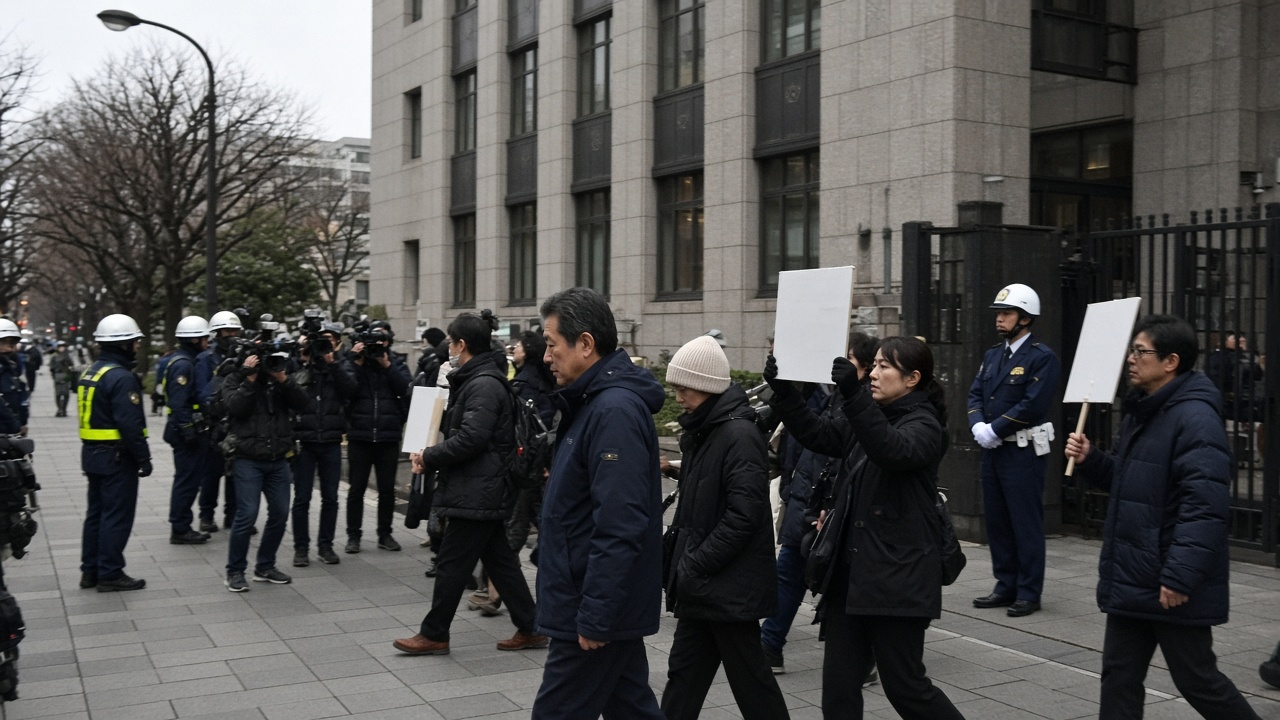
Dozens of protesters rallied in Tokyo on Friday after Okinawa’s prefectural assembly passed a resolution calling for changes to the Japan-U.S. Status of Forces Agreement, the latest escalation in a case that has shaken the island where most American troops in Japan are stationed.
The assembly vote came days after Lance Cpl. Devin Jacob Ballard, 20, a U.S. Marine, was accused of robbing and killing Anna Yagi, 39, at a hotel in Naha. Ballard has denied the allegations, according to reports from Okinawa. Prime Minister Sanae Takaichi has condemned the killing as heinous and Tokyo summoned U.S. diplomats to protest.
What Okinawa’s resolution demands
Al Jazeera reported that the prefectural assembly adopted the measure Friday, asking that SOFA be adapted so the U.S. military is pressed harder to prevent crimes by service members. The resolution and an accompanying statement are to be sent to the U.S. embassy and to the Japanese government.
Okinawa hosts the bulk of the roughly 54,000 U.S. military personnel in Japan. Rapes, assaults, drink-driving incidents and other offenses involving Americans have triggered periodic protests for decades; the assembly passed a similar resolution in 2024 after a series of sexual assault cases drew renewed anger.
U.S. military response
The III Marine Expeditionary Force paused operational activity for 48 hours from Wednesday and imposed a 30-day curfew from midnight to 5 a.m. starting Friday, measures Okinawa officials had demanded while the criminal case proceeds. The Japan Times and other outlets reported parallel demonstrations in Okinawa itself, not only in Tokyo.
Diet and diplomatic track
For national politicians, the resolution does not by itself change SOFA, which is negotiated between governments. But it gives opposition lawmakers in Tokyo fresh ammunition before budget and base-realignment debates, and it raises the visibility of crimes that prefectural leaders say fall disproportionately on Okinawan residents.
Foreign Ministry officials have reiterated that Japan relies on the alliance for deterrence while insisting that U.S. commanders enforce discipline. With curfews and operational pauses now public, the question is whether Washington offers additional concessions—such as tighter liberty rules or faster cooperation with Japanese investigators—before anger spreads beyond Okinawa’s assembly chamber.
Friday’s Tokyo march, though modest in size, signaled that mainland activists are aligning with Okinawa’s institutional protest. Police monitored the gathering; no major clashes were reported in early accounts. The criminal case against Ballard, meanwhile, will move through Japanese courts under procedures SOFA defines for suspects in U.S. custody.