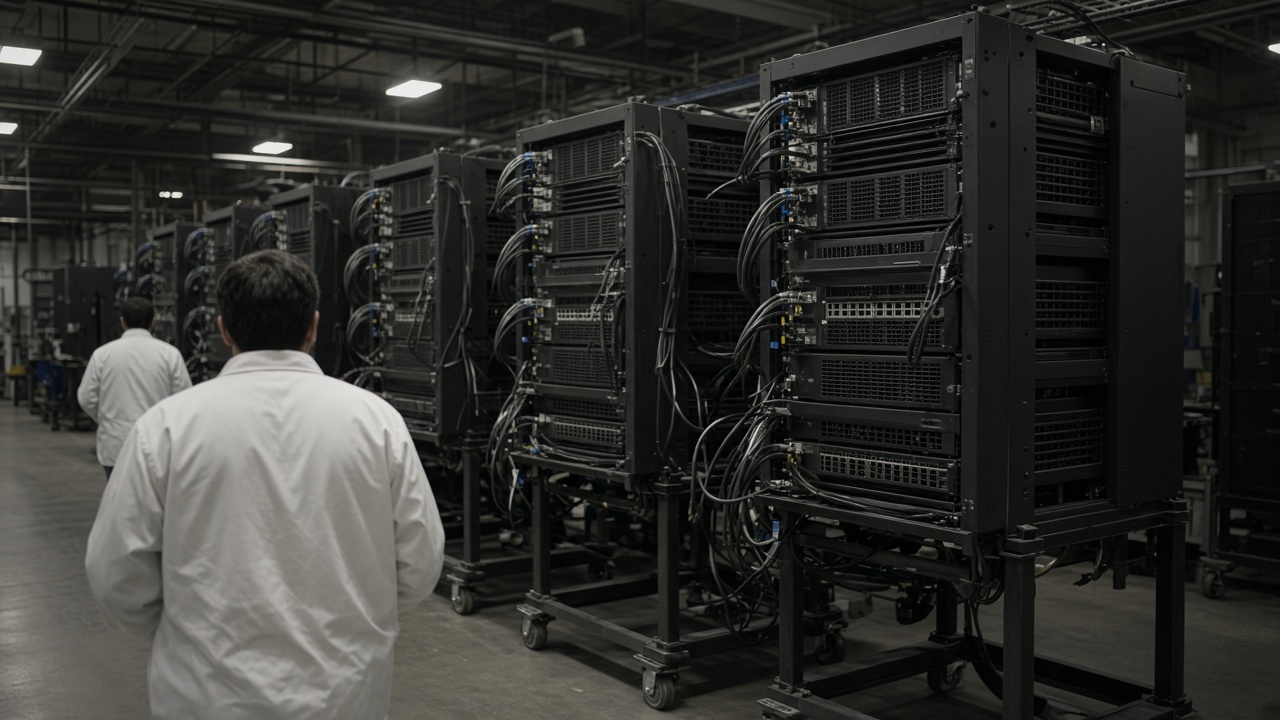
Taiwanese AI server integrators notified hyperscale clients this weekend that December rack deliveries would stretch one to three weeks as chip-on-wafer-on-substrate packaging lines remained fully allocated, extending a bottleneck that predates President Lai’s compute ambitions but now sits at the center of them.
Executives at two integrators who ship GPU-heavy cabinets from Taoyuan and New Taipei said CoWoS capacity at Taiwan Semiconductor Manufacturing Co. and select OSAT partners is booked through the first quarter of 2027 for the largest accelerators. Smaller customers feel the squeeze first: their orders queue behind mega-cloud batches tied to long-term supply agreements.
From wafer allocation to rack integration
Integrators do not merely screw rails into chassis. They validate liquid cooling loops, BMC firmware, and NIC firmware before racks leave the dock. When CoWoS deliveries slip, entire integration bays idle—even if standard motherboards are ready. One operations chief said three integration lines would run partial loads next month unless TSMC pulls forward a tranche of advanced packages.
NVIDIA chief executive Jensen Huang’s recent remarks that AI compute demand remains strong gave sales teams cover to push clients toward earlier 2027 slots. Some buyers accepted partial shipments: CPU management nodes now, GPU sleds later.
Power and site readiness abroad
Domestic integrators also cited overseas data-center readiness, not just silicon. Several Middle East and Southeast Asia builds lack finalized substations, so containers sit in Taiwanese warehouses accruing storage fees. That paradox—fully booked factories and delayed overseas energization—shows up in working-capital lines on integrator balance sheets.
Policy versus physics
Lai’s pledge to elevate Taiwan into the top tier of compute markets assumes racks ship on time. Without additional packaging fabs or disciplined customer forecasting, policy speeches risk outrunning physical output. For the AI desk, the actionable read is lead-time inflation: plan December clusters as January arrivals, and treat CoWoS slot letters as binding as fab wafer starts.
Channel inventory signals
Distributors tracking GPU board shipments said channel inventory in Taoyuan warehouses ticked up one week in September when a U.S. hyperscaler delayed a Middle East energization date. Integrators stressed that the bump is temporary: backlog letters from TSMC still show no open CoWoS slots for H-class accelerators before late December. Retail investors should treat integrator margin guidance as more sensitive to packaging slips than to Double Ten rhetoric.
Analysts and officials cautioned that holiday-thinned staffing can delay public updates until the regular workweek resumes, so readers should watch for revised figures when ministries publish Monday bulletins.