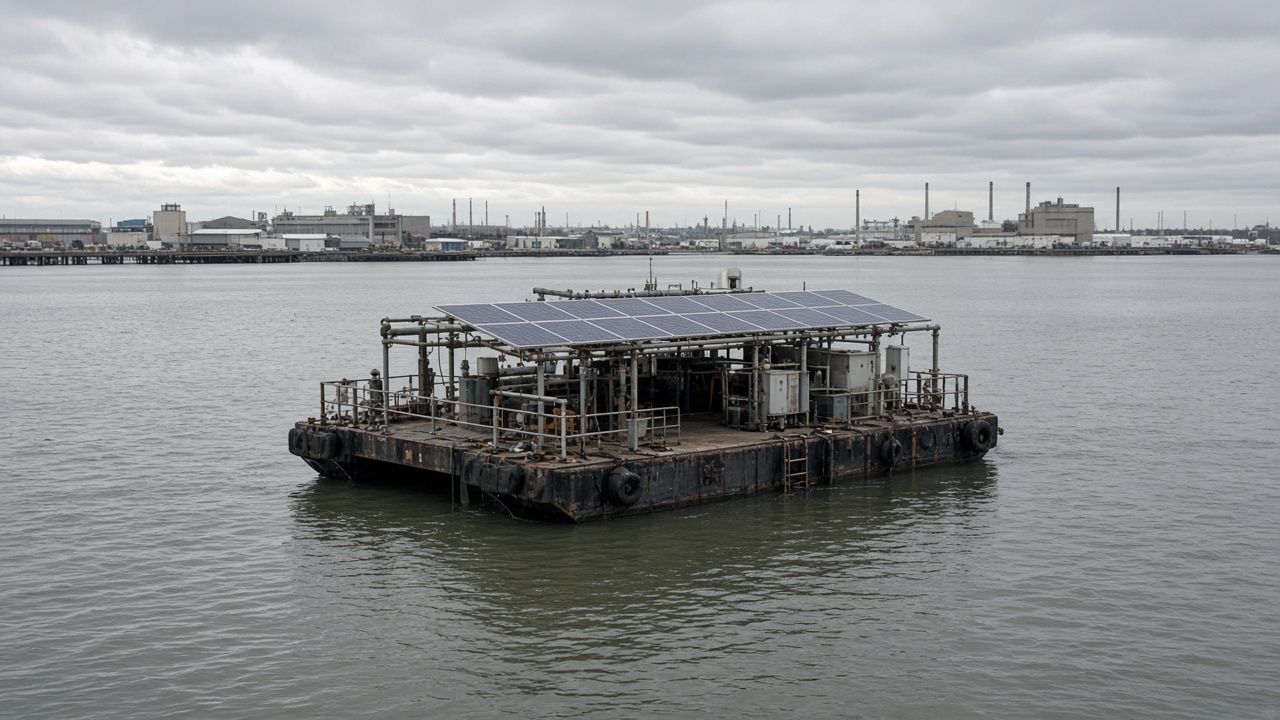
Researchers at IIT Madras said their seawater electrolysis pilot moored in the Ennore estuary achieved 78 percent faradaic efficiency over a seventy-two-hour continuous run, a record for the site’s brackish conditions. The figure measures how much of the applied current actually splits water into hydrogen and oxygen rather than corroding electrodes or producing chlorine gas as a side reaction.
Why Ennore’s water is the stress test
Most green-hydrogen demos use purified freshwater; Ennore mixes sewage outfalls, port dredging, and Bay of Bengal salinity. The team’s nickel-iron oxide anode and sulfide-tolerant membrane were designed to survive chloride attack that destroys lab-grade cells within hours. Mooring the rig on a barge let engineers swap stacks without hauling equipment through Chennai’s congested port roads.
Faradaic efficiency climbed from 71 percent in August after they tuned pulse-width modulation on the power supply, reducing parasitic reactions when biofilms coated the cathode. Graduate students on night shift scraped biofouling every six hours during the record run—an operational detail venture capital slides often omit when they promise “ocean hydrogen.”
Energy balance still tight
The pilot drew 420 kilowatts from a mix of rooftop solar on the quay and grid power when clouds rolled in. Levelized hydrogen cost remains far above industrial grey hydrogen from steam methane reforming. The Ministry of New and Renewable Energy funded the demo under a small-scale saline electrolysis track, not a commercial offtake contract. DST officials said the goal is materials data, not a plant announcement.
Environmental monitoring
Fisher cooperatives downstream asked for dissolved oxygen readings after early trials showed brief pH dips near the outflow. The team now bubbles product hydrogen through a scrubber before venting and publishes weekly water samples to the Tamil Nadu pollution control board portal. Critics want an independent audit; IIT Madras invited the National Institute of Ocean Technology to co-instrument the next run in November.
What comes next
If November’s run holds above 75 percent for seven days, researchers will ship electrode stacks to Kandla for a higher-salinity test. Commercial partners are not signed; Oil and Natural Gas Corporation observers attended Saturday’s briefing but did not commit capex. For now the win is proof that seawater electrolysis can survive real Indian estuaries—not that pump prices will drop next quarter.
Workforce and skills
The project employs fourteen technicians from nearby fishing villages after safety training on high-voltage barges. IIT Madras said it will open a short course on marine electrolysis maintenance for polytechnic graduates if the Kandla deployment proceeds, part of a broader push to keep green-hydrogen jobs local rather than imported.